Thank you for visiting SNEWPapers!
Sign up free
The Arkansas Advocate
Little Rock, Pulaski County, Arkansas
What is this article about?
Reports from September 1830 detail the Belgian Revolution: intense fighting in Brussels where inhabitants repelled Dutch troops led by Prince Frederick, driving them out after days of combat; victory at Louvain; uprisings in Bruges, Ostend, and other towns; formation of Provisional Government; significant casualties and property damage.
Merged-components note: Continuation of the same foreign news article on the Belgian revolution across pages 1 and 2, with sequential reading order.
Clippings
1 of 2
OCR Quality
Full Text
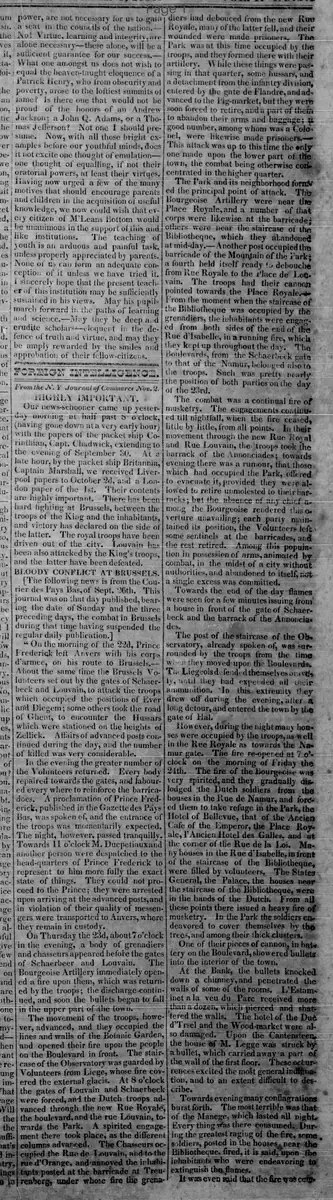
From the N. Y. Journal of Commerce Nov. 2.
HIGHLY IMPORTANT.
Our news-schooner came up yesterday morning at half past 8 o'clock, (having gone down at a very early hour) with the papers of the packet ship Corinthian, Capt. Chadwick, extending to the evening of September 30. At a late hour, by the packet ship Britannia, Captain Marshall, we received Liverpool papers to October 2d. and a London paper of the 1st. Their contents are highly important. There has been hard fighting at Brussels, between the troops of the King and the inhabitants, and victory has declared on the side of the latter. 'The royal troops have been driven out of the city. Louvain has been also attacked by the King's troops, and the latter have been defeated.
BLOODY CONFLICT AT BRUSSELS.
[The following news is from the Courier des Pays Bas, of Sept. 26th. This journal was on that day published, bearing the date of Sunday and the three preceding days, the combat in Brussels during that time having suspended the regular daily publication.]
'On the morning of the 22d, Prince Frederick left Anvers with his corps d'armee, on his route to Brussels.-- About the same time the Brussels Volunteers set out by the gates of Schaerbeck and Louvain, to attack the troops which occupied the positions of Ever and Diegem; some others took the road of Ghent, to encounter the Hussars which were stationed on the heights of Zellick. Affairs of advanced posts continued during the day, and the number of killed was very considerable.
In the evening the greater number of the Volunteers returned. Every body repaired towards the gates, and laboured every where to reinforce the barricades. A proclamation of Prince Frederick, published in the Gazette des Pays Bas, was spoken of, and the entrance of the troops was momentarily expected. The night, however, passed tranquilly.
Towards II o'clock M. Ducpetiaux and another person were despatched to the head-quarters of Prince Frederick to represent to him more fully the exact state of things. They could not proceed to the Prince; they were arrested upon arriving at the advanced posts, and in violation of their quality of messengers were transported to Anvers, where they remain in custody.
On Thursday the 23d, about 7 o'clock in the evening, a body of grenadiers and chasseurs appeared before the gates of Schaerbeer and Louvain. The Bourgeoise Artillery immediately opened a fire upon them, which was returned by the troops; the discharge continued, and soon the bullets began to fall in the upper part of the town.
The movement of the troops, however, advanced, and they occupied the lines and walls of the Botanic Garden, and opened their fire upon the people on the Boulevard in front. The staircase of the Observatory was guarded by Volunteers from Liege, whose fire covered the external glacis. At 8 o'clock the gates of Louvain and Schaerbeck were forced, and the Dutch troops advanced through the new Rue Royale, the boulevard, and the rue Louvain, towards the Park. A spirited engagement there took place, as the different columns advanced. The Chasseurs occupied the Rue de Louvain, and to the rue d'Orange, and annoyed the inhabitants posted at the barricade at Treurenberg, under whose fire the grenadiers had debouched from the new Rue Royale, many of the latter fell, and their wounded were made prisoners. The Park was at this time occupied by the troops, and they formed there with their artillery. While these things were passing in that quarter, some hussars, and a detachment from the infantry division entered by the gate de Flandre, and advanced to the Pig-market, but they were soon forced to retire, and a part of them to abandon their arms and baggage; good number, among whom was a colonel, were likewise made prisoners.-
This attack was up to this time the only one made upon the lower part of the town, the combat being otherwise concentrated in the higher quarter.
The Park and its neighborhood formed the principal point of attack. The Bourgeoise Artillery were near the Place Rovale, and a number of that corps were likewise at the barricaded others were near the staircase of the Bibliotheque, which they abandoned at mid-day.--Another post occupied the barricade of the Mountain of the Park: a fourth held itself ready to debouch from Rue Royale to the Place de Louvain. The troops had their cannon pointed towards the Place Rovale..
From the moment when the staircase of the Bibliotheque was occupied by the grenadiers, the inhabitants were engaged from both sides of the end of the Rue d'Isabelle, in a running fire, which they kept up throughout the day. The Boulevards, from the Schaerbeck gate to that of the Namur, belonged also to the troops. Such was pretty nearly the position of both parties on the day of the 23rd.
The combat was a continual fire of musketry. The engagements continued till nightfall, when the fire ceased little by little, from all points. In their movement through the new Rue Royal and Rue Louvain, the troops took the barrack of the Annonciades; towards evening there was a rumour, that those which had occupied the Park, offered to evacuate it, provided they were allowed to retire unmolested to their barracks: but the absence of any chief among the Bourgeoise rendered this overture unavailing; each party maintained its position, the Volunteers left some sentinels at the barricades, and the rest retired. Among this population in possession of arms, animated by combat, in the midst of a city without authorities, and abandoned to itself, not a single excess was committed.
Towards the end of the day flames were seen for a few minutes issuing from a house in front of the gate of Schaerbeck and the barrack of the Annonciades. The post of the staircase of the Observatory, already spoken of, was surrounded by the troops from the time when they moved upon the Boulevards. The Liegeois defended themselves bravely, until they had expended all their ammunition. In this extremity they drew off during the evening, after a long detour, and entered the town by the gate of Hal.
However, during the night many houses were occupied by the troops, as well in the Rue Royale as towards the Namur gate. The fire re-opened at 7 o'clock on the morning of Friday the 24th. The fire of the Bourgeoise was very spirited and they gradually dislodged the Dutch soldiers from the houses in the Rue de Namur, and forced them to take refuge in the Park, the Hotel of Bellevue, that of the Ancien Cafe of the Emperor, the Place Royale, l'Ancien Hotel des Calles, and at the corner of the Rue de la Loi. Many houses in the Rue d'Isabelle in front of the staircase of the Bibliotheque, were filled by volunteers. The States General, the Palace, the houses near the staircase of the Bibliotheque, were in the hands of the Dutch. -From all these points there issued a heavy fire of musketry. In the Park the soldiers endeavored to cover themselves by the trees, and among their thick clusters. One of their pieces of cannon, in battery on the Boulevard, showered bullets into the interior of the town.
At the Bank, the bullets knocked down a chimney, and penetrated the walls of some of the rooms. L'Estiminet ala vue du Parc received more than a dozen, which pierced and shattered the walls. The hotel of the Due d'Ursel and the Wood-market were also damaged. Upon the Cantensteen, the house of M. Legge was struck by a bullet, which carried away a part of the wall of the first floor. These occurrences excited the most general indignation, and to an extent difficult to describe.
Towards evening many conflagration burst forth. The most terrible was that of the Manege, which lasted all night. Every thing was there consumed. During the greatest raging of the fire, some soldiers, posted in the houses near the Bibliotheque, fired, it is said upon the inhabitants who were endeavoring to extinguish the flames.
It was even said that the fire was caused by shells, as on the previous evening the fire ceased, and the night was tranquil. On Saturday the 25th. the combat began anew about 7 o'clock in the morning. To the taking of the Park all efforts were then directed. The volunteers made repeated attacks, and entered many parts of it. As well from the side of the mountain of the Park. as from that of the Place Royale, the Brabant flag was borne along the middle of the Park; but it appeared that the confusion with which these different attacks were made, did not for the moment permit of their being followed up with advantage. The Volunteers were several times obliged to evacuate the Park, and it is even said that by a fatal mistake two troops of citizens fired upon each other. However the Dutch troops enclosed in the Park were dreadfully fatigued, and they lay down in their positions for rest. Such was the exact state of things yesterday evening; nothing has this day changed it; the troops remained always in the Park, and at this moment the fire of the Tirailleurs continues.
A superior officer was taken prisoner on Friday morning. Another was subsequently taken: they were both sent to the Artillery barracks, from thence to L'Amigo.
Hospitals have been established in the chapels of the Madeleine and St. Anne, and in many other public and private houses. Everywhere the brave inhabitants are receiving and succouring the wounded. Reinforcements have arrived from all the neighboring towns, and they combat with great ardour, and at once, notwithstanding the fatigue of their previous marches.
By an order of General Vanthier; the soldiers employed in the citadel of Tournay, received double rations, as in a campaign. On the morning of the 21st, the cannoniers, instead of continuing their works on the bastions, have abandoned their tools and departed.
"A NEW VICTORY."
Louvain, Sept. 24.
Despatch to M. Baron Vanderlinden D'Hoogvorst, Commander-in-chief of the Bourgeoise Guard of Brussels.
"At 7 o'clock yesterday morning the Dutch attacked Louvain from the side of the gate of Malines, and discharged several shells, when we advanced to repulse them. At 10 o'clock we received the news that a part of the Dutch army of Tongres had set out for Louvain in great force, and with many cannons; about 11 o'clock the troops were in fact, already before our town, upon which they began an immediate attack by a discharge of cannon and volleys of musketry. We sustained this attack, and our brave inhabitants made a sortie which was attended with complete success; for at 2 o'clock retreat and confusion were in the Dutch army, which was furiously assailed by our brave patriots, and driven to Tirlemont where their route became a race owing to the valiant resistance of the people of that town, who would not permit them to retire through it. We have many prisoners, and our loss is trifling."
"Signed by the Commander-in-Chief of the citizens of Louvain.
"J. NELIS."
By other accounts we learn from Paris, by our letters of Tuesday evening, that on the 27th the Belgians had attacked and succeeded in driving the Dutch troops from the Park in Brussels and the neighborhood, and that the town was free. A letter from Brussels of the 27th says, that the troops of Prince Frederick have been beaten on all sides, and that the Belgian inhabitants are everywhere arming against the Dutch.- The fortress of Mons is in the power of the Belgian inhabitants, who have attacked Ath, and, assisted by the inhabitants of that place, have made themselves masters of the garrison, who had laid down their arms. The same success has just taken place at Tournay.
Paris, Tuesday, half-past 4 P. M.- A large caravan, filled inside and out with Belgians, to the number of about 50 persons, is now passing the post office, on their road to Brussels. They are singing the Marseillaise Hymn: not only the people in the street, but the grenadiers of the National Guard on duty at the post office, are clapping their hands and cheering them as they pass.
A private letter received at Ghent, Sept. 26. 11 o'clock at night, states that Gen. Collerdijk, on his march to Brussels, had taken possession of Louvain. As every other statement communicated in connexion with this, is known to be false, we hope this may prove to be so likewise.
From the Courier des Pays Bas.
BRUSSELS, Sept. 27.
Our readers are informed that till further notice the Provisional Government will communicate its official news through the medium of the Courier des Pays Bas.
Victory! The herds of brigands who, under the name of soldiers, had penetrated into our walls, have been forced to abandon them this night. The desperate engagement yesterday proved to them that it was impossible for them to enter Brussels in spite of its inhabitants.
Our artillery, the command of which has been since Friday confided to an experienced superior officer, yesterday made a great slaughter of our barbarous enemies. The commander had found a favorable position from which he directed his artillery to the lower grounds of the Park, where the Dutch had taken refuge.
Our sharp shooters, more eager and more numerous than the day before, seconded the artillery with the greatest success. The firing had never been more brisk than between 11 and 3 o'clock in the afternoon. It was impossible for an army even twice as numerous as that which we combatted to resist such attacks.
The firing continued till 6 o'clock as on the preceding days, but gradually abated about 3 o'clock. The soldiers fled successively from the only houses which they occupied towards the States-General, and took refuge in the lower grounds of the Park, near the Palaces of the King and Prince. A great number of them were killed during the retreat. Our citizens waited for them as they came out of the houses, and fired on them with muskets as they passed.
At six o'clock, the fire had caught the houses in the vicinity of the Palace. At the beginning of the night this fire (of which we shall give some particulars below) illuminated the whole place before the Park. The Volunteers of Charleroi, Gosselies, and other towns, who were soon joined by several Bruxellois, stationed themselves near the Hotel de Belle Vue, and thence fired upon the soldiers, who still escaped from the Palaces. At length, about four o'clock in the morning, all the Dutch who had escaped the carnage of the day effected their complete retreat from our walls.
An immense crowd proceeded at day break to the places abandoned by these cowardly incendiaries. These places presented only a vast scene of desolation and carnage. The alleys of the Park are dyed with blood, and several corpses horribly mutilated and stripped, having been forgotten by the enemy and lie at the foot of the passages hardly covered with a few branches of trees; fragments of iron railing, and of statues destroyed by the grape-shot, lie on all the roads. The carcases of six artillery horses have been placed by the enemy as a redoubt at the Park gate, opposite the stair-case of the library. The wing of the palace usually occupied by Prince Frederick, the Hotel de Belle Vue, the Coffeehouse de l'Amitie, are pierced every where with musket and cannon balls; the same is the case with all the houses of the Montagne du Parc, and a great part of those in the Rue Royale.
The people, and a great number of volunteers in arms, this morning, at seven o'clock, were in all the avenues of the Park and the adjacent street; and soldiers, either deserters or prisoners, are now in great numbers in every quarter.
M. de Hoogvorst, who was going to the palace, having appeared among the crowd, was received with huzzas and cries of Liberty forever! It is impossible to describe the intoxication of joy of all the population, at length delivered from their barbarous invaders. The Palaces, on which the standard of Brabant is hoisted, are guarded by posts of volunteers well armed; the Commandant Don Juan d'Aulnis, removed his head quarters thither this morning. We are informed that measures are taken vigorously to pursue the enemy, who have already withdrawn to the distance of more than two leagues from the city.–– Two notices were posted up yesterday; one announcing that to prevent the dangers which might arise from the fall of a shell into the gas works, the gas will be drawn off. The citizens are requested to place lights in their windows, to prevent the city from being involved in darkness.
(This request was complied with, and the city well lighted by the citizens.)
The other notice was to the effect. that in the present critical state of affairs, the Provisional Government was constituted as follows:––Baron Vanderlinden d'Hoogvorst; Chevalier Rogier, Advocate in the Tribunal of Liege; Count, Felix de Merode; Gendebien Advocate in the Tribunal of Brussels; Etuvain de Weyer, ditto; Jolly, late Officer of Engineers; Joseph Vanderlinden, Treasurer; J. Nicolay, Advocate, and F. de Coppin Secretaries. All these gentlemen accepted their functions.
The following has been published this morning:
"Head Quarters, Sept. 27.
Half-past 5. A. M.
"To the Members of the Provisional Government.
"Gentlemen––The enemy, whose deplorable state of demoralization was doubtless completed by the warm action yesterday, has felt a longer resistance to be impossible, and has just abandoned our walls. The heroic Brussels is free!––The park and all the gates are occupied by our brave men. Major Palmaert, my first aid-de-camp, is appointed Governor of the Palaces.
"The remarkable facts that have signalized this day are so numerous, and my occupations so many, that it is not possible for me to give you all the necessary details of this glorious event. As soon as I have leisure, one of my first cares, as my dearest duties, will be to acquaint you with the services rendered by so many generous citizens, many of whom have purchased our memorable victory with their blood. One of the losses which I most regret is, that of my aid-de-camp, Baron Fellner, who fell yesterday while leading one of our detachments hand to the attack of La Madeleine, a position so dangerous and so long disputed.
To-morrow there will be a general review of our actual force.
"The Commander-in-Chief.
JUAN VAN HALEN"
Victory must not hinder us from taking measures for our security. New barricades are raising in the New Royale, where three pieces of cannon are to be planted. However, when the men of the north go and relate in their marches how the Belgians have relieved them, we may believe that those heroes will lose a little of their warlike ardour, and that they will not again venture to appear before us. We were mistaken when we announced yesterday that the Palace of the States-General was burnt: it was the adjoining houses that were burnt. The fire caused by a bomb, in the house of Counselor Greindl, was immediately extinguished. The wretches who have left our city during the night, shot before their departure, all the foreigners whom they had taken prisoners during the six days of the combat which has just ended. Several Frenchmen fell victims to their rage.
An army of Tartars would not have behaved with more cruelty and brutality than the Dutch soldiers. To fire and pillage they have added rape and assassination. Many houses in the Rue Vesdre and the adjacent streets, are mentioned as the scenes of such excesses. Numerous detachments of prisoners and deserters increase from all quarters: they wear at their button holes the tri-colored ribband of Brabant, and cries of "Liberty forever!" raised as they pass, are repeated by them with enthusiasm.
This morning, at eight o'clock, the people went to the house of Mr. Fred. Meeus. In a moment the whole house was pillaged; the furniture thrown into the street and burnt. The house was then set on fire, and is now burning with great fury. We hope it will not reach the adjoining houses. This act of popular vengeance is ascribed to various motives. We do not know what to think of it.
From Le Belge, Sept. 28.
BRUSSELS, Sept. 28.––Among the persons who have fallen victims to the fury of the Dutch soldiers, we may mention Lord Blantyre, who was killed in his hotel in the Rue Royale. It was on the 24th when the citizens made themselves masters of the hotel, that he met his death. We are assured that Lord Blantyre was a General Officer in the English service. His family, consisting of ten children, found means to escape. It is positively affirmed that the Dutch troops were guilty of the most brutal excesses in an English Boarding-school in this city, where there are many young persons of the first English families.–– Energetic complaints have been sent to London upon this fact, as well as of the horrors committed by these Vandals in the hotel of the British Ambassador.
Several subaltern officers of the garrison of Tournay have arrived here.–– They have been immediately incorporated in a free corps.
M. de Potter arrived yesterday at five o'clock by the gate of Anderlecht, in a post chaise, accompanied by two other persons, one of whom bore the tri-colored flag; the people immediately took off the horses and drew him in triumph to the grand square, where the corps de garde presented arms. On arriving at the Town Hall, he appeared at the balcony with some of the members of the Provisional Government, and addressed the people, declared his intention to act with his whole soul to conquer and secure our liberty. The popularity which he has so nobly and justly acquired, gives us the assurance that his presence will complete our victory.
The ladies of Ninove have just sent to our hospitals two bales of lint, and some more will come in the course of the day. All the mills at Ninove are grinding corn, which will be immediately sent gratuitously to Brussels.
Several free companies are in pursuit of the flying enemy, and leave them no rest. A person who has arrived to-day, in Termonde, assures us, that he was informed that the troops there had unanimously refused to march against Brussels.
From the London Courier.
Rising at Bruges––Reported retirement of the troops from Brussels––Death of Lord Blantyre––Tumultuous proceedings at Ostend, with loss of Lives, &c.
We have just received very important letters from Bruges, Ostend, and Antwerp. The following summary of their contents will be read with great interest, particularly as our readers may rely upon their authenticity; and, however painful they may be, they will be found less alarming than the rumors which are in circulation. On Sunday, in consequence of the proceedings at Brussels, the populace of Bruges rose and hoisted the National colors. The Burghers, to prevent a conflict between the troops and the people, subsequently exerted themselves to maintain tranquillity, and on promising to preserve order, induced the Commandant to withdraw his troops, and to proceed with them to Ostend. The details of this affair are not, however, given. At Ostend, on Sunday evening, the populace assembled in considerable numbers on the Grande Place, and whilst one portion of them entered the church, and began to ring the bells to create alarm, another attempted to disarm the guard. The Commander of the soldiers, wishing to avoid effusion of blood, ordered his men to fire in the air, in the hope of dispersing the populace by that means––this however, failing in effect, the soldiers were then ordered to fire among the crowd. They did so, and four were killed and twelve or thirteen wounded. This shew of determination induced the populace to retire; and during the night no tumult of consequence took place. The military, however, remained under arms, and paraded the streets during the night. On the following day, the troops who had evacuated Bruges, arrived in Ostend, and the forces were then combined under the command of the General from Bruges, who immediately issued a proclamation, explanatory of the causes which had led to the firing of the troops on Sunday, and every thing became apparently tranquil, and continued so up to the departure of the steam packet yesterday: but the diligences were not suffered to enter Ostend.
From Antwerp our account is excessively brief. It merely states that the affairs of Brussels remained very bad and that between seven and eight hundred wounded had arrived there from Brussels.
What sub-type of article is it?
What keywords are associated?
What entities or persons were involved?
Where did it happen?
Foreign News Details
Primary Location
Brussels
Event Date
September 22 28, 1830
Key Persons
Outcome
dutch troops defeated and driven from brussels and louvain; many killed, wounded, and prisoners taken; belgian inhabitants victorious, provisional government formed; uprisings in bruges and ostend with casualties; significant property damage and fires.
Event Details
Belgian revolutionaries in Brussels fought Dutch royal troops from September 22-27, repelling attacks, capturing positions like the Park, and forcing retreat after heavy combat involving barricades, artillery, and volunteers from nearby towns. Similar victory at Louvain on September 24. Uprisings spread to Bruges, Ostend (with 4 killed, 12-13 wounded), Mons, Ath, Tournay; Provisional Government established in Brussels.