Thank you for visiting SNEWPapers!
Sign up free
Gazette Of The United States And Daily Evening Advertiser
Philadelphia, Philadelphia County, Pennsylvania
What is this article about?
Historical account tracing the 1793 yellow fever epidemic in Philadelphia to English settlers from Bulam, Africa, via the ship Hankey to Grenada and other West Indian islands, detailing spread, symptoms, and treatments.
Clipping
OCR Quality
Full Text
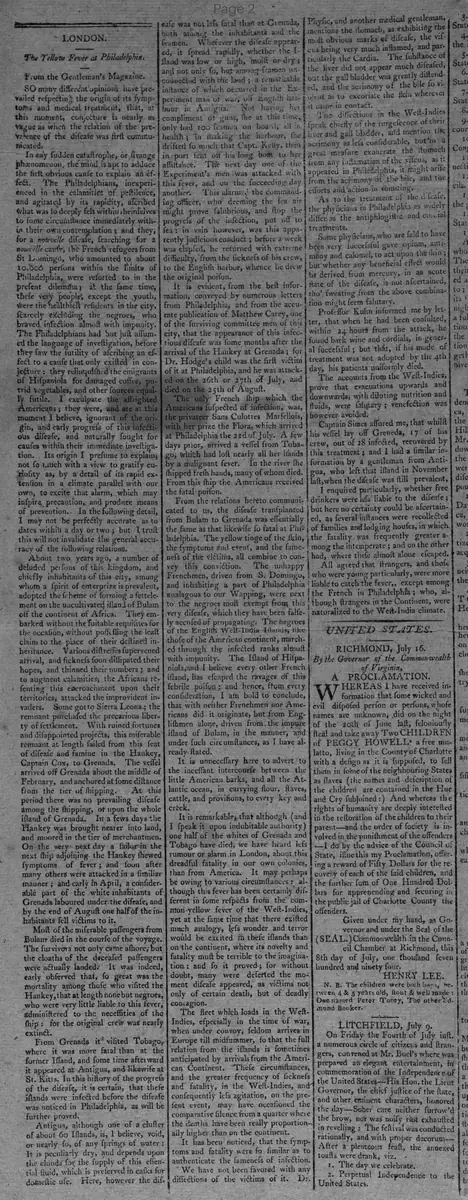
In any sudden catastrophe, or strange phenomenon, the mind is apt to adduce the first obvious cause to explain an effect. The Philadelphians, inexperienced in the calamities of pestilence, and agitated by its rapidity, ascribed what was so deeply felt within themselves to some circumstance immediately within their own contemplation; and they, for a novel disease, searching for a novel cause; the French refugees from St. Domingo, who amounted to about 2,000 persons within the limits of Philadelphia, were resorted to in the present dilemma; at the same time, these very people, except the youth, were the healthiest residents in the city, scarcely excluding the negroes, who braved infection almost with impunity.
The Philadelphians had but just assumed the language of investigation, before they saw the futility of ascribing an effect to a cause that only existed in conjecture: they relinquished the emigrants of Hispaniola for damaged coffee, putrid vegetables, and other sources equally futile. I excuse the affrighted Americans; they were, and are at this moment I believe, ignorant of the origin, and early progress of this infectious disease, and naturally sought for causes within their immediate investigation. Its origin I presume to explain not so much with a view to gratify curiosity, as, by a detail of its rapid extension in a climate parallel with our own, to excite that alarm, which may inspire precaution, and produce means of prevention. In the following detail, I may not be perfectly accurate as to dates within a day or two; but I trust this will not invalidate the general accuracy of the following relations.
About two years ago, a number of deluded persons of this kingdom, and chiefly inhabitants of this city, among whom a spirit of enterprize is prevalent, adopted the scheme of forming a settlement on the uncultivated island of Bulam off the continent of Africa. They embarked without the suitable requisites for the occasion, without possessing the least claim to the place of their destined inheritance. Various distresses supervened arrival, and sickness soon dissipated their hopes, and thinned their numbers; and to augment calamities, the Africans resenting this encroachment upon their territories, attacked the improvident invaders. Some got to Sierra Leona; the remnant purchased the precarious liberty of settlement. With ruined fortunes and disappointed projects, this miserable remnant at length sailed from this seat of disease and famine in the Hankey, Captain Cox, to Grenada. The vessel arrived off Grenada about the middle of February, and anchored at some distance from the tier of shipping. At this period there was no prevailing disease among the shipping, or upon the whole island of Grenada. In a few days the Hankey was brought nearer into land, and moored in the tier of merchantmen. On the very next day a sailor in the next ship adjoining the Hankey shewed symptoms of fever; and soon after many others were attacked in a similar manner; and early in April, a considerable part of the white inhabitants of Grenada laboured under the disease, and by the end of August one half of the inhabitants fell victims to it.
Most of the miserable passengers from Bulam died in the course of the voyage. The survivors not only came ashore, but the cloaths of the deceased passengers were actually landed. It was indeed, early observed that, so great was the mortality among those who visited the Hankey, that at length none but negroes, who were very little liable to this fever, administered to the necessities of the ship: for the original crew was nearly extinct.
From Grenada it visited Tobago, where it was more fatal than at the former island, and some time afterward it appeared at Antigua, and likewise at St. Kitts. In this history of the progress of the disease, it is certain, that these islands were infected before the disease was noticed in Philadelphia, as will be further proved.
Antigua, although one of a cluster of about 60 islands, is, I believe, void, or nearly so, of any springs of water: It is peculiarly dry, and depends upon the clouds for the supply of this essential fluid, which is preserved in casks for domestic use. Here, however the disease was not less fatal than at Grenada, both among the inhabitants and the seamen. Wherever the disease appeared, it spread rapidly, whether the island was low or high, moist or dry; and not only so, but among seamen unconnected with the land; a remarkable instance of which occurred in the Experiment man of war, off English harbour in Antigua. Not having her compliment of guns, she at this time, only had 100 seamen on board, all in health; in making the harbour, she drifted so much that Capt. Kelly, then in port sent off his long boat to her assistance. The next day one of the Experiment's men was attacked with this fever, and on the succeeding day another. This alarmed the commanding officer, who deeming the sea air might prove salubrious, and stop the progress of the infection, put to sea: in vain however, was this apparently judicious conduct; before a week was elapsed, he returned with extreme difficulty, from the sickness of his crew, to the English harbor, whence he drew the original poison.
It is evident, from the best information, conveyed by numerous letters from Philadelphia, and from the accurate publication of Matthew Carey, one of the surviving committee men of this city, that the appearance of this infectious disease was some months after the arrival of the Hankey at Grenada; for Dr. Hodge's child was the first victim of it at Philadelphia, and he was attacked on the 26th or 27th of July, and died on the 25th of August.
The only French ship which the Americans suspected of infection, was, the privateer Sans Culottes Marseillois, with her prize the Flora, which arrived at Philadelphia the 22d of July. A few days prior, arrived a vessel from Tobago; which had lost nearly all her hands by a malignant fever. In the river he shipped fresh hands, many of whom died. From this ship the Americans received the fatal poison.
From the relations hereto communicated to us, the disease transplanted from Bulam to Grenada was essentially the same as that likewise so fatal at Philadelphia. The yellow tinge of the skin, the symptoms and event, and the sameness of the victims, all combine to convey this conviction. The unhappy Frenchmen, driven from S. Domingo, and inhabiting a part of Philadelphia analogous to our Wapping, were next to the negroes most exempt from this very disease, which they have been falsely accused of propagating: The negroes of the English West-India Islands, like those of the American continent, marched through the infected ranks almost with impunity. The island of Hispaniola, and I believe every other French island, has escaped the ravages of this febrile poison: and hence; from every consideration, I am bold to conclude, that with neither Frenchmen nor Americans did it originate, but from Englishmen alone, driven from, the impure island of Bulam, in the manner, and under such circumstances, as I have already stated.
It is unnecessary here to advert to the incessant intercourse, between the little American barks, and all the Atlantic ocean, in carrying flour, staves, cattle, and provisions, to every key and creek.
It is remarkable that although (and I speak it upon indubitable authority) one half of the whites of Grenada and Tobago have died; we have heard less rumour or alarm in London, about this dreadful fatality in our own colonies, than from America. It may perhaps be owing to various circumstances; although this fever has been certainly different in some respects from, the common yellow fever of the West-Indies, yet at the same time that there existed much analogy, less wonder and terror would be excited in these islands than on the continent, where its novelty and fatality must be terrible to the imagination: and so it proved; for without doubt, many were deserted the moment disease appeared, as victims not only of certain death, but of deadly contagion.
The fleet which loads in the West Indies, especially in the time of war, when under convoy, seldom arrives in Europe till midsummer, so that the full relation from the islands is sometimes anticipated by arrivals from the American Continent. These circumstances, and the greater frequency of sickness and fatality, in the West-Indies, and consequently less agitation, on the present event, may have occasioned the comparative silence from a quarter where the deaths have been really proportionably higher than on the continent.
It has been noticed, that the symptoms and fatality were so similar as to authenticate the sameness of infection. We have not been favored with any directions of the victims of it. Dr. mentions the stomach, as exhibiting the most obvious marks of disease, the viscera being very much inflamed, and particularly the Cardia. The substance of the liver did not appear much diseased, but the gall bladder was greatly distended, and the acrimony of the bile so virulent as to excoriate the skin wherever it came in contact.
The dissections in the West-Indies speak chiefly of the turgescence of their liver and gall bladder, and mention the acrimony as less considerable, but in a great measure exonerate the stomach from any inflammation of the viscera, as it appeared in Philadelphia, it might arise from the acrimony of the bile, and the efforts and action in vomiting.
As to the treatment of the disease, the physicians in Philadelphia as widely differ as the antiphlogistic and co.cial treatments. Some physicians, who are said to have been very successful gave opium, antimony and calomel, to act upon the skin; but whether any beneficial effect would be derived from mercury, in an acute state of the disease, is not ascertained, tho' sweating from the above combination might seem salutary.
Professor Kuhn informed me by letter, that when he had been consulted, within 24 hours from the attack, he found bark wine and cordials, in general successful; but that, if his mode of treatment was not adopted by the 4th day, his patients uniformly died.
The accounts from the West-Indies; prove that evacuations upwards and downwards, with diluting nutrition and fluids, were salutary; venesection was however avoided.
Captain Simes assured me, that whilst his vessel lay off Grenada, 17 of his crew, out of 28 infected, recovered by this treatment: and I had a similar information by a gentleman from Antigua, who left that island in November last, when the disease was still prevalent.
I enquired particularly, whether free drinkers were less liable to the disease; but here no certainty could be ascertained, as several instances were recollected of families and lodging houses, in which the fatality was frequently greater among the intemperate; and on the other hand, where these almost alone escaped. All agreed that strangers, and those who were young particularly, were more liable to catch the fever, except among the French in Philadelphia; who, although strangers in the Continent, were naturalized to the West-India climate.
What sub-type of article is it?
What themes does it cover?
What keywords are associated?
What entities or persons were involved?
Where did it happen?
Story Details
Key Persons
Location
Bulam Off Africa, Grenada, Tobago, Antigua, St. Kitts, Philadelphia
Event Date
About Two Years Ago; Hankey Arrived Mid February; Philadelphia July August 1793
Story Details
English settlers from Bulam bring infectious fever via ship Hankey to Grenada in February, spreading to other West Indian islands and later Philadelphia in July 1793, causing massive deaths among whites; French refugees falsely blamed; details symptoms, autopsies, and varying treatments.