Thank you for visiting SNEWPapers!
Sign up free
Norfolk Gazette And Publick Ledger
Norfolk, Virginia
What is this article about?
Rev. Samuel Coate reports French privateer Eliza (alias Duke of Monte Bello), fitted out in US ports, attacking and robbing multiple American vessels in the Gulf and Caribbean, including beatings, whippings, and hangings, before seeking refuge in New Orleans.
Clipping
OCR Quality
Full Text
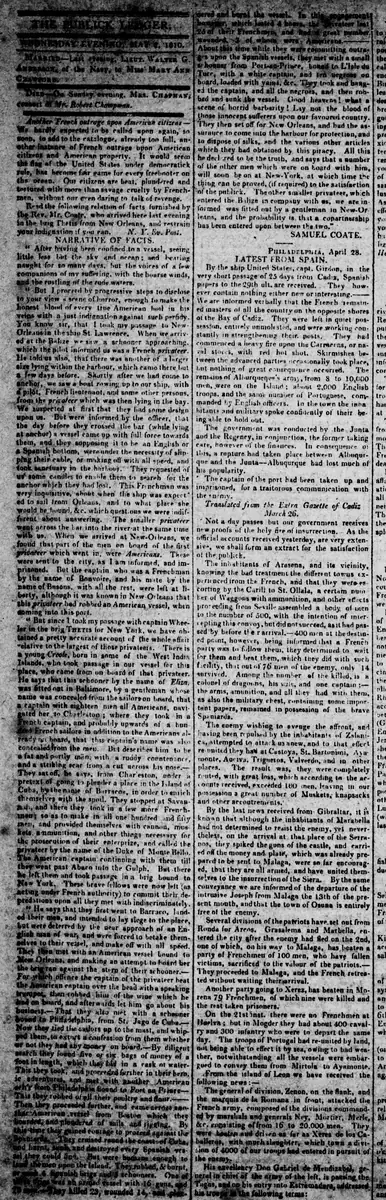
We hardly expected to be called upon again, so soon, to add to the catalogue, already too full, another instance of French outrage upon American citizens and American property. It would seem the flag of the United States under democratic rule, has become fair game for every freebooter on the ocean. Our citizens are beat, plundered and tortured with more than savage cruelty by Frenchmen, without our even daring to talk of revenge.
Read the following relation of facts furnished by the Rev. Mr. Coate who arrived here last evening in the brig Thetis from New Orleans, and restrain your indignation if you can.
N. Y. Ev. Post.
NARRATIVE OF FACTS.
After having been confined to a vessel, seeing little less than the sky and ocean; and hearing naught for so many days, but the voices of a few companions of my suffering, with the hoarse winds, and the rustling of the rude waters.
But I proceed by progressive steps to disclose to your view a scene of horror, enough to make the honest blood of every true American boil in his veins with a just indignation against such perfidy.
You know sir, that I took my passage to New Orleans in the ship St. Lawrence. When we arrived at the Balize we saw a schooner approaching, which the pilot informed us was a French privateer. He told us also, that there was another of a larger size lying within the harbour, which came there but a few days before. Shortly after we had come to anchor, we saw a boat rowing up to our ship, with the pilot, French lieutenant, and some other persons, from the privateer which was then lying in the bay. We suspected at first that they had some design upon us. But were informed by the officer, that the day before they crossed the bar (while lying at anchor) a vessel came up with full force towards them, and they supposing it to be an English or Spanish bottom, were under the necessity of slipping their cable, or making off with all speed, and took sanctuary in the harbour. They requested of us some candles to enable them to search for the anchor which they had lost. This Frenchman was very inquisitive, about when the ship was expected to sail from Orleans, and to what place she would be bound, &c. which questions we were indifferent about answering. The smaller privateer went across the bar into the river at the same time with us. When we arrived at New-Orleans, we found that part of the men on board of the first privateer which went in, were Americans. These were sent to the city, as I am informed, and imprisoned. But the captain who was a Frenchman by the name of Bonvoir, and his mate by the name of Busson, with all the rest, were left at liberty, although it was known in New-Orleans that this privateer had robbed an American vessel, when coming into this port.
But since I took my passage with captain Wheelor in the brig Thetis for New York, we have obtained a pretty accurate account of the whole affair relative to the largest of those privateers. There is a young Creole born in some of the West India Islands, who took passage in our vessel for this place, who came from on board of that privateer. He says that this schooner by the name of Eliza, was fitted out in Baltimore, by a gentleman whose name was concealed from the sailors on board, that a captain with eighteen men all Americans, navigated her to Charleston; where they took in a French captain, and probably upwards of a hundred French sailors in addition to the Americans already on board, that this captain's name was also concealed from the men. But describes him to be a fat and portly man, with a ruddy countenance, and a striking scar from a cut across his nose.
They sailed, he says, from Charleston, under a pretext of going to plunder a place in the Island of Cuba, by the name of Baracoa, in order to enrich themselves with the spoil. They stopped at Savannah, and there they took in a few more Frenchmen so as to make in all one hundred and fifty men, and provided themselves with cannon, muskets, ammunition, and other things necessary for the prosecution of their enterprize, and called the privateer by the name of the Duke of Monte Bello. The American captain continuing with them till they went past Abaco into the Gulph. But there left them and took passage in a brig bound to New York. These brave fellows were now left (as detailing under French authority) to commit their depredations upon all they met with indiscriminately.
He says that they first went to Baracoa, landed their men, and intended to lay siege to the place, but were deterred by the near approach of an English man of war, and were forced to betake themselves to their vessel, and make off with all speed. They then met with an American vessel bound to New Orleans, and making an attempt to board her the brig ran against the stern of their schooner. For which offence the captain of the privateer beat the American captain over the head with a speaking trumpet, then robbed him of the wine which he had on board, and afterwards let him go about his business. That they also met with a schooner bound to Philadelphia, from St. Jago de Cuba. Now they tied the sailors up to the mast, and whipped them to extort a confession from them whether or not they had any money on board. By diligent search they found five or six bags of money of a foot in length, which they had hid in a cask of water. This they took, and proceeded farther in their heroic adventures, and met with another American whir from Philadelphia bound to Port au Prince. This they robbed of all their poultry and furniture. When they proceeded further, and came across another American vessel from Boston which they plundered and pillaged of sails, and rigging. By this they gained courage to proceed against the enemy; cruised round the coast of Cuba and burnt and destroyed every Spanish vessel they could find. But were humane enough to take the men upon the Island, there jobbed & burnt schooners. Once an armed vessel with 16 guns.
[Continuation with garbled parts corrected: hundreds of cases of which...]
About this time while they were committing outrages upon the Spanish vessels, they met with a small schooner from Port au Prince bound to L'Isle du Furc with a white captain, and four negroes on board, loaded with yams, &c. They took and hanged the captain, and all the negroes, and then robbed and sunk the vessel. Good heavens! what a scene of horrid barbarity! Lay not the blood of those innocent sufferers upon our favoured country.
They then set off for New Orleans, and had the assurance to come into the harbour for protection, and to dispose of silks, and the various other articles which they had obtained by this piracy. All this he declared to be the truth, and says that a number of the other men which were on board with him, will soon be in at New-York, at which time the thing can be proved, (if required) to the satisfaction of the publick. The other smaller privateer, which entered the Balize in company with us, we are informed was fitted out by a gentleman in New-Orleans, and the probability is, that a copartnership has been entered upon between the two.
SAMUEL COATE.
What sub-type of article is it?
What keywords are associated?
What entities or persons were involved?
Where did it happen?
Foreign News Details
Primary Location
Gulf Of Mexico
Key Persons
Outcome
multiple american vessels robbed of cargo including wine, money, poultry, furniture, sails, and rigging; one captain beaten; sailors whipped; one white captain and four negroes hanged; several spanish vessels burnt and destroyed; privateer sought protection in new orleans.
Event Details
French privateer schooner Eliza, fitted out in Baltimore and Charleston with American and French crew, renamed Duke of Monte Bello, attempted siege of Baracoa, Cuba but fled; attacked and robbed several American vessels bound to New Orleans, Philadelphia, Port au Prince, and Boston; plundered Spanish ships off Cuba; hanged crew of a schooner from Port au Prince; entered New Orleans harbor to sell stolen goods despite known piracy.