Thank you for visiting SNEWPapers!
Sign up free
Letter to Editor
November 24, 1826
Richmond Enquirer
Richmond, Richmond County, Virginia
What is this article about?
Cato writes to Curio, arguing that Virginia should not support John Quincy Adams or Andrew Jackson for president, as neither aligns with the state's republican principles. The election is seen as a personal struggle rather than political, with Virginia urged to abstain from involvement.
Clipping
OCR Quality
98%
Excellent
Full Text
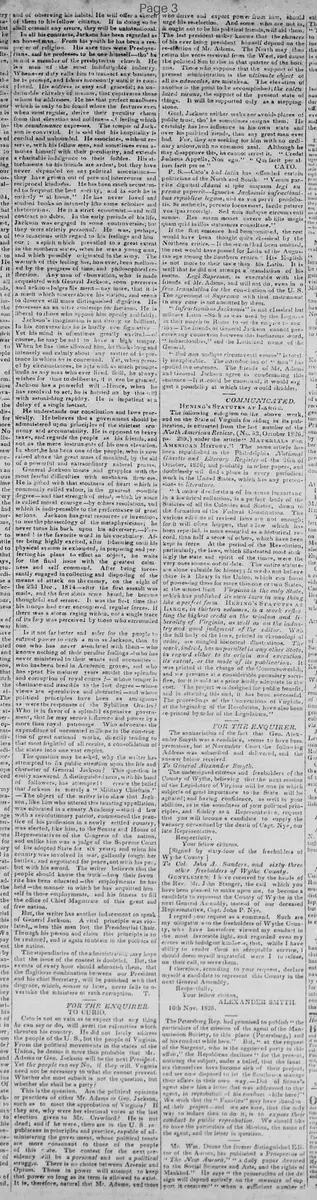
FOR THE ENQUIRER.
TO CURIO.
Cato is not so vain as to expect that any thing he can say or do, will avert the calamities which threaten his country. He did not lately address the people of the U. S., but the people of Virginia. From the political movements in the states of the Union, he deems it more than probable that Mr. Adams or Gen. Jackson will be the next President. Yet the people can say No, If they will. Virginia need not be accessory to what she cannot prevent. Whether she must submit is not the question, but whether she shall be a party?
This is the question. Are the political opinions or practices of either Mr. Adams or Gen. Jackson, such as to meet the approbation of Virginia? If they are, why were her electoral votes at the last election given to Mr. Crawford? He is not dead; and if he were, there are in the U. S. republicans in principles and practice, capable of administering the government, whose political tenets are more consonant to those of the people of this state. The contest for the next presidency will be a personal and not a political struggle. There is no choice between Arsenic and Opium. Those in power will attempt to keep that power so long as its term is allowed to exist. It is, therefore, natural that Mr. Adams, and those who derive and expect power from him, should urge his re-election. And some who are not in, & ought not to be his political friends, will aid them. The last president-maker knows that the chances of his ever being president himself depend on the re-election of Mr. Adams. The North may then return the votes received from the West, and cause the political Sun to rise in that quarter of the horizon. Those who suppose that the support of the present administration is the ultimate object of all its advocates, are mistaken. The elevation of another is the point to be accomplished; the calculated means, the support of the present state of things. It will be supported only as a stepping-stone.
Genl. Jackson neither seeks nor avoids places of public trust, tho' he sometimes resigns them. He certainly has less influence in his own state and over his political friends, than any great man ever had. For, they are seeking for him with no ordinary ardour, with no common zeal. Although he may disapprove this, he cannot arrest it. 'Credat Judaeus Apella, Non ego.' 'Qui facit per alium facit per se.' CATO.
P. S.—Cato's bad latin has offended certain politicians of the North and South—'Verum parcito dignitati Adami si ipse unquam legi supremâ pepercit—Ignoscite Jacksonis infractionibus reipublicæ legum, nisi ea vobis parvi pendbatis. Si mehercule, peccato locus esset, facile paterer vos ipsa recognosci. Sed non undique circumventi sumus. Res autem monet cavere ab illis magis quam quid in illos statuamus consultare.'
If the first sentence had been omitted, the rest would have been thought quite classical by the Northern critics.—If the second had been omitted, the rest would have passed for Latin of the Augustan age among the Southern critics.—His English is not more to their taste than his Latin. It is well that he did not attempt a translation of his motto. Legi Supremæ, is execrable with the friends of Mr. Adams, and will not do, even in a free translation for the constitution of the U. S. The agreement of Supremæ with that instrument in any case is not admitted by them.
'Infractionibus Jacksonis' is not classical but military Latin—Such as was used by the Legions in their march to Rome to set the empire to auction—The friends of General Jackson cannot perceive any connexion between this barbarous word, 'infractionibus,' and the Latinized name of the General.
'Sed non undique circumventi sumus' is totally inexplicable. The introduction of 'non' has spoiled the sentence. The friends of Mr. Adams and General Jackson agree in condemning this sentence—If it could be construed, it would suggest a possibility at which they would shudder.
TO CURIO.
Cato is not so vain as to expect that any thing he can say or do, will avert the calamities which threaten his country. He did not lately address the people of the U. S., but the people of Virginia. From the political movements in the states of the Union, he deems it more than probable that Mr. Adams or Gen. Jackson will be the next President. Yet the people can say No, If they will. Virginia need not be accessory to what she cannot prevent. Whether she must submit is not the question, but whether she shall be a party?
This is the question. Are the political opinions or practices of either Mr. Adams or Gen. Jackson, such as to meet the approbation of Virginia? If they are, why were her electoral votes at the last election given to Mr. Crawford? He is not dead; and if he were, there are in the U. S. republicans in principles and practice, capable of administering the government, whose political tenets are more consonant to those of the people of this state. The contest for the next presidency will be a personal and not a political struggle. There is no choice between Arsenic and Opium. Those in power will attempt to keep that power so long as its term is allowed to exist. It is, therefore, natural that Mr. Adams, and those who derive and expect power from him, should urge his re-election. And some who are not in, & ought not to be his political friends, will aid them. The last president-maker knows that the chances of his ever being president himself depend on the re-election of Mr. Adams. The North may then return the votes received from the West, and cause the political Sun to rise in that quarter of the horizon. Those who suppose that the support of the present administration is the ultimate object of all its advocates, are mistaken. The elevation of another is the point to be accomplished; the calculated means, the support of the present state of things. It will be supported only as a stepping-stone.
Genl. Jackson neither seeks nor avoids places of public trust, tho' he sometimes resigns them. He certainly has less influence in his own state and over his political friends, than any great man ever had. For, they are seeking for him with no ordinary ardour, with no common zeal. Although he may disapprove this, he cannot arrest it. 'Credat Judaeus Apella, Non ego.' 'Qui facit per alium facit per se.' CATO.
P. S.—Cato's bad latin has offended certain politicians of the North and South—'Verum parcito dignitati Adami si ipse unquam legi supremâ pepercit—Ignoscite Jacksonis infractionibus reipublicæ legum, nisi ea vobis parvi pendbatis. Si mehercule, peccato locus esset, facile paterer vos ipsa recognosci. Sed non undique circumventi sumus. Res autem monet cavere ab illis magis quam quid in illos statuamus consultare.'
If the first sentence had been omitted, the rest would have been thought quite classical by the Northern critics.—If the second had been omitted, the rest would have passed for Latin of the Augustan age among the Southern critics.—His English is not more to their taste than his Latin. It is well that he did not attempt a translation of his motto. Legi Supremæ, is execrable with the friends of Mr. Adams, and will not do, even in a free translation for the constitution of the U. S. The agreement of Supremæ with that instrument in any case is not admitted by them.
'Infractionibus Jacksonis' is not classical but military Latin—Such as was used by the Legions in their march to Rome to set the empire to auction—The friends of General Jackson cannot perceive any connexion between this barbarous word, 'infractionibus,' and the Latinized name of the General.
'Sed non undique circumventi sumus' is totally inexplicable. The introduction of 'non' has spoiled the sentence. The friends of Mr. Adams and General Jackson agree in condemning this sentence—If it could be construed, it would suggest a possibility at which they would shudder.
What sub-type of article is it?
Political
Persuasive
Provocative
What themes does it cover?
Politics
What keywords are associated?
Presidential Election
John Quincy Adams
Andrew Jackson
Virginia Politics
Republican Principles
Crawford Support
What entities or persons were involved?
Cato
Curio
Letter to Editor Details
Author
Cato
Recipient
Curio
Main Argument
virginia should not support either john quincy adams or andrew jackson for president, as neither aligns with the state's republican principles, and the election is a personal rather than political contest.
Notable Details
References To William H. Crawford
Latin Quotes And Satirical Commentary On Cato's Latin In P.S.
Analogy Of 'Arsenic And Opium' For Adams And Jackson