Thank you for visiting SNEWPapers!
Sign up free
Atlanta Daily World
Atlanta, Fulton County, Georgia
What is this article about?
U.S. merchant fleet carried over $3B in farm surpluses abroad in 1954, per Committee of American Steamship Lines study. Exports vital for farmers; 20% rise in Q3 1955. Government programs like PL 480 and Mutual Security Act aid disposal, requiring 50% U.S. ships.
Clipping
OCR Quality
Full Text
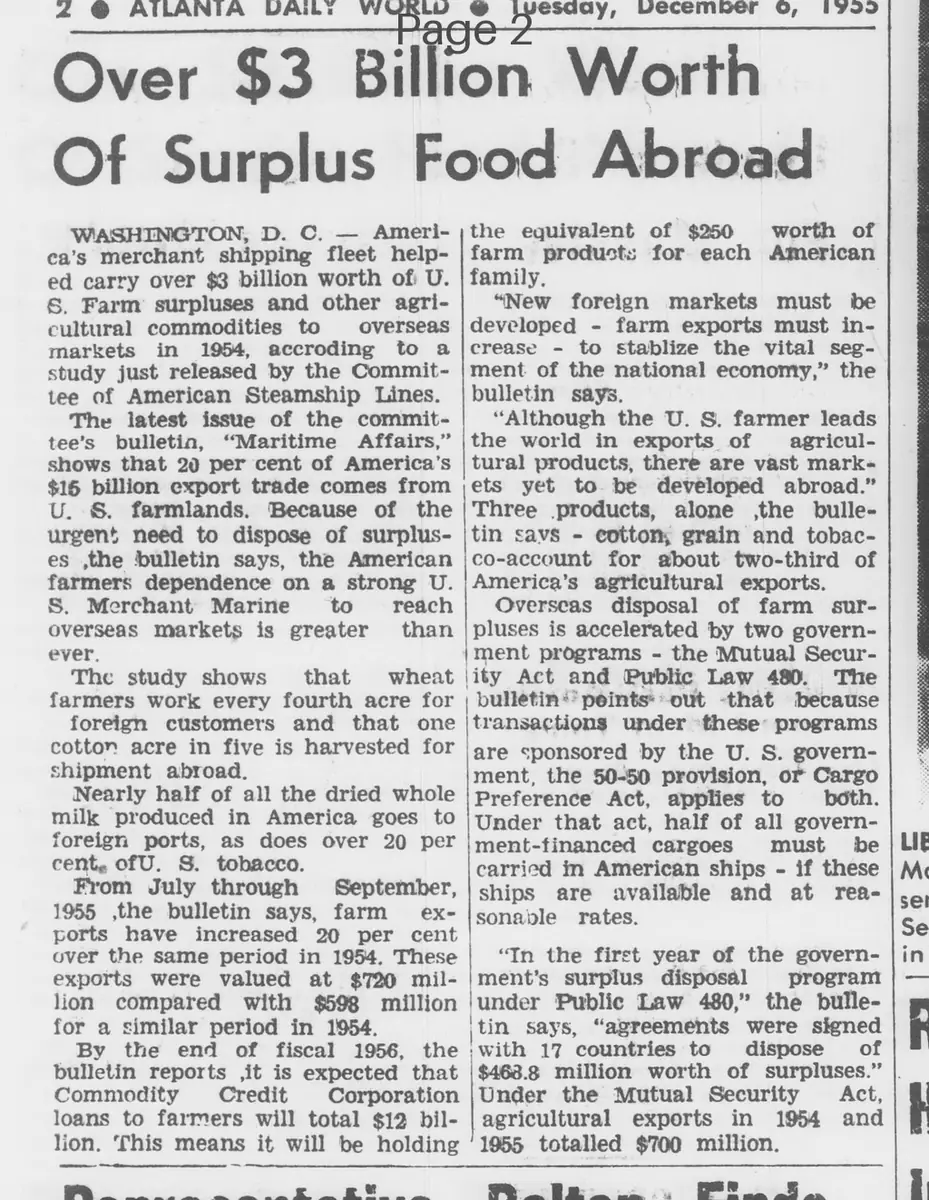
WASHINGTON, D. C. - America's merchant shipping fleet helped carry over $3 billion worth of U. S. Farm surpluses and other agricultural commodities to overseas markets in 1954, according to a study just released by the Committee of American Steamship Lines.
The latest issue of the committee's bulletin, "Maritime Affairs," shows that 20 per cent of America's $15 billion export trade comes from U. S. farmlands. Because of the urgent need to dispose of surpluses the bulletin says, the American farmers dependence on a strong U. S. Merchant Marine to reach overseas markets is greater than ever.
The study shows that wheat farmers work every fourth acre for foreign customers and that one cotton acre in five is harvested for shipment abroad. Nearly half of all the dried whole milk produced in America goes to foreign ports, as does over 20 per cent of U. S. tobacco.
From July through September 1955, the bulletin says, farm exports have increased 20 per cent over the same period in 1954. These exports were valued at $720 million compared with $598 million for a similar period in 1954.
By the end of fiscal 1956, the bulletin reports, it is expected that Commodity Credit Corporation loans to farmers will total $12 billion. This means it will be holding the equivalent of $250 worth of farm products for each American family.
New foreign markets must be developed - farm exports must increase - to stabilize the vital segment of the national economy," the bulletin says.
"Although the U. S. farmer leads the world in exports of agricultural products, there are vast markets yet to be developed abroad."
Three products alone, the bulletin says - cotton, grain and tobacco - account for about two-thirds of America's agricultural exports.
Overseas disposal of farm surpluses is accelerated by two government programs - the Mutual Security Act and Public Law 480. The bulletin points out that because transactions under these programs are sponsored by the U. S. government, the 50-50 provision, or Cargo Preference Act, applies to both.
Under that act, half of all government-financed cargoes must be carried in American ships - if these ships are available and at reasonable rates.
"In the first year of the government's surplus disposal program under Public Law 480," the bulletin says, "agreements were signed with 17 countries to dispose of $463.8 million worth of surpluses."
Under the Mutual Security Act, agricultural exports in 1954 and 1955 totalled $700 million.
What sub-type of article is it?
What keywords are associated?
Where did it happen?
Domestic News Details
Primary Location
Washington, D. C.
Event Date
1954 1955
Outcome
over $3 billion worth of u.s. farm surpluses exported in 1954; farm exports increased 20% from july-september 1955 vs. 1954, valued at $720 million; expected $12 billion in commodity credit corporation loans by end of fiscal 1956; agricultural exports under mutual security act totaled $700 million in 1954-1955; $463.8 million disposed under public law 480 in first year with 17 countries.
Event Details
America's merchant shipping fleet carried over $3 billion worth of U.S. farm surpluses and agricultural commodities to overseas markets in 1954, per a study by the Committee of American Steamship Lines. 20% of U.S. $15 billion export trade from farmlands. Wheat: every fourth acre for foreign customers; cotton: one in five acres for abroad; nearly half dried whole milk and over 20% tobacco to foreign ports. Farm exports up 20% July-September 1955 to $720 million. New markets needed to stabilize economy. Cotton, grain, tobacco account for two-thirds of exports. Accelerated by Mutual Security Act and Public Law 480, with 50-50 Cargo Preference Act applying.