Thank you for visiting SNEWPapers!
Sign up free
The Pacific Commercial Advertiser
Honolulu, Honolulu County, Hawaii
What is this article about?
Retrospect of the 1895 Wilcox Rebellion in Hawaii: Government swiftly suppressed the uprising with minimal casualties, demonstrated military strength, tried 190 rebels via Military Commission, sentenced leaders to long terms, deported some, and solidified the Republic's stability in Honolulu, Oahu.
Clipping
OCR Quality
Full Text
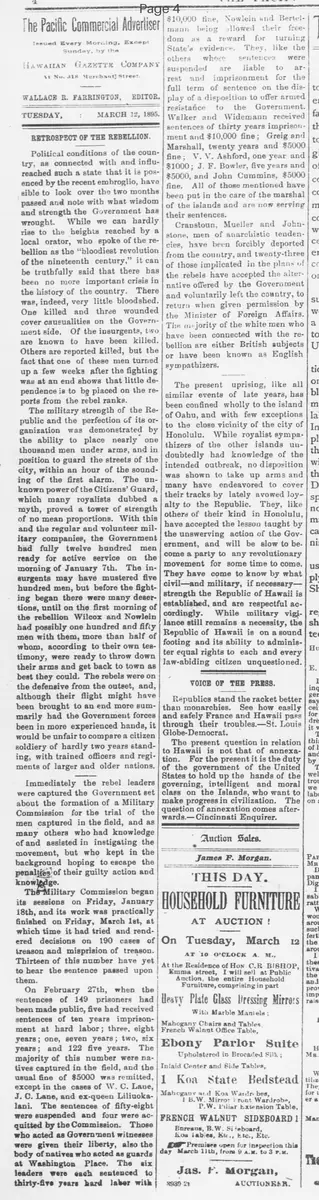
Political conditions of the country, as connected with and influenced by the recent embroglio, have reached such a state that it is possible to look over the two months passed and note with what wisdom and strength the Government has wrought. While we can hardly rise to the heights reached by a local orator, who spoke of the rebellion as the "bloodiest revolution of the nineteenth century," it can be truthfully said that there has been no more important crisis in the history of the country. There was, indeed, very little bloodshed. One killed and three wounded cover casualties on the Government side. Of the insurgents, two are known to have been killed. Others are reported killed, but the fact that one of these men turned up a few weeks after the fighting was at an end shows that little dependence is to be placed on the reports from the rebel ranks.
The military strength of the Republic and the perfection of its organization was demonstrated by the ability to place nearly one thousand men under arms, and in position to guard the streets of the city, within an hour of the sounding of the first alarm. The unknown power of the Citizens' Guard, which many royalists dubbed a myth, proved a tower of strength of no mean proportions. With this and the regular and volunteer military companies, the Government had fully twelve hundred men ready for active service on the morning of January 7th. The insurgents may have mustered five hundred men, but before the fighting began there were many desertions, until on the first morning of the rebellion Wilcox and Nowlein had possibly one hundred and fifty men with them, more than half of whom, according to their own testimony, were ready to throw down their arms and get back to town as best they could. The rebels were on the defensive from the outset, and although their flight might have been brought to an end more summarily had the Government forces been in more experienced hands, it would be unfair to compare a citizen soldiery of hardly two years standing, with trained officers and regiments of larger and older nations.
Immediately the rebel leaders were captured the Government set about the formation of a Military Commission for the trial of the men captured in the field, and as many others who had knowledge of and assisted in instigating the movement, but who kept in the background hoping to escape the penalties of their guilty action and knowledge. The Military Commission began its sessions on Friday, January 18th, and its work was practically finished on Friday, March 1st, at which time it had tried and rendered decisions on 190 cases of treason and misprision of treason. Thirteen of this number have yet to hear the sentence passed upon them.
On February 27th, when the sentences of 149 prisoners had been made public, five had received sentences of ten years imprisonment at hard labor; three, eight years; one, seven years; two, six years; and 122 five years. The majority of this number were natives captured in the field, and the usual fine of $5000 was remitted, except in the cases of I.C. Lane, J. C. Lane, and ex-queen Liliuokalani. The sentences of fifty-eight were suspended and four were acquitted by the Commission. Those who acted as Government witnesses were given their liberty, also the body of natives who acted as guards at Washington Place. The six leaders were each sentenced to thirty-five years hard labor with $10,000 fine, Nowlein and Bertelmann being allowed their freedom as a reward for turning State's evidence. They, like the others whose sentences were suspended, are liable to arrest and imprisonment for the full term of sentence on the display of a disposition to offer armed resistance to the Government.
Walker and Widemann received sentences of thirty years imprisonment and $10,000 fine; Greig and Marshall, twenty years and $5000 fine; V. V. Ashford, one year and $1000; J. F. Bowler, five years and $5000, and John Cummins, $5000 fine. All of those mentioned have been put in the care of the marshal of the islands and are now serving their sentences. Cranstoun, Mueller and Johnstone, men of anarchistic tendencies, have been forcibly deported from the country, and twenty-three of those implicated in the plans of the rebels have accepted the alternative offered by the Government and voluntarily left the country, to return when given permission by the Minister of Foreign Affairs.
The majority of the white men who have been connected with the rebellion are either British subjects or have been known as English sympathizers. The present uprising, like all similar events of late years, has been confined wholly to the island of Oahu, and with few exceptions to the close vicinity of the city of Honolulu. While royalist sympathizers of the other islands undoubtedly had knowledge of the intended outbreak, no disposition was shown to take up arms and many have endeavored to cover their tracks by lately avowed loyalty to the Republic. They, like others of their kind in Honolulu, have accepted the lesson taught by the unswerving action of the Government, and will be slow to become a party to any revolutionary movement for some time to come.
They have come to know by what civil—and military, if necessary—strength the Republic of Hawaii is established, and are respectful accordingly. While military vigilance still remains a necessity, the Republic of Hawaii is on a sound footing and its ability to administer equal rights to each and every law-abiding citizen unquestioned.
What sub-type of article is it?
What themes does it cover?
What keywords are associated?
What entities or persons were involved?
Where did it happen?
Story Details
Key Persons
Location
Honolulu, Oahu, Republic Of Hawaii
Event Date
January 7th To March 1st
Story Details
The Republic of Hawaii suppressed a royalist rebellion led by Wilcox and Nowlein with superior military force and minimal casualties. A Military Commission tried 190 for treason, sentencing leaders to long imprisonments and fines, suspending others, acquitting some, deporting anarchists, and allowing voluntary exile for implicated parties, affirming the government's stability.