Thank you for visiting SNEWPapers!
Sign up free
Alexandria Advertiser And Commercial Intelligencer
Alexandria, Virginia
What is this article about?
Letter from Cape-Francois, Dec. 26, 1802, details a forced loan of 37,000 dollars from merchants to fund the French army amid colonial financial woes, resulting in brief imprisonment of seven merchants who paid to secure release.
Clipping
OCR Quality
Full Text
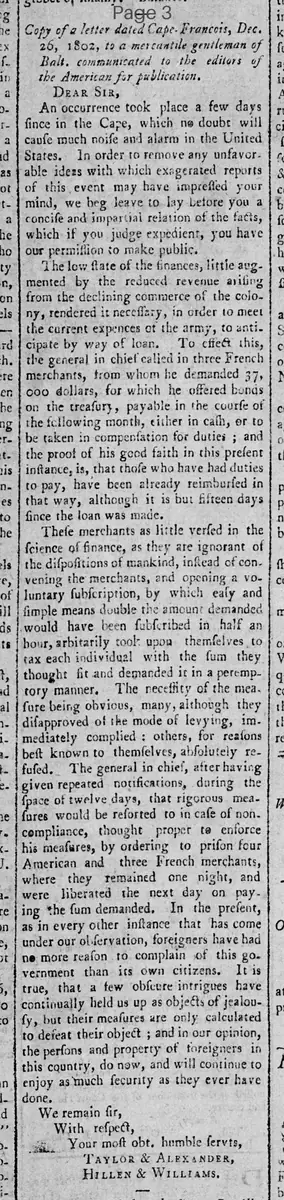
Dear Sir,
An occurrence took place a few days since in the Cape, which no doubt will cause much noise and alarm in the United States. In order to remove any unfavorable ideas with which exaggerated reports of this event may have impressed your mind, we beg leave to lay before you a concise and impartial relation of the facts, which if you judge expedient, you have our permission to make public.
The low state of the finances, little augmented by the reduced revenue arising from the declining commerce of the colony, rendered it necessary, in order to meet the current expenses of the army, to anticipate by way of loan. To effect this, the general in chief called in three French merchants, from whom he demanded 37,000 dollars, for which he offered bonds on the treasury, payable in the course of the following month, either in cash, or to be taken in compensation for duties; and the proof of his good faith in this present instance, is, that those who have had duties to pay, have been already reimbursed in that way, although it is but fifteen days since the loan was made.
These merchants as little versed in the science of finance, as they are ignorant of the dispositions of mankind, instead of convencing the merchants, and opening a voluntary subscription, by which easy and simple means double the amount demanded would have been subscribed in half an hour, arbitrarily took upon themselves to tax each individual with the sum they thought fit and demanded it in a peremptory manner. The necessity of the measure being obvious, many, although they disapproved of the mode of levying, immediately complied: others, for reasons best known to themselves, absolutely refused. The general in chief, after having given repeated notifications, during the space of twelve days, that rigorous measures would be resorted to in case of noncompliance, thought proper to enforce his measures, by ordering to prison four American and three French merchants, where they remained one night, and were liberated the next day on paying the sum demanded. In the present, as in every other instance that has come under our observation, foreigners have had no more reason to complain of this government than its own citizens. It is true, that a few obscure intrigues have continually held us up as objects of jealousy, but their measures are only calculated to defeat their object; and in our opinion, the persons and property of foreigners in this country, do now, and will continue to enjoy as much security as they ever have done.
We remain sir,
With respect,
Your most obt. humble servts,
TAYLOR & ALEXANDER,
HILLEN & WILLIAMS.
What sub-type of article is it?
What keywords are associated?
What entities or persons were involved?
Where did it happen?
Foreign News Details
Primary Location
Cape Francois
Event Date
A Few Days Before Dec. 26, 1802
Key Persons
Outcome
four american and three french merchants imprisoned for one night and liberated after paying the demanded sum; loan of 37,000 dollars secured via bonds on the treasury.
Event Details
Due to low finances and reduced revenue from declining commerce, the general in chief demanded a loan of 37,000 dollars from three French merchants, offering treasury bonds payable in cash or duties. The merchants arbitrarily taxed others, leading to compliance by many but refusal by some. After notifications, the general ordered imprisonment of four American and three French merchants, who paid and were released the next day.