Thank you for visiting SNEWPapers!
Sign up free
Chicago Daily Tribune
Chicago, Cook County, Illinois
What is this article about?
Admiral Ammen's report details the 1879 Paris Inter-Oceanic Canal Congress, where delegates debated routes like Nicaragua and Panama. Technical presentations exposed Panama sea-level canal flaws due to Chagres River floods. Despite engineer support for Nicaragua, the resolution favored Panama amid concession influences and abstentions.
Clipping
OCR Quality
Full Text
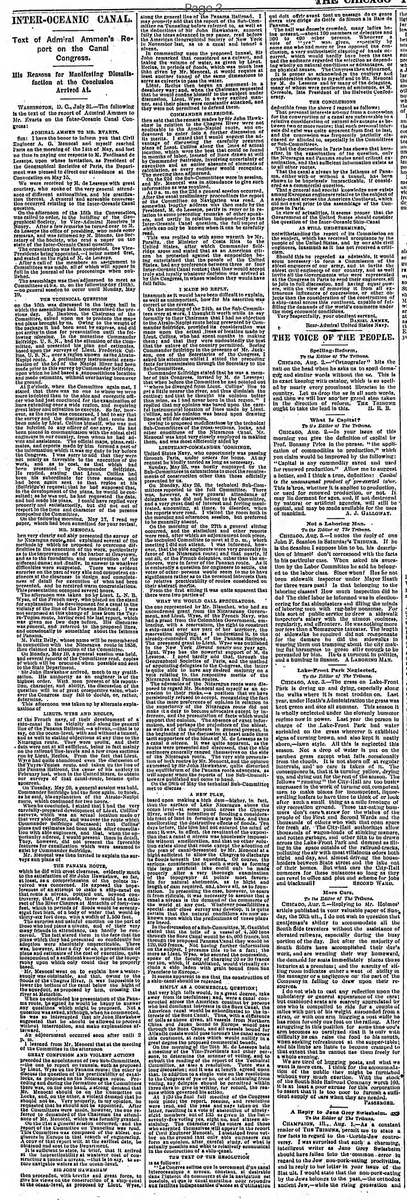
Text of Admiral Ammen's Report on the Canal Congress.
His Reasons for Manifesting Dissatisfaction at the Conclusion Arrived At.
WASHINGTON, D. C., July 31.—The following Is the text of the report of Admiral Ammen to Mr. Evarts on the Inter-Oceanic Canal Congress:
ADMIRAL AMMEN TO MR. EVARTS
Sir: I have the honor to inform you that Civil Engineer A. G. Menocal and myself reached Paris on the morning of the 11th of May, and lost no time in paying our respects to M. Ferdinand de Lesseps, upon whose invitation, as President of the Geographical Societies of Paris, the Department was pleased to direct our attendance at the Convocation on May 15.
We were received by M. de Lesseps with great courtesy, who spoke of the very general attendance of different nationalities, and his gratification thereat. A general and agreeable conversation occurred relating to the Inter-Oceanic Canal question.
On the afternoon of the 15th the Convocation was called to order, in the building of the Geographical Society, by Vice-Admiral La Ronciere le Noury. After a few remarks he turned over to M. de Lesseps the office of presiding, who made some remarks, and was followed by M. Bionne, the Secretary of the Society, who read a paper on the state of the Inter-Oceanic Canal question.
The organization was then completed, five Vice-Presidents being appointed, I being named first, and seated on the right of M. de Lesseps.
After a call of the members an assignment to Committees was made, all of which will appear in full in the journal of the proceedings when published.
The assemblage was then adjourned to meet as Committees at 2 p. m. on the following day (16th). No general session to occur until Monday, May 19.
THE TECHNICAL QUESTION
on the 16th was discussed in the large hall in which the assemblage had been organized the previous day. M. Dambre, the Chairman of the Committee, called upon me to produce the maps and plans brought by us. Owing to the weight of the package it had been sent by express, and did not arrive in time for presentation until the following morning. In the meantime Commander Selfridge, U. S. N., had the attention of the Committee, and presented his plan and estimates, based upon the surveys of Lieut. Frederick Collins, U. S. N., over a region known as the Atrato-Napipi route. A preliminary instrumental examination of the bed of the Napipi River had been made prior to this survey by Commander Selfridge, upon which he had based a supposititious location and made estimates, without ever having been over the ground.
At 2 o'clock, when the Committee again met, I stated that there was no one to whom we were more indebted than to the able and energetic officer who had just concluded for the exploration of lines extending over a wide region, and requiring great labor and privation to execute. So far, however, as the route was concerned, I had to say that the survey and the discussion of that route had been made by Lieut. Collins himself, who was not the inferior to any officer of our navy. He had been placed in communication with the ablest civil engineers in our country, from whom he had advice and assistance. The official maps, plans, estimates, and reports made by him formed a part of the information which it was my duty to lay before the Congress. I was sorry to add that they were not nearly as favorable to the execution of the work, and as to cost, as that which had been presented by Commander Selfridge.
He replied, stating that Lieut. Collins had been his subordinate for three seasons, and had been again sent to that region at his (Selfridge's) request; that he had supposed that, in the development of the plans, he would be consulted; as he was not, he had requested the data, and had made his plans. I could have replied very properly and satisfactorily, but did not out of respect to the time and character of the persons composing the Committee.
On the following morning, May 17, I read my paper, which had been submitted for your revision.
MR. MENOCAL
had very clearly and ably presented the survey of his Nicaragua route and explained several of the methods by which he proposed to overcome difficulties in the execution of the work, particularly as to the improvement of the harbor at Greytown, and as to the foundation and construction of the different dams; and finally, in answer to whatever difficulties were suggested. There was evident surprise on the part of very able and competent engineers at the clearness of design and completeness of detail for execution of what had been presented, and he received warm congratulations. His presentation occupied several hours.
The afternoon was taken up by Lieut. L. N. B. Wyse, of the French navy, who placed on the stand for explanation his development for a canal in the vicinity of the line of the Panama Railroad. I was not surprised at this change of base from the Tuyra-Tupia route, having read his last report, which was given me two days before. His discourse was general, and referred to the proposed lines, and occasionally to something about the Isthmus of Panama.
M. Felix Belly, whose name will be remembered in connection with the Nicaragua route in 1858, then claimed the attention of the Committee.
On Monday, May 19, a general session was held. And several reports of the Committees read, copies of which will be procured when possible and sent to the State Department.
Sir John Hawkshaw arrived, much to my gratification. His authority as an engineer is of the highest order. With men present of his reputation, character, and ability, the discussion of the question will be of great prospective value, whatever the Congress may fail to decide, or, rather, determine.
This afternoon was taken up by alternate explanations of
LIEUTS. WYSE AND RECLUS,
of the French navy, of their development of a ship-canal in the vicinity and along the general line of the Panama Railroad,—a niveau, that is to say, on the ocean-level, with aid without a tunnel. And as well in stating objections at any time to the Nicaragua route. They were prolix, and their data were not at all sufficient, being in fact mainly on the railroad line-levels and a few cross sections run by Lieut. Reclus. From the fact that Lieut. Wyse had quite abandoned even the discussion of the Tuyra-Tupia route, and taken up the line of the Panama Railroad, the cause of his anxiety in February last, when in the United States, to obtain our surveys of that canal-route, became quite apparent.
Up Tuesday, May 20, a general session was held. Commander Selfridge had the floor again, to detail, as he said, his explanation of the Atrato-Napipi route, which continued for two hours.
When he concluded I stated that I had the very carefully-prepared development of Lieut. Collins' surveys, which was an actual location made by that very able officer, and was over the route which Commander Selfridge discussed; that Collins' plans and estimates had been made after consultation with able engineers, and that, when the opportunity offered, I would present them in detail. They, however, did not present the favorable features for canalization which were assumed to exist by Commander Selfridge.
Mr. Menocal was then invited to explain the surveys and plans of
THE PANAMA ROUTE,
which he did with great clearness, evidently much to the satisfaction of Sir John Hawkshaw, so far, at least, as a comprehension of the points involved was concerned. He exposed the hopelessness of an attempt to make a ship-canal on that route a niveau, pointed out, beyond controversy, that, if so made, there would be a cataract of the River Chagres at Matachin of forty-two feet, which in periods of floods would be seventy-eight feet high, of a body of water that would be thirty-six feet deep, with a width of 1,500 feet.
The surprise and painful emotion on the part of those who had planned a niveau, and of their very many friends in attendance, can hardly be conceived. The fact stared them in the face that the plans which they had presented so confidently for adoption were absolutely impracticable. There was, however, after a day or so, a presentation of plans and estimates of the cost of execution, quite independent of a sufficient knowledge of the topography upon which only could they be properly based.
Mr. Menocal went on to explain how a water supply was obtainable. And that, owing to the fluctuations of the Chagres River, it was impossible to lower the bottom of the canal below the height of the aqueduct, as proposed by him, crossing the river at Matachin.
When he concluded his presentation of the Panama route, he stated he would be happy to answer any questions which might be proposed. Not a question was asked, although, when he commenced, he was so interrupted that Sir John Hawkshaw suggested that he should be allowed to proceed without interruption, and make explanations afterward.
An adjournment occurred soon after until 2 p. m.
I learned from Mr. Menocal that at the meeting of the Committee in the afternoon
GREAT CONFUSION AND VIOLENT ACTIONS
preceded the appointment of two Sub-Committees,—the one to report on tunnels, such as proposed by Lieut. Wyse on the Panama route; the other to discuss the question of the practicability of canal locks, as proposed on the Nicaragua route. Preceding and during the formation of the Committees there was, on the one hand, a strong demand that Mr. Menocal should be on the Committee on Locks, and, on the other, a violent demand that he should not be. Very properly, in my opinion, he requested that he should not be appointed. After the Committees were made, however, the one referred to demanded of the Chairman the attendance of Mr. Menocal, which was finally granted.
On the 21st a general session occurred; and the report of the Committee on Tunneling was read. This Committee was composed of the ablest engineers in Europe in that branch of engineering. A copy of that report will, at the earliest date, be obtained and sent to the Department.
It is sufficient to state, in brief, that it arrived at the impracticability at whatever cost of constructing a tunnel a niveau,—that is to say, to secure navigable waters at the ocean-level.
SIR JOHN HAWKSH AW
then proceeded, with brevity and great force, to give his views on the construction of a ship-canal at the Ocean-level, as proposed by Lieut. Wyse
Along the general line of the Panama Railroad. I may properly add that the report of the Sub-Committee on Tunneling before referred to, as well as the deductions of Sir John Hawkshaw, support fully the idea advanced in my paper, read before the American Geographical Society of New York in November last, as to a canal and tunnel a niveau.
In commenting upon the proposed tunnel, Sir John remarked that considered as a culvert, and taking the volume of water, as given by Lieut. Reclus, in periods of floods, which was much less than given by Mr. Menocal, it would require at least another tunnel of the same dimensions to serve as culverts to pass the water.
Necessity was: and, when the Chairman requested Lieut. Reclus then began an argument—in that he would confine himself to the subject under discussion, Lieut. Wyse, in a very excited manner, said their plans were constantly attacked, and they were not permitted to defend them.
COMMANDER SELFRIDGE
above in relation to the Chagres River were not applicable to the Atrato-Napipi route, and endeavored to enter into a further discussion of the advantages of discussing the carefully prepared plans of Lieut. Collins along the lines of actual location, which were the best that could be found in months of labor, instead of lines drawn at will by Commander Selfridge, involving uncertainty of execution and an entire absence of elements of calculation, as every engineer would recognize.
The meeting then adjourned.
On the 22d the Sub-Committees were in session, and Mr. Menocal was in attendance to give such information as was required.
At 9 a. m. on the 23d a general session occurred. After the usual preliminary proceedings the report of the Committee on Navigation was read. A somewhat lengthy address was then made by the President, M. de Lesseps, partly in reply or in relation to some preceding remarks of other speakers, and partly in relation independently to the Inter-Oceanic Canal question, the full import of which can only be known when it can be carefully read.
This was replied to with some warmth by Mr. Peralta, the Minister of Costa Rica to the United States, after which Commander Selfridge arose and stated that as an American citizen he protested against the supposition being entertained that the people of the United States had any preference between three or four Inter-Oceanic Canal routes; that they would accept truly and loyally whatever decision was arrived at by this Congress, in whose wisdom they would have full faith.
I MADE NO REPLY,
inasmuch as it would have been difficult to explain, as well as unimportant, how far his assertion was correct or the reverse.
On the morning of the 24th, as the Sub-Committees were at work, I thought it worth while to say formally to their Chairman that I had no objection to the Atrato-Napipi route being presented by Commander Selfridge, provided its consideration was made upon the actual lines of location made by Lieut. Collins, who had spent months in making them; and that they were undoubtedly the best that the nature of the country permitted. Seeing Commander Selfridge in the presence of Mr. Jackson, one of the Secretaries of the Congress, I asked his attention whilst I stated the preceding facts for transmission through the Secretary to the Sub-Committees.
Commander Selfridge stated that he was a member of this Congress, invited by M. de Lesseps; that when before the Committee he had pointed out where he diverged from Lieut. Collins' line to get a little nearer the river, and thus diminish the cutting; and that he thought his opinion better than mine, as I had never been in that region.
I replied that my opinion was based upon the careful instrumental location of lines made by Lieut. Collins, and his opinion was based upon drawing lines upon at will for discussion.
Owing to proposed modifications by the technical Sub-Committees of the cross-sections, locks, and other conditions of the Nicaragua Canal, Mr. Menocal was kept very closely employed in making them, and was most efficiently aided by
LIEUTENANT-COMMANDER GORINGE,
United States Navy, who opportunely was passing through Paris, under orders for home. At my request he kindly tarried as long as necessary.
Sunday, May 25, was busily employed by the Sub-Committees in calculations to meet the requirements of construction other than those officially presented by us.
On Monday, May 26, the technical Sub-Committees reported to the full Committee. There was, however, a very general attendance of delegates who did not belong to the Committee, and a very great deal of interest and feeling manifested, amounting, at times, to disorder, when the reports were read. I visited the room both in the morning and afternoon session, but preferred to be generally absent.
On the morning of the 27th a general sitting occurred, and the statistical and other reports were read, after which an adjournment took place to the technical Committee to meet at 2 p. m., which meeting I did not attend. I was informed, however, that the able engineers were very generally in favor of the Nicaragua route; and that nearly, if not all, of the French delegates, other than the engineers, were in favor of the Panama route. As it is eminently a question for engineers to settle, the vote of others would seem to me to have significance rather as to the personal interests than to relative practicability of routes considered on their abstract merits.
From the first sitting it was quite apparent that there were five parties of
WHAT WE WOULD CALL SPECULATORS.
the one represented by Mr. Blanchet, who had an unconfirmed grant from the Nicaraguan Government, and Lieut. Wyse, of the French Navy, who had a grant from the Colombian Government, embracing, with a reservation, the right to construct a ship-canal over any part of her territory, the reservation applying, as I understand it, to the already-conceded right of the Panama Railroad.
The presumed grant to Lieut. Wyse was published in the New York Herald nearly one year ago.
Lieut. Wyse has the powerful support of M. de Lesseps. I need hardly add that, through the Geographical Societies of Paris, and the method of appointing delegates to the Congress, the latter is quite able to have any desired majority on a vote relating to the respective merits of the Nicaragua and Panama routes.
The advocates of the Nicaragua route were disposed to regard Mr. Menocal and myself as an accession to their ranks,—a position that we have persistently refused to accept, recognizing the fact that the mere preference of opinion in relation to the superiority of the Nicaragua route did not make it a duty to become advocates except by inference, and the presentation of facts which would support that opinion. The absence of exact information, and perhaps the prejudices of the ablest, as well as of the engineers in general present, in the beginning of the discussion at least, made them tacit supporters of the ideas of M. de Lesseps as to a canal a niveau. It was quite apparent, as the routes were presented and discussed, that the able engineers generally ranged themselves on the side of the Nicaragua route. The very able presentation of both routes by Mr. Menocal, and the opinion expressed by Sir John Hawkshaw, quite disturbed the equilibrium of the Panama route advocates, as will appear when the reports of the Sub-Committees are published and come to hand.
On the 28th of May the technical Sub-Committee met to discuss.
A NEW PLAN
based upon making a high dam—higher, in fact, than the surface of Lake Nicaragua above the ocean level—at some point across the Chagres River, with the intention of flooding a considerable tract of land in forming a large lake, and thus ameliorating the destructive effects of floods. Ten days before, this idea had not entered the mind of man; it was, in effect, the resultant of the exposition that a canal a niveau was hopelessly impossible without amelioration, and that no other conclusion arrives along that route except the adoption of the plan of canals presented by Mr. Menocal at a height sufficient to allow the Chagres to discharge its floods beneath the aqueduct. Of course, the serious consideration of such a work as forming this large artificial lake could only be made properly after a very thorough examination of the topography at points most favorable for natural abutments, as to height and length of dam required, and, above all, as to foundation. In presenting the case, however, to spare it from ridicule, it was necessary to assume that a canal a niveau is the demand of the commerce of the world at any cost. Whatever possibilities a special and close survey may develop, it is quite certain that the natural conditions are not unknown upon which the predications of those plans are based.
In the discussion of Sub-Committee, M. Cauthiot stated that the toll of a vessel of 4,000 tons through the Suez Canal would be 200,000 francs, but through the proposed Panama Canal they would be 160,000 francs. Not having further information on the subject, I presume this to be a fact. The more as Lieut. Wyse, who secured the concession, spoke of the facility of charging 50 or 30 francs per ton, which, if established, would virtually exclude a ship laden with grain bound from San Francisco to Europe.
It seems apparent to me that the construction of a ship-canal should be regarded
SIMPLY AS A COMMERCIAL QUESTION;
that very high tolls would, to a great degree, take away from its usefulness; and, were a canal constructed across the American continent by persons who had dominant interests in the Suez Canal the American canal would be subordinated to the interests of the Suez Canal. Thus with difference of tolls as above given, all vessels from Northern China and Japan bound to Europe would pass through the Suez Canal, and all vessels bound for Atlantic coasts would pass through the canal across this continent, at rates which would nullify in great degree the proposed commercial benefit.
On the morning of the 29th M. de Lesseps held a meeting of the Vice-Presidents and other persons, to determine the manner of voting, and to submit the reading of the report of the Technical Committee, as also a resolution. There was a long discussion; and it was at length agreed upon that, in addition to a single vote on the resolution to the Congress of yea or nay, or of abstaining from voting, any delegate should be permitted within three days to give in writing, for record, the reasons which governed his action.
At 1:30 the final full meeting of the Congress took place; the report, result, and resolution were read, and the yeas and nays taken on the latter, resulting in a vote of abstention of ninety-eight members out of 118 as given in the list—seventy-five voting yea, eight nay, and sixteen abstaining. The character of the voters and those who absented themselves will appear in the report of Civil Engineer Menocal. I abstained from voting on the ground that only able engineers can form an opinion, after careful study, of what is actually possible and what it positively costs in the construction of a ship-canal.
THE TEXT OF THE RESOLUTION
is as follows:
"Le Congres estimant qu'un canal interoceanique a niveau, continu, est 'aussi desirable dans l'interet du commerce et de la navigation que possible, et que le canal le plus maritime pour repondre aux facilites indispensables d'acces et d'utilisation devra etre dirige du Golfe de Simon a la Bale de Panama."
There were present—about 100 members or delegates and 300 to 400 other persons. The hall was densely crowded, many ladies being present. Whenever a vote of "yea" was given, especially by some one who had more or less opposed the conclusion, a very enthusiastic clapping of hands occurred, which would hardly have been the case had the audience regarded the selection as depending wholly on natural conditions or advantages, or on physical causes. The Congress then adjourned.
It is proper to acknowledge the courtesy and consideration shown to myself and to Mr. Menocal by M. de Lesseps and by many of the delegates, many of whom were gentlemen of eminence, as M. Cercsole, late President of the Helvetic Confederacy.
THE CONCLUSIONS
deducible from the above I regard as follows:
That personal interests arising from a concession for the construction of a canal act unfaithfully to relative consideration of natural advantages as between two or more routes; that much personal interest did exist was quite apparent from first to last, and the concession was frequently partially glanced or alluded to, especially in the Committees or Sub-Committees.
That the discussion in Paris has shown that hereafter, in the examination of the question, only the Nicaragua and Panama routes need critical examination, and that sufficient information exists as to all other routes.
That the canal a niveau by the Isthmus of Panama, either with or without a tunnel, has been shown to be hopelessly impracticable, if considered as a commercial question.
That a general and serial knowledge now exists among European engineers relative to the subject of a ship-canal across the American Continent which did not exist prior to the assemblage of the Congress in Paris.
In view of actual results, it seems proper that the Government of the United States should consider the question of the Inter-Oceanic Ship-Canal
AS STILL UNDETERMINED,
notwithstanding the report of its Commission on the subject, which has received acceptance by the people of the United States, and by our able civil engineers, inasmuch as it has not received a criticism.
Should this be regarded as advisable, it would seem necessary to form a Commission of the ablest engineers of our army, and to invite the ablest civil engineers of our country, and as well invite all the governments why were represented at the Congress in Paris to send their engineers, and to join in full discussion, and having caucus view, ere, with the view of removing it from all extraneous influences of concessions, or other objects than the consideration of the construction of a ship-canal across this continent, capable of fulfilling the demands of the world's commerce under the most economical conditions.
Very respectfully, your obedient servant,
Daniel Ammen,
Rear-Admiral United States Navy.
What sub-type of article is it?
What keywords are associated?
What entities or persons were involved?
Where did it happen?
Foreign News Details
Primary Location
Paris
Event Date
May 15 To May 29
Key Persons
Outcome
the congress passed a resolution favoring a sea-level inter-oceanic canal from the gulf of simon to the bay of panama, with 75 yeas, 8 nays, and 98 abstentions out of 118 members. admiral ammen abstained, citing the need for expert engineering opinion, and expressed dissatisfaction due to personal interests and impracticability of proposals.
Event Details
Admiral Ammen and Civil Engineer Menocal attended the Inter-Oceanic Canal Congress in Paris, invited by Ferdinand de Lesseps. The congress discussed various routes, including Nicaragua, Panama, and Atrato-Napipi. Presentations highlighted technical challenges, such as floods on the Chagres River making a sea-level Panama canal impracticable. Sub-committees reported on tunneling and locks, favoring Nicaragua's feasibility. Despite this, the resolution endorsed a Panama sea-level canal amid influences from concessions and interests.