Thank you for visiting SNEWPapers!
Sign up free
Literary
December 28, 1839
Columbus Democrat
Columbus, Lowndes County, Mississippi
What is this article about?
Newspaper article reports the discovery and transcription of an ancient Hebrew death warrant for Jesus Christ, issued by Pontius Pilate, listing charges of sedition and blasphemy. Found in 1820 near Naples, it emphasizes the relic's religious significance.
Clipping
OCR Quality
92%
Excellent
Full Text
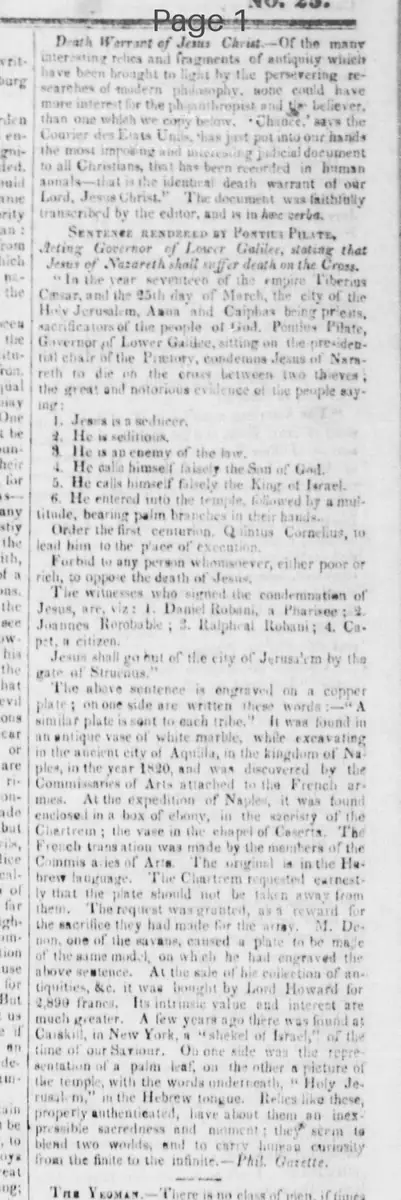
Death Warrant of Jesus Christ. Of the many
interesting relics and fragments of antiquity which
have been brought to light by the persevering researches of modern philosophy, none could have
more interest for the philanthropist and believer,
than one which we copy below. Chance,' says the
Courier des Etats Unis, 'has just put into our hands
the most imposing and interesting of all documents
to all Christians, that have been rescued from human
annihilation—the wonderful death warrant of our
Lord. Jesus Christ.' The document was faithfully
transcribed by the editor, and is in the Hebrew language.
Sentence rendered by Pontius Pilate,
Acting Governor of Lower Galilee, stating that
Jesus of Nazareth shall suffer death on the Cross.
"In the year seventeen of the empire Tiberius
Cæsar, and the 25th day of March, the city of the
High Jerusalem, Annas and Caiaphas being priests,
sacrificators of the people of Judæa. Pontius Pilate,
Governor of Lower Galilée, acting on the pretent-
dential chair of the Prætorium, Condemns Jesus of Naz-
areth to death on the cross between two thieves, the
great and notorious evidence of the people saying:
1. Jesus is a seducer;
2. He is seditious.
3. He is an enemy of the law
4. He calls himself falsely the Son of God.
5. He calls himself falsely the King of Israel.
6. He entered unto the temple, followed by a mul-
titude, bearing palm branches in their hands.
Order the first centurion Quinius Cornelius, to
lead him to the place of execution.
Forbad to any person whomsoever, either poor or
rich, to oppose the death of Jesus.
The witnesses who signed the condemnation of
Jesus, are, viz: 1. Daniel Robani, a Pharisee; 2.
Joannes Roroboble, 3. Raphael Robani; 4. Ca-
poh, a citizen.
Jesus shall go out of the city of Jerusalem by the
gate of Struthius.
The above sentence is engraved on a copper
plate; on one side are written these words:—'A
similar plate is sent to each tribe. It was found in
an antique vase of white marble, while excavating
in the ancient city of Aquila, in the kingdom of Na-
ples, in the year 1820, and was discovered by the
Commissaries of Arts attached to the French ar-
mies. At the expedition of Naples, it was found
enclosed in a box of ebony, in the vestry of the
Cathedral; the vase in the chapel of Caserta. The
French translation was made by the members of the
Commission of Arts. The original is in the He-
brew language. The Cathedral requested earnest-
ly that the plate should not be taken away from
them. The request was granted, as a reward for
the sacrifice they had made for their army. M. De-
non, one of the savans, caused a plate to be made
of the same model, on which he had engraved the
above sentence. At the sale of his collection of an-
tiquities, &c. it was bought by Lord Howard for
2500 francs. Its intrinsic value and interest are
much greater. A few years ago there was found at
Catskill, in New York, a "shekel of Israel," of the
time of our Saviour. On one side was the repre-
sentation of a palm leaf, on the other a picture of
the temple, with the words underneath, "Holy Je-
rusalem," in the Hebrew tongue. Relics like these,
properly authenticated, have about them an inex-
pressible sacredness and moment: they seem to
blend two worlds, and to carry forward con-
tinuity from the finite to the infinite.—Phil. Gazette.
interesting relics and fragments of antiquity which
have been brought to light by the persevering researches of modern philosophy, none could have
more interest for the philanthropist and believer,
than one which we copy below. Chance,' says the
Courier des Etats Unis, 'has just put into our hands
the most imposing and interesting of all documents
to all Christians, that have been rescued from human
annihilation—the wonderful death warrant of our
Lord. Jesus Christ.' The document was faithfully
transcribed by the editor, and is in the Hebrew language.
Sentence rendered by Pontius Pilate,
Acting Governor of Lower Galilee, stating that
Jesus of Nazareth shall suffer death on the Cross.
"In the year seventeen of the empire Tiberius
Cæsar, and the 25th day of March, the city of the
High Jerusalem, Annas and Caiaphas being priests,
sacrificators of the people of Judæa. Pontius Pilate,
Governor of Lower Galilée, acting on the pretent-
dential chair of the Prætorium, Condemns Jesus of Naz-
areth to death on the cross between two thieves, the
great and notorious evidence of the people saying:
1. Jesus is a seducer;
2. He is seditious.
3. He is an enemy of the law
4. He calls himself falsely the Son of God.
5. He calls himself falsely the King of Israel.
6. He entered unto the temple, followed by a mul-
titude, bearing palm branches in their hands.
Order the first centurion Quinius Cornelius, to
lead him to the place of execution.
Forbad to any person whomsoever, either poor or
rich, to oppose the death of Jesus.
The witnesses who signed the condemnation of
Jesus, are, viz: 1. Daniel Robani, a Pharisee; 2.
Joannes Roroboble, 3. Raphael Robani; 4. Ca-
poh, a citizen.
Jesus shall go out of the city of Jerusalem by the
gate of Struthius.
The above sentence is engraved on a copper
plate; on one side are written these words:—'A
similar plate is sent to each tribe. It was found in
an antique vase of white marble, while excavating
in the ancient city of Aquila, in the kingdom of Na-
ples, in the year 1820, and was discovered by the
Commissaries of Arts attached to the French ar-
mies. At the expedition of Naples, it was found
enclosed in a box of ebony, in the vestry of the
Cathedral; the vase in the chapel of Caserta. The
French translation was made by the members of the
Commission of Arts. The original is in the He-
brew language. The Cathedral requested earnest-
ly that the plate should not be taken away from
them. The request was granted, as a reward for
the sacrifice they had made for their army. M. De-
non, one of the savans, caused a plate to be made
of the same model, on which he had engraved the
above sentence. At the sale of his collection of an-
tiquities, &c. it was bought by Lord Howard for
2500 francs. Its intrinsic value and interest are
much greater. A few years ago there was found at
Catskill, in New York, a "shekel of Israel," of the
time of our Saviour. On one side was the repre-
sentation of a palm leaf, on the other a picture of
the temple, with the words underneath, "Holy Je-
rusalem," in the Hebrew tongue. Relics like these,
properly authenticated, have about them an inex-
pressible sacredness and moment: they seem to
blend two worlds, and to carry forward con-
tinuity from the finite to the infinite.—Phil. Gazette.
What sub-type of article is it?
Essay
Prose Fiction
What themes does it cover?
Religious
Political
Death Mortality
What keywords are associated?
Death Warrant
Jesus Christ
Pontius Pilate
Religious Relic
Historical Document
Crucifixion
Ancient Artifact
Literary Details
Title
Death Warrant Of Jesus Christ
Subject
Sentence Rendered By Pontius Pilate
Form / Style
Transcribed Historical Document In Prose
Key Lines
In The Year Seventeen Of The Empire Tiberius Cæsar, And The 25th Day Of March, The City Of The High Jerusalem, Annas And Caiaphas Being Priests, Sacrificators Of The People Of Judæa.
1. Jesus Is A Seducer; 2. He Is Seditious. 3. He Is An Enemy Of The Law 4. He Calls Himself Falsely The Son Of God. 5. He Calls Himself Falsely The King Of Israel.
Order The First Centurion Quinius Cornelius, To Lead Him To The Place Of Execution.