Thank you for visiting SNEWPapers!
Sign up free
Literary
October 23, 1937
Henderson Daily Dispatch
Henderson, Vance County, North Carolina
What is this article about?
In chapters 33 and 34 of 'Dead Reckoning,' Dr. Tim Kennedy grapples with blackmail from his servant Adams over a past incident involving his late wife Esther. He plans to buy off Adams by renting out their home, The Wilderness, while navigating financial constraints and his romance with Alma. Complications arise when Esther's brother Neddy claims ownership of the property under entail and proposes renting or selling it, forcing Tim to verify legal arrangements.
Merged-components note: Consecutive chapters of 'Dead Reckoning' serialized story.
Clipping
OCR Quality
95%
Excellent
Full Text
DEAD RECKONING
Thou shalt not Kill
By BRUCE HAMILTON
CHAPTER 33
BEING HONEST enough to recognize the justice of the misfortune that had overtaken him by the evidence Adams had discovered, Tim never attempted to palliate his deficiencies by ascribing them to bad luck. For almost the only ethical principle he acknowledged was a belief that anyone who behaved in a foolish or injudicious manner fully deserved to suffer the consequences entailed by his own action.
He was not beyond applying the rule to himself, and even succeeded in extracting consolation from his own freedom from self-deception, arguing that experience would immunize him from blunders in the future. He admitted that he had been singularly fortunate to escape complete disaster at the price of a money tax which, however severe, he was not incapable of paying.
His external life, indeed, suffered no considerable change. Adams, now the mischief was out, relapsed into the model servant he always had been, treating Tim with scrupulous respect in public, and in private obtruding himself as little as possible, only using a very moderate degree of familiarity when contact was unavoidable. He even showed positive consideration. It was at his suggestion that the story was given out at The Wilderness that his London doctor had advised him to take things easier owing to a weak heart. In this way his sudden emancipation from all household duties escaped dangerous speculation and comment, and Tim got credit for his thoughtfulness and solicitude.
It became necessary to take on a boy to relieve the extra pressure on the domestic staff, and this cost a little more money. But Adams fulfilled his promise to carry on with his work at the surgery. He showed his power only by more frequent demands for leave of absence, which he customarily overstayed.
Tim did not find his feelings toward Alma in any way diminished by worry over self-preservation. Indeed, he thought of her more often and with intenser passion, as a refuge from other preoccupations. But after a good deal of self-communion he decided not to advance the day for bringing his affairs with her to a clear understanding. He wanted to go to her with a clear, untroubled mind, and he felt this to be impossible under present conditions.
Though reconciled to the necessity of paying hush money for a while, he had no intention of continuing to do so indefinitely. But he needed time to elaborate a policy. He had a strong belief that, provided the inducement was sufficiently tempting, Adams would not be able to resist indefinitely the offer of a big cash payment in return for the letter. Freedom would bring restlessness, and by waiting patiently and choosing his time Tim hoped to arrange a deal which would make him his own master again.
The problem was how to raise the money. When he had told Adams that £500 was all he could manage, he was almost speaking the truth. Actually, he had rather over £600 at the bank—£500 on deposit, a sum he had for several years been intending to invest in industrial securities, the remainder the balance of his current account.
His standard of living had always marched pretty close to his income, and he had never succeeded in saving very much. During the last year, owing to Esther's accident, he had spent considerably more than was coming in. He had planned to put by £200 or £300 a year when he reached the age of 50. Presuming he retired at 65 this amount, together with what he had saved already, and the proceeds of the sale of his practice, would have sufficed to buy him a comfortable annuity and make provision for Esther, if still alive.
It was evident that this scheme would have to be modified. He was afraid he might have to go up to £1,000 to attract Adams. At the same time, he was not prepared to curtail drastically his rate of expenditure. He was fixed in his personal habits, used to certain comforts and conveniences which cost money; besides, his pride made it impossible to inaugurate his marriage to Alma with a regime of economy.
After long thought he devised what seemed to be a likely solution. If he let The Wilderness, which he could probably do at a rental of between £300 and £400 a year, he believed he would be able to borrow from his bank enough to make up £1,000 to buy off Adams. The rent would serve as security, and afford him something over for current expenses.
In the meantime he and Alma could live at Maybank. It would be a wrench parting with The Wilderness, it would be hard to ask Alma to share the sacrifice, for she had obviously fallen in love with the place. But he could provide a very plausible reason which would do him credit—say that for the time being memories of Esther had made the place unbearable to him. And they would be able to return there directly his finances were straight again, probably in a couple of years.
Under such circumstances, however, it would be advisable for him to make the gesture of offering to pay the rent of Maybank, or at least part of it. He was pretty certain that this did not amount to more than £80 or £90 a year, at an outside figure, but it became important to find out something about Alma's financial situation.
It is curious but quite characteristic that Tim had never shown the slightest interest in this. Never an avaricious man, he had rested serene in the assurance that he could earn enough to ensure the happiness of their lives together. There was no mercenary motive behind his pursuit of Alma. But he had assumed that she was quite comfortably off. Her dress, her whole style of living, were not that of a woman who found making ends meet and keeping up appearances anything of a struggle.
Tim could not of course sound her personally, however delicate his approach, with a proposal of marriage looming in the near foreground. But by discreet handling, so that they had no suspicion that they were being pumped, he managed to get the information he wanted out of the Grantleys, who had known Alma for a good many years.
It appeared that her personal fortune amounted to between £600 and £700 a year, leaving aside alimony (which would probably cease on remarriage) of about £200. This was eminently satisfactory, and Tim felt he could go ahead without fear of embarrassment.
Accordingly, one morning before going to work he looked in at Blacklidge and Son, the chief real estate agents in West Shilston, and had a very satisfactory conversation with the son.
"I can let The Wilderness easily, Mr. Kennedy," said young Blacklidge. "It's just the right size for a country house just now. What length of lease have you in mind?"
"I thought about two years."
"It would be better for a longer or a shorter period, but I've no doubt we can manage it."
"What sort of rent can I ask for?"
"You'd let furnished, I suppose?"
"Oh, certainly."
"Well, I'd like to talk it over with my father before making a definite suggestion. And it would be better for one of us to look over the place. But I should say provisionally you ought to ask for at least £350, and be prepared to come down to £325. I certainly shouldn't let it go for less than £300."
Tim nodded. This was very much what he had expected.
"I wish you'd go ahead then. And if you or your father want to look over the house, I'll show you round. What about the lunch hour tomorrow?"
"That'll do, Mr. Kennedy. I think my father knows the accommodation pretty well. It's a question of condition, you see, sir. If the house is in good order, it makes quite a difference to the rent."
"Oh, it's in excellent order."
Tim went on to his surgery well satisfied. He finished work at about half past 1. He was about to cross the road to the William and Mary, where he usually lunched these days, when Dr. Harold Arkwright's car pulled up at the curb in front of him.
"Hullo, Tim," said Doctor Arkwright.
"I haven't seen you for quite a while. Had your lunch?"
"I was just going over the road to get it."
"Well, jump in and come and have a bite with me instead."
"Thanks. I don't mind if I do."
Tim got in, and Doctor Arkwright restarted the car. "How are you feeling these days, old man?" he asked.
"Pretty low. But I keep going."
"Same here. But I don't know if I'll be able to much longer. I'm getting to be an old man, Tim. I'm seriously thinking of retiring next year."
"Nonsense, Harold. You've half a dozen years of good work in front of you yet."
Doctor Arkwright shook his head gloomily.
"One's as old as one's arteries," he said. "I get tired very easily nowadays. And I find it harder and harder keeping my temper with stupid patients. That's fatal, you know."
"Oh, all you want is a good holiday."
(To Be Continued)
DEAD RECKONING
CHAPTER 34
THE CONVERSATION between Kennedy and Dr. Harold Arkwright continued in a rather dismal strain. By tacit consent they kept off the subject of Esther, but her ghost hung over the dinner table.
When they had finished, Doctor Arkwright said, with a rather too casual air:
"By the way, I had a letter from Neddy yesterday."
Tim looked blank.
"Neddy?"
"Neddy Ashwell."
"Oh, of course, Esther's brother. How's he getting along?"
"Not too well, by his account. The people he's been working for have been badly hit by the depression, and they've had to sell their stables. So Neddy's lost his job."
"That's bad. Still, he must have plenty of friends by now over on that side. I expect he'll fall into another."
"He doesn't seem to think so. In fact he talks of returning to England."
Tim pursed his lips.
"How does he think he's going to live over here?"
"Well ... that's why I thought I ought to mention it to you. He talks of breaking the entail and selling The Wilderness."
"He can't do that." Tim spoke abruptly.
"Can't he? To tell the truth, I never quite knew what the arrangement was that you all came to, at the time of Edgar's death."
"It was quite an explicit arrangement. He took Esther's share of the money, and Esther took The Wilderness."
"Well, I suppose you've got it in black and white. I don't profess to know anything about the business side of it. I knew the place was entailed, of course."
Tim considered for a moment.
"May I have a look at his letter?" he said presently.
Doctor Arkwright seemed unwilling.
"He said he was writing to you."
"I haven't heard. ... I'd like to know what idea he has got into his head."
"All right. ..I think I've got it on me."
Tim quickly understood the reason for Doctor Arkwright's reluctance to show him the letter. It was Neddy's first letter to England after hearing the news of his sister's death. He was clearly deeply distressed, but his grief took a rather brutal mode of expression. He did not appear to blame his uncle but his one reference in this connection to Tim was unpleasant. "I don't see how it could possibly have happened if her husband had looked after her properly. If he stood to gain anything I should suspect worse, but as it is I suppose it's only criminal negligence."
"He was always a reckless young fool," said Doctor Arkwright.
His eyes had followed Tim's and he knew when he reached the passage.
"Yes, I know." said Tim.
He read on. . .. The part about The Wilderness was brief enough. "It'll probably take me a couple of months to round up things here, and I shall be pretty well broke by the time I get over. I suppose the first step will be to cut the entail and sell The Wilderness.
"If you're in London I'll be glad if you'd talk to Marstons' about it. I suppose there'll be formalities. I should think I ought to get £6,000. I am writing to Kennedy. I don't suppose he thinks I'm going to provide him with free lodging for the rest of his life, but you never know."
Tim handed back the letter.
"It's all nonsense," he said, with an unusual bitterness in his tone.
"As far as I can make out he spent all his early life sponging on his father, and now he's trying to bluff me. But he can't get away with it; he was very generously treated by Esther and me, and he's got to stick to his bargain."
"Well, for your sake I hope you're right." said Doctor Arkwright dubiously. "In any case I shall keep out of it. I shouldn't let it worry you, Tim."
"I don't intend to." Nevertheless as he returned to the surgery he felt distinctly worried, and he found it difficult to concentrate throughout the afternoon. When he had finished, at about half past 5, he looked in again at Blacklidge's. It was the old man who greeted him this time.
"Good evening, Mr. Kennedy. My son told me you were thinking of letting The Wilderness."
"Yes. .. " Tim tried to appear casual. "I just looked in again because it occurred to me that it might not be in order for you to go ahead just yet. .. . Of course my wife left everything to me, but her will's not proved yet. I don't know the law on these matters."
Mr. Blacklidge nodded.
"I'm glad you've raised this question of title, Mr. Kennedy." he said.
"It struck me there might be a snag, directly my boy told me.
"You see, we never had the handling of the Ashwell estate, but I always understood there was an entail. If that is so, you understand that The Wilderness is the property of Mr. Edwin Ashwell—has been in fact since Mr. Edgar's death . .. of course I haven't heard anything of Mr. Edwin since he went to America, and I'm presuming he's still living."
"Yes, he's still living. But there was a very definite arrangement at the time of Mr. Edgar Ashwell's death. I've always understood that The Wilderness became my wife's property in return for a considerable money sum made over to Mr. Edwin."
"Was the entail cut?"
"I can't remember the exact legal form the arrangement took. But it was quite explicit."
"Well. you know best. Mr. Kennedy. I suppose you have documents establishing it."
"I believe there are some letters."
"No doubt it's all right then. In any case, if Mr. Edwin made that arrangement, I don't suppose he'll want to repudiate it. Unless, of course, he regarded it as only valid during Mrs. Kennedy's lifetime."
Mr. Blacklidge thought for a moment. "I tell you what I'd do if I were you, Mr. Kennedy. Go and see Marstons' in St. James street. They've always been the agents for the Ashwell properties.
They'll be able to tell you if the entail still holds, and if it does whether there's likely to be any difficulty about this arrangement you speak of."
It was plain that Mr. Blacklidge was anxious to wash his hands of the matter.
Tim went home in a very uneasy frame of mind. He had always understood that The Wilderness had been made over to Esther, and he had never anticipated any such contingency as this. .. . Yet, if there was a legal loophole, he was afraid that Neddy would allow no consideration of common honesty to restrain him from taking advantage of it.
He decided to go and see Marstons' on the following Saturday, and, if the interview should prove satisfactory, to take legal advice.
Next day, however, he received a letter from Neddy. It was cold and curt, and made no reference to Esther's death.
Dear Kennedy,
I am returning to England shortly, so think I should acquaint you with my plans about The Wilderness. You are, of course, aware that the property is mine under entail.
I have not yet definitely decided whether to let the house or cut the entail and sell it. The latter would probably take time, so I will not make a final decision until I get back. In the meantime, if you would care to consider renting the place from me it might save us both trouble, and if we can agree on terms, I will abandon the idea of a sale. I would suggest £400 a year as a fair figure.
In any case it will be a few months before I finish up over here, so you will have ample time to make what arrangements you please.
Yours truly,
Ed. Ashwell.
The cool insolence of it! A disingenuous pretense to a clear and undisputed title to do what he pleased with the place: And the crowning insult of the offer to rent it, at £400 a year, please! Tim's first impulse was to write a fierce and bitter reply, but he restrained it. He must make sure of his facts. If he could produce anything in black and white, Neddy, whatever his legal position, might yet be shamed into keeping his agreement.
(To Be Continued)
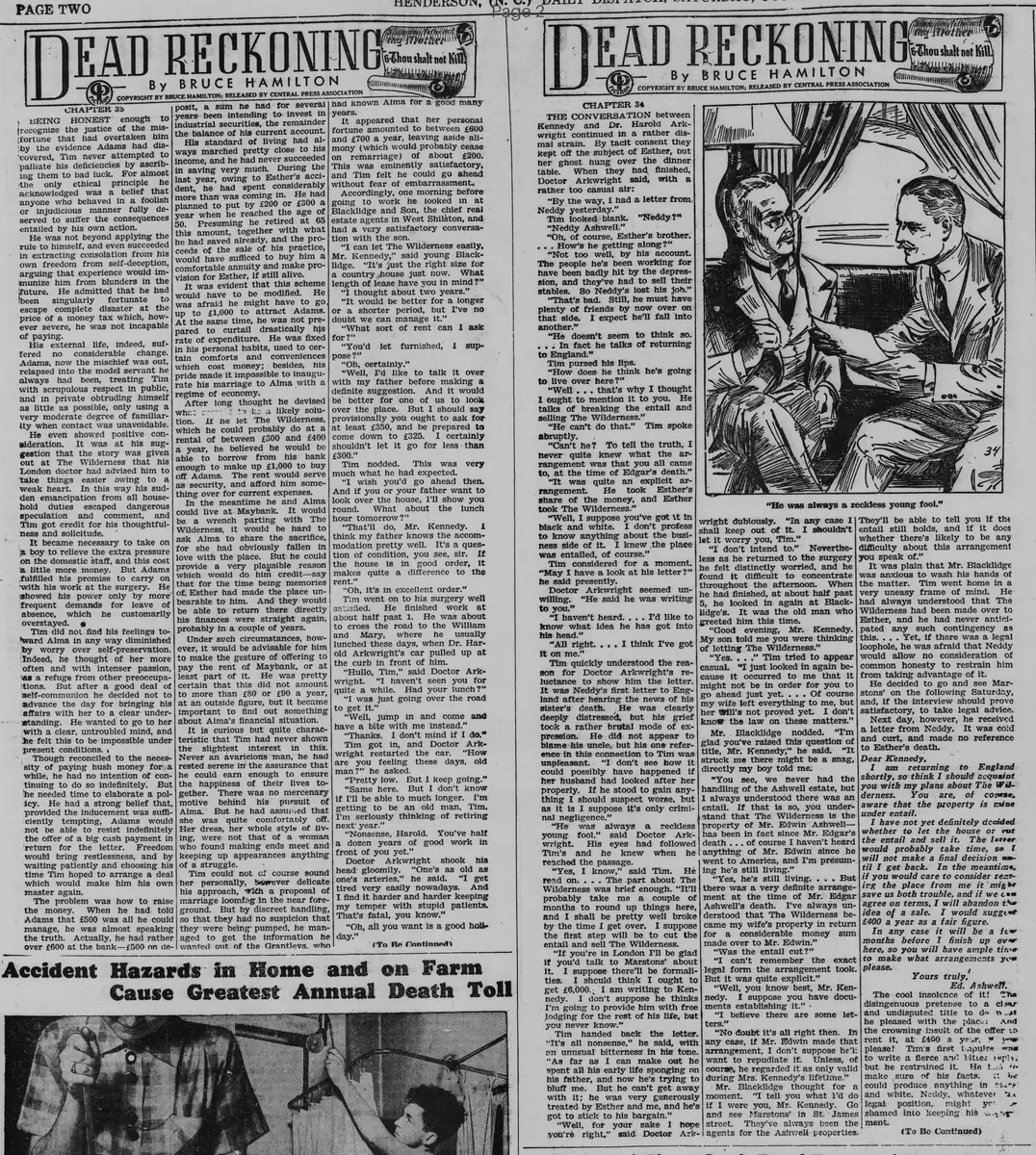
"He was always a reckless young fool."
Thou shalt not Kill
By BRUCE HAMILTON
CHAPTER 33
BEING HONEST enough to recognize the justice of the misfortune that had overtaken him by the evidence Adams had discovered, Tim never attempted to palliate his deficiencies by ascribing them to bad luck. For almost the only ethical principle he acknowledged was a belief that anyone who behaved in a foolish or injudicious manner fully deserved to suffer the consequences entailed by his own action.
He was not beyond applying the rule to himself, and even succeeded in extracting consolation from his own freedom from self-deception, arguing that experience would immunize him from blunders in the future. He admitted that he had been singularly fortunate to escape complete disaster at the price of a money tax which, however severe, he was not incapable of paying.
His external life, indeed, suffered no considerable change. Adams, now the mischief was out, relapsed into the model servant he always had been, treating Tim with scrupulous respect in public, and in private obtruding himself as little as possible, only using a very moderate degree of familiarity when contact was unavoidable. He even showed positive consideration. It was at his suggestion that the story was given out at The Wilderness that his London doctor had advised him to take things easier owing to a weak heart. In this way his sudden emancipation from all household duties escaped dangerous speculation and comment, and Tim got credit for his thoughtfulness and solicitude.
It became necessary to take on a boy to relieve the extra pressure on the domestic staff, and this cost a little more money. But Adams fulfilled his promise to carry on with his work at the surgery. He showed his power only by more frequent demands for leave of absence, which he customarily overstayed.
Tim did not find his feelings toward Alma in any way diminished by worry over self-preservation. Indeed, he thought of her more often and with intenser passion, as a refuge from other preoccupations. But after a good deal of self-communion he decided not to advance the day for bringing his affairs with her to a clear understanding. He wanted to go to her with a clear, untroubled mind, and he felt this to be impossible under present conditions.
Though reconciled to the necessity of paying hush money for a while, he had no intention of continuing to do so indefinitely. But he needed time to elaborate a policy. He had a strong belief that, provided the inducement was sufficiently tempting, Adams would not be able to resist indefinitely the offer of a big cash payment in return for the letter. Freedom would bring restlessness, and by waiting patiently and choosing his time Tim hoped to arrange a deal which would make him his own master again.
The problem was how to raise the money. When he had told Adams that £500 was all he could manage, he was almost speaking the truth. Actually, he had rather over £600 at the bank—£500 on deposit, a sum he had for several years been intending to invest in industrial securities, the remainder the balance of his current account.
His standard of living had always marched pretty close to his income, and he had never succeeded in saving very much. During the last year, owing to Esther's accident, he had spent considerably more than was coming in. He had planned to put by £200 or £300 a year when he reached the age of 50. Presuming he retired at 65 this amount, together with what he had saved already, and the proceeds of the sale of his practice, would have sufficed to buy him a comfortable annuity and make provision for Esther, if still alive.
It was evident that this scheme would have to be modified. He was afraid he might have to go up to £1,000 to attract Adams. At the same time, he was not prepared to curtail drastically his rate of expenditure. He was fixed in his personal habits, used to certain comforts and conveniences which cost money; besides, his pride made it impossible to inaugurate his marriage to Alma with a regime of economy.
After long thought he devised what seemed to be a likely solution. If he let The Wilderness, which he could probably do at a rental of between £300 and £400 a year, he believed he would be able to borrow from his bank enough to make up £1,000 to buy off Adams. The rent would serve as security, and afford him something over for current expenses.
In the meantime he and Alma could live at Maybank. It would be a wrench parting with The Wilderness, it would be hard to ask Alma to share the sacrifice, for she had obviously fallen in love with the place. But he could provide a very plausible reason which would do him credit—say that for the time being memories of Esther had made the place unbearable to him. And they would be able to return there directly his finances were straight again, probably in a couple of years.
Under such circumstances, however, it would be advisable for him to make the gesture of offering to pay the rent of Maybank, or at least part of it. He was pretty certain that this did not amount to more than £80 or £90 a year, at an outside figure, but it became important to find out something about Alma's financial situation.
It is curious but quite characteristic that Tim had never shown the slightest interest in this. Never an avaricious man, he had rested serene in the assurance that he could earn enough to ensure the happiness of their lives together. There was no mercenary motive behind his pursuit of Alma. But he had assumed that she was quite comfortably off. Her dress, her whole style of living, were not that of a woman who found making ends meet and keeping up appearances anything of a struggle.
Tim could not of course sound her personally, however delicate his approach, with a proposal of marriage looming in the near foreground. But by discreet handling, so that they had no suspicion that they were being pumped, he managed to get the information he wanted out of the Grantleys, who had known Alma for a good many years.
It appeared that her personal fortune amounted to between £600 and £700 a year, leaving aside alimony (which would probably cease on remarriage) of about £200. This was eminently satisfactory, and Tim felt he could go ahead without fear of embarrassment.
Accordingly, one morning before going to work he looked in at Blacklidge and Son, the chief real estate agents in West Shilston, and had a very satisfactory conversation with the son.
"I can let The Wilderness easily, Mr. Kennedy," said young Blacklidge. "It's just the right size for a country house just now. What length of lease have you in mind?"
"I thought about two years."
"It would be better for a longer or a shorter period, but I've no doubt we can manage it."
"What sort of rent can I ask for?"
"You'd let furnished, I suppose?"
"Oh, certainly."
"Well, I'd like to talk it over with my father before making a definite suggestion. And it would be better for one of us to look over the place. But I should say provisionally you ought to ask for at least £350, and be prepared to come down to £325. I certainly shouldn't let it go for less than £300."
Tim nodded. This was very much what he had expected.
"I wish you'd go ahead then. And if you or your father want to look over the house, I'll show you round. What about the lunch hour tomorrow?"
"That'll do, Mr. Kennedy. I think my father knows the accommodation pretty well. It's a question of condition, you see, sir. If the house is in good order, it makes quite a difference to the rent."
"Oh, it's in excellent order."
Tim went on to his surgery well satisfied. He finished work at about half past 1. He was about to cross the road to the William and Mary, where he usually lunched these days, when Dr. Harold Arkwright's car pulled up at the curb in front of him.
"Hullo, Tim," said Doctor Arkwright.
"I haven't seen you for quite a while. Had your lunch?"
"I was just going over the road to get it."
"Well, jump in and come and have a bite with me instead."
"Thanks. I don't mind if I do."
Tim got in, and Doctor Arkwright restarted the car. "How are you feeling these days, old man?" he asked.
"Pretty low. But I keep going."
"Same here. But I don't know if I'll be able to much longer. I'm getting to be an old man, Tim. I'm seriously thinking of retiring next year."
"Nonsense, Harold. You've half a dozen years of good work in front of you yet."
Doctor Arkwright shook his head gloomily.
"One's as old as one's arteries," he said. "I get tired very easily nowadays. And I find it harder and harder keeping my temper with stupid patients. That's fatal, you know."
"Oh, all you want is a good holiday."
(To Be Continued)
DEAD RECKONING
CHAPTER 34
THE CONVERSATION between Kennedy and Dr. Harold Arkwright continued in a rather dismal strain. By tacit consent they kept off the subject of Esther, but her ghost hung over the dinner table.
When they had finished, Doctor Arkwright said, with a rather too casual air:
"By the way, I had a letter from Neddy yesterday."
Tim looked blank.
"Neddy?"
"Neddy Ashwell."
"Oh, of course, Esther's brother. How's he getting along?"
"Not too well, by his account. The people he's been working for have been badly hit by the depression, and they've had to sell their stables. So Neddy's lost his job."
"That's bad. Still, he must have plenty of friends by now over on that side. I expect he'll fall into another."
"He doesn't seem to think so. In fact he talks of returning to England."
Tim pursed his lips.
"How does he think he's going to live over here?"
"Well ... that's why I thought I ought to mention it to you. He talks of breaking the entail and selling The Wilderness."
"He can't do that." Tim spoke abruptly.
"Can't he? To tell the truth, I never quite knew what the arrangement was that you all came to, at the time of Edgar's death."
"It was quite an explicit arrangement. He took Esther's share of the money, and Esther took The Wilderness."
"Well, I suppose you've got it in black and white. I don't profess to know anything about the business side of it. I knew the place was entailed, of course."
Tim considered for a moment.
"May I have a look at his letter?" he said presently.
Doctor Arkwright seemed unwilling.
"He said he was writing to you."
"I haven't heard. ... I'd like to know what idea he has got into his head."
"All right. ..I think I've got it on me."
Tim quickly understood the reason for Doctor Arkwright's reluctance to show him the letter. It was Neddy's first letter to England after hearing the news of his sister's death. He was clearly deeply distressed, but his grief took a rather brutal mode of expression. He did not appear to blame his uncle but his one reference in this connection to Tim was unpleasant. "I don't see how it could possibly have happened if her husband had looked after her properly. If he stood to gain anything I should suspect worse, but as it is I suppose it's only criminal negligence."
"He was always a reckless young fool," said Doctor Arkwright.
His eyes had followed Tim's and he knew when he reached the passage.
"Yes, I know." said Tim.
He read on. . .. The part about The Wilderness was brief enough. "It'll probably take me a couple of months to round up things here, and I shall be pretty well broke by the time I get over. I suppose the first step will be to cut the entail and sell The Wilderness.
"If you're in London I'll be glad if you'd talk to Marstons' about it. I suppose there'll be formalities. I should think I ought to get £6,000. I am writing to Kennedy. I don't suppose he thinks I'm going to provide him with free lodging for the rest of his life, but you never know."
Tim handed back the letter.
"It's all nonsense," he said, with an unusual bitterness in his tone.
"As far as I can make out he spent all his early life sponging on his father, and now he's trying to bluff me. But he can't get away with it; he was very generously treated by Esther and me, and he's got to stick to his bargain."
"Well, for your sake I hope you're right." said Doctor Arkwright dubiously. "In any case I shall keep out of it. I shouldn't let it worry you, Tim."
"I don't intend to." Nevertheless as he returned to the surgery he felt distinctly worried, and he found it difficult to concentrate throughout the afternoon. When he had finished, at about half past 5, he looked in again at Blacklidge's. It was the old man who greeted him this time.
"Good evening, Mr. Kennedy. My son told me you were thinking of letting The Wilderness."
"Yes. .. " Tim tried to appear casual. "I just looked in again because it occurred to me that it might not be in order for you to go ahead just yet. .. . Of course my wife left everything to me, but her will's not proved yet. I don't know the law on these matters."
Mr. Blacklidge nodded.
"I'm glad you've raised this question of title, Mr. Kennedy." he said.
"It struck me there might be a snag, directly my boy told me.
"You see, we never had the handling of the Ashwell estate, but I always understood there was an entail. If that is so, you understand that The Wilderness is the property of Mr. Edwin Ashwell—has been in fact since Mr. Edgar's death . .. of course I haven't heard anything of Mr. Edwin since he went to America, and I'm presuming he's still living."
"Yes, he's still living. But there was a very definite arrangement at the time of Mr. Edgar Ashwell's death. I've always understood that The Wilderness became my wife's property in return for a considerable money sum made over to Mr. Edwin."
"Was the entail cut?"
"I can't remember the exact legal form the arrangement took. But it was quite explicit."
"Well. you know best. Mr. Kennedy. I suppose you have documents establishing it."
"I believe there are some letters."
"No doubt it's all right then. In any case, if Mr. Edwin made that arrangement, I don't suppose he'll want to repudiate it. Unless, of course, he regarded it as only valid during Mrs. Kennedy's lifetime."
Mr. Blacklidge thought for a moment. "I tell you what I'd do if I were you, Mr. Kennedy. Go and see Marstons' in St. James street. They've always been the agents for the Ashwell properties.
They'll be able to tell you if the entail still holds, and if it does whether there's likely to be any difficulty about this arrangement you speak of."
It was plain that Mr. Blacklidge was anxious to wash his hands of the matter.
Tim went home in a very uneasy frame of mind. He had always understood that The Wilderness had been made over to Esther, and he had never anticipated any such contingency as this. .. . Yet, if there was a legal loophole, he was afraid that Neddy would allow no consideration of common honesty to restrain him from taking advantage of it.
He decided to go and see Marstons' on the following Saturday, and, if the interview should prove satisfactory, to take legal advice.
Next day, however, he received a letter from Neddy. It was cold and curt, and made no reference to Esther's death.
Dear Kennedy,
I am returning to England shortly, so think I should acquaint you with my plans about The Wilderness. You are, of course, aware that the property is mine under entail.
I have not yet definitely decided whether to let the house or cut the entail and sell it. The latter would probably take time, so I will not make a final decision until I get back. In the meantime, if you would care to consider renting the place from me it might save us both trouble, and if we can agree on terms, I will abandon the idea of a sale. I would suggest £400 a year as a fair figure.
In any case it will be a few months before I finish up over here, so you will have ample time to make what arrangements you please.
Yours truly,
Ed. Ashwell.
The cool insolence of it! A disingenuous pretense to a clear and undisputed title to do what he pleased with the place: And the crowning insult of the offer to rent it, at £400 a year, please! Tim's first impulse was to write a fierce and bitter reply, but he restrained it. He must make sure of his facts. If he could produce anything in black and white, Neddy, whatever his legal position, might yet be shamed into keeping his agreement.
(To Be Continued)
"He was always a reckless young fool."
What sub-type of article is it?
Prose Fiction
What themes does it cover?
Moral Virtue
Death Mortality
Commerce Trade
What keywords are associated?
Blackmail
Inheritance Dispute
Financial Scheme
Family Property
Ethical Consequences
What entities or persons were involved?
By Bruce Hamilton
Literary Details
Title
Dead Reckoning (Chapters 33 And 34)
Author
By Bruce Hamilton
Key Lines
Thou Shalt Not Kill
For Almost The Only Ethical Principle He Acknowledged Was A Belief That Anyone Who Behaved In A Foolish Or Injudicious Manner Fully Deserved To Suffer The Consequences Entailed By His Own Action.
I Don't See How It Could Possibly Have Happened If Her Husband Had Looked After Her Properly. If He Stood To Gain Anything I Should Suspect Worse, But As It Is I Suppose It's Only Criminal Negligence.
The Cool Insolence Of It! A Disingenuous Pretense To A Clear And Undisputed Title To Do What He Pleased With The Place: And The Crowning Insult Of The Offer To Rent It, At £400 A Year, Please!