Thank you for visiting SNEWPapers!
Sign up free
Editorial
October 29, 1886
The Pacific Commercial Advertiser
Honolulu, Honolulu County, Hawaii
What is this article about?
Editorial defends the Hawaiian government's handling of an excessive Appropriation Act, arguing that legislative over-voting forces executive discretion and that elected representatives, not the administration, bear responsibility for fiscal issues. Critiques 'Planters' Monthly' for unfair attacks.
Clipping
OCR Quality
98%
Excellent
Full Text
THAT APPROPRIATION ACT
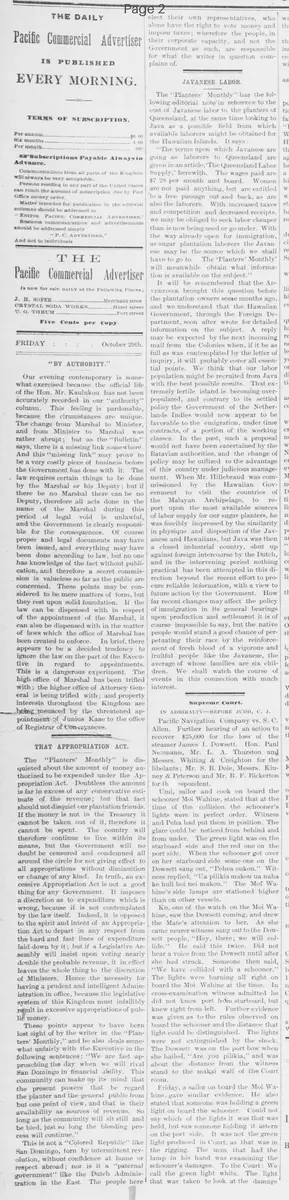
The "Planters' Monthly" is disquieted about the amount of money authorized to be expended under the Appropriation Act. Doubtless the amount is far in excess of any conservative estimate of the revenue; but that fact should not disquiet our plantation friends.
If the money is not in the Treasury it cannot be taken out of it, therefore it cannot be spent. The country will therefore continue to live within its means. but the Government will no doubt be censured and condemned all around the circle for not giving effect to all appropriations without diminution or change of any kind. In truth, an excessive Appropriation Act is not a good thing for any Government. It imposes a discretion as to expenditure which is wrong, because it is not contemplated by the law itself. Indeed, it is opposed to the spirit and intent of an Appropriation Act to depart in any respect from the hard and fast lines of expenditure laid down by it: but if a Legislative Assembly will insist upon voting nearly double the probable revenue. it in effect leaves the whole thing to the discretion of Ministers. Hence the necessity for having a prudent and intelligent Administration in office, because the legislative system of this Kingdom must infallibly result in excessive appropriations of public money.
These points appear to have been lost sight of by the writer in the "Planters' Monthly," and he also deals somewhat unfairly with the Executive in the following sentences: "We are fast approaching the day when we will rival San Domingo in financial ability. This community can make up its mind that the present powers that be regard the planter and the general public from but one point of view, and that is their availability as sources of revenue. So long as the community will sit still and be bled, just so long the bleeding process will continue."
This is not a "Colored Republic" like San Domingo, torn by intermittent revolution, without confidence at home or respect abroad; nor is it a "paternal government" like the Dutch Administration in the East. The people here elect their own representatives, who alone have the right to vote money and impose taxes; wherefore the people, in their corporate capacity, and not the Government as such, are responsible for what the writer in question complains of.
The "Planters' Monthly" is disquieted about the amount of money authorized to be expended under the Appropriation Act. Doubtless the amount is far in excess of any conservative estimate of the revenue; but that fact should not disquiet our plantation friends.
If the money is not in the Treasury it cannot be taken out of it, therefore it cannot be spent. The country will therefore continue to live within its means. but the Government will no doubt be censured and condemned all around the circle for not giving effect to all appropriations without diminution or change of any kind. In truth, an excessive Appropriation Act is not a good thing for any Government. It imposes a discretion as to expenditure which is wrong, because it is not contemplated by the law itself. Indeed, it is opposed to the spirit and intent of an Appropriation Act to depart in any respect from the hard and fast lines of expenditure laid down by it: but if a Legislative Assembly will insist upon voting nearly double the probable revenue. it in effect leaves the whole thing to the discretion of Ministers. Hence the necessity for having a prudent and intelligent Administration in office, because the legislative system of this Kingdom must infallibly result in excessive appropriations of public money.
These points appear to have been lost sight of by the writer in the "Planters' Monthly," and he also deals somewhat unfairly with the Executive in the following sentences: "We are fast approaching the day when we will rival San Domingo in financial ability. This community can make up its mind that the present powers that be regard the planter and the general public from but one point of view, and that is their availability as sources of revenue. So long as the community will sit still and be bled, just so long the bleeding process will continue."
This is not a "Colored Republic" like San Domingo, torn by intermittent revolution, without confidence at home or respect abroad; nor is it a "paternal government" like the Dutch Administration in the East. The people here elect their own representatives, who alone have the right to vote money and impose taxes; wherefore the people, in their corporate capacity, and not the Government as such, are responsible for what the writer in question complains of.
What sub-type of article is it?
Economic Policy
Taxation
What keywords are associated?
Appropriation Act
Government Spending
Fiscal Discretion
Legislative Excess
Planters Monthly
Revenue Policy
What entities or persons were involved?
Planters' Monthly
Government
Legislative Assembly
Ministers
San Domingo
Dutch Administration
Editorial Details
Primary Topic
Defense Of Executive Discretion Under The Appropriation Act
Stance / Tone
Supportive Of Government Administration, Critical Of Planter Critics
Key Figures
Planters' Monthly
Government
Legislative Assembly
Ministers
San Domingo
Dutch Administration
Key Arguments
Excessive Appropriations Exceed Revenue But Cannot Be Spent If Funds Unavailable
Legislature's Over Voting Leaves Expenditure To Ministerial Discretion
Prudent Administration Needed Due To Legislative System's Flaws
Criticism Of Executive Unfair; People Elect Representatives Who Control Appropriations And Taxes
Not Like Unstable San Domingo Or Paternal Dutch Rule; Local Responsibility