Thank you for visiting SNEWPapers!
Sign up free
Foreign News
July 14, 1883
The People's Advocate
Alexandria, Virginia
What is this article about?
Detailed description of Fingal's Cave on the uninhabited island of Staffa in the Hebrides, highlighting its volcanic basalt formations, cavern structure, and scenic beauty with waves and colorful stalactites.
Clipping
OCR Quality
98%
Excellent
Full Text
Fingal's Cave.
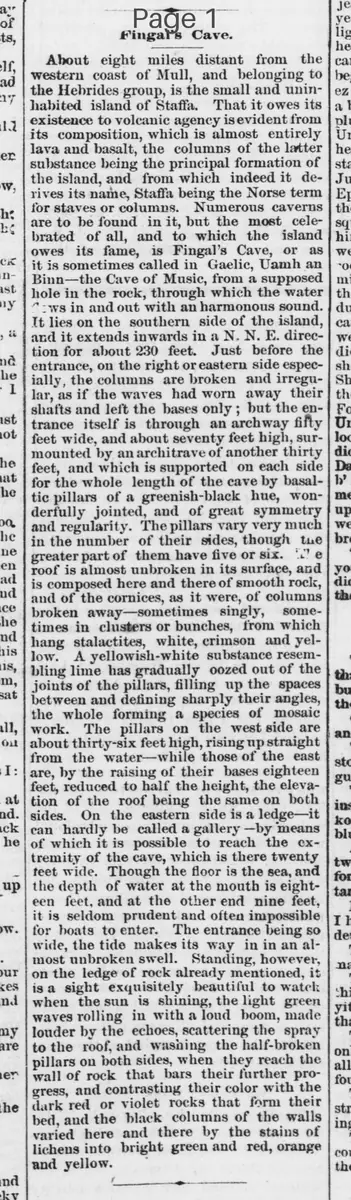
About eight miles distant from the western coast of Mull, and belonging to the Hebrides group, is the small and uninhabited island of Staffa. That it owes its existence to volcanic agency is evident from its composition, which is almost entirely lava and basalt, the columns of the latter substance being the principal formation of the island, and from which indeed it derives its name. Staffa being the Norse term for staves or columns. Numerous caverns are to be found in it, but the most celebrated of all, and to which the island owes its fame, is Fingal's Cave, or as it is sometimes called in Gaelic, Uamh an Binn—the Cave of Music, from a supposed hole in the rock, through which the water flows in and out with a harmonious sound.
It lies on the southern side of the island, and it extends inwards in a N. N. E. direction for about 230 feet. Just before the entrance, on the right or eastern side especially, the columns are broken and irregular, as if the waves had worn away their shafts and left the bases only; but the entrance itself is through an archway fifty feet wide, and about seventy feet high, surmounted by an architrave of another thirty feet, and which is supported on each side for the whole length of the cave by basaltic pillars of a greenish-black hue, wonderfully jointed, and of great symmetry and regularity. The pillars vary very much in the number of their sides, though the greater part of them have five or six. The roof is almost unbroken in its surface, and is composed here and there of smooth rock, and of the cornices, as it were, of columns broken away—sometimes singly, sometimes in clusters or bunches, from which hang stalactites, white, crimson and yellow. A yellowish-white substance resembling lime has gradually oozed out of the joints of the pillars, filling up the spaces between and defining sharply their angles, the whole forming a species of mosaic work. The pillars on the west side are about thirty-six feet high, rising up straight from the water—while those of the east are, by the raising of their bases eighteen feet, reduced to half the height, the elevation of the roof being the same on both sides. On the eastern side is a ledge—it can hardly be called a gallery—by means of which it is possible to reach the extremity of the cave, which is there twenty feet wide. Though the floor is the sea, and the depth of water at the mouth is eighteen feet, and at the other end nine feet, it is seldom prudent and often impossible for boats to enter. The entrance being so wide, the tide makes its way in in an almost unbroken swell. Standing, however, on the ledge of rock already mentioned, it is a sight exquisitely beautiful to watch when the sun is shining, the light green waves rolling in with a loud boom, made louder by the echoes, scattering the spray to the roof, and washing the half-broken pillars on both sides, when they reach the wall of rock that bars their further progress, and contrasting their color with the dark red or violet rocks that form their bed, and the black columns of the walls varied here and there by the stains of lichens into bright green and red, orange and yellow.
About eight miles distant from the western coast of Mull, and belonging to the Hebrides group, is the small and uninhabited island of Staffa. That it owes its existence to volcanic agency is evident from its composition, which is almost entirely lava and basalt, the columns of the latter substance being the principal formation of the island, and from which indeed it derives its name. Staffa being the Norse term for staves or columns. Numerous caverns are to be found in it, but the most celebrated of all, and to which the island owes its fame, is Fingal's Cave, or as it is sometimes called in Gaelic, Uamh an Binn—the Cave of Music, from a supposed hole in the rock, through which the water flows in and out with a harmonious sound.
It lies on the southern side of the island, and it extends inwards in a N. N. E. direction for about 230 feet. Just before the entrance, on the right or eastern side especially, the columns are broken and irregular, as if the waves had worn away their shafts and left the bases only; but the entrance itself is through an archway fifty feet wide, and about seventy feet high, surmounted by an architrave of another thirty feet, and which is supported on each side for the whole length of the cave by basaltic pillars of a greenish-black hue, wonderfully jointed, and of great symmetry and regularity. The pillars vary very much in the number of their sides, though the greater part of them have five or six. The roof is almost unbroken in its surface, and is composed here and there of smooth rock, and of the cornices, as it were, of columns broken away—sometimes singly, sometimes in clusters or bunches, from which hang stalactites, white, crimson and yellow. A yellowish-white substance resembling lime has gradually oozed out of the joints of the pillars, filling up the spaces between and defining sharply their angles, the whole forming a species of mosaic work. The pillars on the west side are about thirty-six feet high, rising up straight from the water—while those of the east are, by the raising of their bases eighteen feet, reduced to half the height, the elevation of the roof being the same on both sides. On the eastern side is a ledge—it can hardly be called a gallery—by means of which it is possible to reach the extremity of the cave, which is there twenty feet wide. Though the floor is the sea, and the depth of water at the mouth is eighteen feet, and at the other end nine feet, it is seldom prudent and often impossible for boats to enter. The entrance being so wide, the tide makes its way in in an almost unbroken swell. Standing, however, on the ledge of rock already mentioned, it is a sight exquisitely beautiful to watch when the sun is shining, the light green waves rolling in with a loud boom, made louder by the echoes, scattering the spray to the roof, and washing the half-broken pillars on both sides, when they reach the wall of rock that bars their further progress, and contrasting their color with the dark red or violet rocks that form their bed, and the black columns of the walls varied here and there by the stains of lichens into bright green and red, orange and yellow.
What sub-type of article is it?
Natural Landmark
Geographical Description
What keywords are associated?
Fingals Cave
Staffa Island
Hebrides
Basalt Columns
Volcanic Formation
Natural Cavern
Scenic Beauty
Where did it happen?
Staffa, Hebrides
Foreign News Details
Primary Location
Staffa, Hebrides
Event Details
Description of Fingal's Cave on Staffa island, its volcanic basalt columns, structure extending 230 feet, entrance archway, pillars, roof, stalactites, and scenic waves entering the sea-floored cave.