Thank you for visiting SNEWPapers!
Sign up free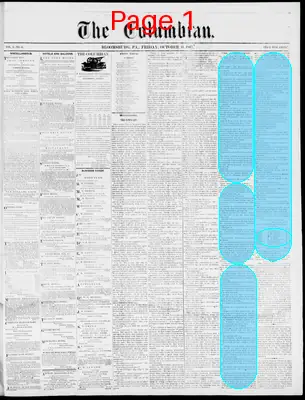
Literary
October 11, 1867
The Columbian
Bloomsburg, Columbia County, Pennsylvania
What is this article about?
Humorous epistle by Corry O'Lan us recounting a chaotic, exaggerated baseball match between the O'Pake club and the Chad club on Capitoline grounds. The O'Pakes win overwhelmingly 82-29 in a satirical narrative blending sports with political allusions and comedic mishaps.
Merged-components note: Humorous literary piece on baseball match continued with score table; sequential reading order and topic coherence indicate merge
Clipping
OCR Quality
70%
Good
Full Text
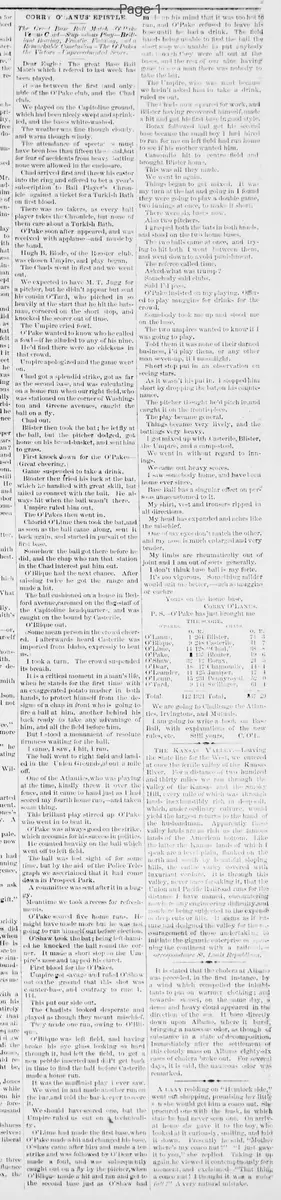
CORRY O' LANUS' EPISTLE
The Great Base Ball Match O'Pake
Vs. Chad—Splendid Play—Brilliant Batting,
Brilliant Fielding, and a
Remarkable Conclusion—The O' Pakes
the Victors—Unprecedented Score.
Dear Eagle: The great Base Ball
Match which I referred to last week has
been played.
It was between the first (and only
nine) of the O'Pake club, and the Chad
club.
We played on the Capitoline ground,
which had been nicely swept and sprinkled,
and the bases white-washed.
The weather was fine though cloudy,
and warm though windy.
The attendance of spectators must
have been less than fifteen thousand, but
for fear of accidents from heavy batting
none were allowed in the enclosure.
Chad arrived first and threw his castor
into the ring and offered to bet a year's
subscription to Ball Player's Chronicle
against a ticket for a Turkish Bath
on first blood.
There was no takers, as every ball
player takes the Chronicle, but none of
them care about a Turkish Bath.
O'Pake soon after appeared, and was
received with applause—and music by
the band.
Hugh B. Blode, of the Rooster club,
was chosen Umpire, and play began.
The Chads went in first and we went
out.
We expected to have M. T. Jugg for
a pitcher, but he didn't appear but sent
his cousin O'Tard, who pitched in so
heavily at the start that he hit the batsman,
cornered on the short stop, and
knocked the scorer out of time.
The Umpire cried fowl.
O'Pake wanted to know who he called
a fowl—if he alluded to any of his nine.
He'd find there were no chickens in
that crowd.
Umpire apologized and the game went
on.
Chad got a splendid strike, got as far
as the second base, and was calculating
on a home run when our right fielder, who
was stationed on the corner of Washington
and Greene avenues, caught the
ball on a fly.
Chad out.
Blister then took the bat; he let fly at
the ball, but the pitcher dodged, got
home on his bread-basket, and sent him
to grass.
First knock down for the O'Pakes—
(Great cheering.)
Bloater then tried his luck at the bat,
which he handled with great skill, but
failed to connect with the ball. He always
hit when the ball wasn't there.
Umpire ruled him out.
The O'Pakes then went in.
Chloride O'Lime then took the bat, and
as soon as the ball came along, sent it
back again, and started in pursuit of the
first base.
Somehow the ball got there before he
did, and the chap who ran that station
in the Chad interest put him out.
O'Blique had the next chance. After
missing twice he got the range and
made a hit.
The ball cushioned on a house in Bedford
avenue, caromed on the flag-staff of
the Capitoline headquarters, and was
caught on the bound by Casteroil.
O'Blique out.
(Some mean person in the crowd cheered.
I afterwards heard Casteroil was
imported from Idaho, expressly to beat
us.)
I took a turn. The crowd suspended
its breath.
It is a critical moment in a man's life,
when he stands for the first time with
an exaggerated potato masher in both
hands, to protect himself from the designs
of a chap in front who is going to
fire a ball at him, another behind his
back ready to take any advantage of
him, and all the field before him.
But I stood a monument of resolute
firmness waiting for the ball.
I came, I saw, I hit, I run.
The ball went to right field and landed
in the Union Grounds, about a mile
off.
One of the Atlantics, who was playing
at the time, kindly threw it over the
fence, and it came to hand just as I had
scored my fourth home run,—and taken
something.
This brilliant play stirred up O'Pake
who went in to beat it.
O'Pake was always good on the strike,
which accounts for his success in politics.
He counted heavily on the ball which
went off to left field.
The ball was lost sight of for some
time, but by the aid of the Police Telegraph
we ascertained that it had come
down in Prospect Park.
A committee was sent after it in a buggy.
Meantime we took a recess for refreshments.
O'Pake scored five home runs. He
might have made more but he was not
going to run himself out before election.
O'Shaw took the bat: being left-handed
he knocked the ball round the corner.
It made a short stop on the Umpire's
nose and tapped his claret.
First blood for the O'Pakes.
Umpire got savage and ruled O'Shaw
out on the ground that this shot was
counter-base, and contrary to rule 1,
section 111.
This put our side out.
The Chadists now scared for work, and
Blister having recovered himself, made
a hit and got his first base in good style.
Borax followed and got his second
base because the small boy I had hired
to run for me on left field had run home
to see if his mother wanted him.
Camomile hit to centre field and
brought Blister home.
This was all they made.
We went in again.
Things began to get mixed. It was
my turn at the bat and going in I found
they were going to play a double game,
two innings at once, to make it short.
There were six bases now.
Also two pitchers.
I grasped both the bats in both hands,
and stood on the two home bases.
The two balls came at once, and trying
to hit both I went between them,
and went down to avoid punishment.
The referee called time.
Asked—what was trump?
Somebody said clubs.
Said I'd play.
O'Pake insisted on my playing. Offered
to play muggins for drinks for the
crowd.
Somebody took me up and stood me
on the base.
The two umpires wanted to know if I
was going to play.
Told them it was none of their darned
business, I'd play them, or any other
man seven-up, till I moonlight.
Short stop put in an observation on
seeing stars.
As it wasn't his put in, I stopped him
short by dropping the bat on his countenance.
The pitcher thought he'd pitch in, and
caught it on the frontispiece.
The play became general.
Things became very lively, and the
battings very heavy:
I got mixed up with Casteroil, Blister,
the Umpire, and a camp-stool.
We went in without regard to innings.
We came out heavy scorers.
I saw somebody home, and have been
home ever since.
Base Ball has a singular effect on persons
unaccustomed to it.
My shirt, vest and trousers ripped in
all directions.
My head has expanded and aches like
the mischief.
One of my eyes don't match the other.
and my nose is much enlarged and very
tender.
My limbs are rheumaticky out of
joint and I am out of sorts—generally.
I don't think by far it is my forte.
It's too vigorous. Something milder
would suit me better,—such as muggins
or euchre
Yours on the limp,
CORRY O'LANUS.
P. S.—O'Pake has just brought me
THE SCORE
Total.
O'Pakes 82 Total,
Chads 17 29
We are going to challenge the Atlantics,
Irvingtons, and Mutuals.
I am going to write a book on Base
Ball, with explanations of the new
rules, etc.
Still yours,
C. O'L.
The Great Base Ball Match O'Pake
Vs. Chad—Splendid Play—Brilliant Batting,
Brilliant Fielding, and a
Remarkable Conclusion—The O' Pakes
the Victors—Unprecedented Score.
Dear Eagle: The great Base Ball
Match which I referred to last week has
been played.
It was between the first (and only
nine) of the O'Pake club, and the Chad
club.
We played on the Capitoline ground,
which had been nicely swept and sprinkled,
and the bases white-washed.
The weather was fine though cloudy,
and warm though windy.
The attendance of spectators must
have been less than fifteen thousand, but
for fear of accidents from heavy batting
none were allowed in the enclosure.
Chad arrived first and threw his castor
into the ring and offered to bet a year's
subscription to Ball Player's Chronicle
against a ticket for a Turkish Bath
on first blood.
There was no takers, as every ball
player takes the Chronicle, but none of
them care about a Turkish Bath.
O'Pake soon after appeared, and was
received with applause—and music by
the band.
Hugh B. Blode, of the Rooster club,
was chosen Umpire, and play began.
The Chads went in first and we went
out.
We expected to have M. T. Jugg for
a pitcher, but he didn't appear but sent
his cousin O'Tard, who pitched in so
heavily at the start that he hit the batsman,
cornered on the short stop, and
knocked the scorer out of time.
The Umpire cried fowl.
O'Pake wanted to know who he called
a fowl—if he alluded to any of his nine.
He'd find there were no chickens in
that crowd.
Umpire apologized and the game went
on.
Chad got a splendid strike, got as far
as the second base, and was calculating
on a home run when our right fielder, who
was stationed on the corner of Washington
and Greene avenues, caught the
ball on a fly.
Chad out.
Blister then took the bat; he let fly at
the ball, but the pitcher dodged, got
home on his bread-basket, and sent him
to grass.
First knock down for the O'Pakes—
(Great cheering.)
Bloater then tried his luck at the bat,
which he handled with great skill, but
failed to connect with the ball. He always
hit when the ball wasn't there.
Umpire ruled him out.
The O'Pakes then went in.
Chloride O'Lime then took the bat, and
as soon as the ball came along, sent it
back again, and started in pursuit of the
first base.
Somehow the ball got there before he
did, and the chap who ran that station
in the Chad interest put him out.
O'Blique had the next chance. After
missing twice he got the range and
made a hit.
The ball cushioned on a house in Bedford
avenue, caromed on the flag-staff of
the Capitoline headquarters, and was
caught on the bound by Casteroil.
O'Blique out.
(Some mean person in the crowd cheered.
I afterwards heard Casteroil was
imported from Idaho, expressly to beat
us.)
I took a turn. The crowd suspended
its breath.
It is a critical moment in a man's life,
when he stands for the first time with
an exaggerated potato masher in both
hands, to protect himself from the designs
of a chap in front who is going to
fire a ball at him, another behind his
back ready to take any advantage of
him, and all the field before him.
But I stood a monument of resolute
firmness waiting for the ball.
I came, I saw, I hit, I run.
The ball went to right field and landed
in the Union Grounds, about a mile
off.
One of the Atlantics, who was playing
at the time, kindly threw it over the
fence, and it came to hand just as I had
scored my fourth home run,—and taken
something.
This brilliant play stirred up O'Pake
who went in to beat it.
O'Pake was always good on the strike,
which accounts for his success in politics.
He counted heavily on the ball which
went off to left field.
The ball was lost sight of for some
time, but by the aid of the Police Telegraph
we ascertained that it had come
down in Prospect Park.
A committee was sent after it in a buggy.
Meantime we took a recess for refreshments.
O'Pake scored five home runs. He
might have made more but he was not
going to run himself out before election.
O'Shaw took the bat: being left-handed
he knocked the ball round the corner.
It made a short stop on the Umpire's
nose and tapped his claret.
First blood for the O'Pakes.
Umpire got savage and ruled O'Shaw
out on the ground that this shot was
counter-base, and contrary to rule 1,
section 111.
This put our side out.
The Chadists now scared for work, and
Blister having recovered himself, made
a hit and got his first base in good style.
Borax followed and got his second
base because the small boy I had hired
to run for me on left field had run home
to see if his mother wanted him.
Camomile hit to centre field and
brought Blister home.
This was all they made.
We went in again.
Things began to get mixed. It was
my turn at the bat and going in I found
they were going to play a double game,
two innings at once, to make it short.
There were six bases now.
Also two pitchers.
I grasped both the bats in both hands,
and stood on the two home bases.
The two balls came at once, and trying
to hit both I went between them,
and went down to avoid punishment.
The referee called time.
Asked—what was trump?
Somebody said clubs.
Said I'd play.
O'Pake insisted on my playing. Offered
to play muggins for drinks for the
crowd.
Somebody took me up and stood me
on the base.
The two umpires wanted to know if I
was going to play.
Told them it was none of their darned
business, I'd play them, or any other
man seven-up, till I moonlight.
Short stop put in an observation on
seeing stars.
As it wasn't his put in, I stopped him
short by dropping the bat on his countenance.
The pitcher thought he'd pitch in, and
caught it on the frontispiece.
The play became general.
Things became very lively, and the
battings very heavy:
I got mixed up with Casteroil, Blister,
the Umpire, and a camp-stool.
We went in without regard to innings.
We came out heavy scorers.
I saw somebody home, and have been
home ever since.
Base Ball has a singular effect on persons
unaccustomed to it.
My shirt, vest and trousers ripped in
all directions.
My head has expanded and aches like
the mischief.
One of my eyes don't match the other.
and my nose is much enlarged and very
tender.
My limbs are rheumaticky out of
joint and I am out of sorts—generally.
I don't think by far it is my forte.
It's too vigorous. Something milder
would suit me better,—such as muggins
or euchre
Yours on the limp,
CORRY O'LANUS.
P. S.—O'Pake has just brought me
THE SCORE
Total.
O'Pakes 82 Total,
Chads 17 29
We are going to challenge the Atlantics,
Irvingtons, and Mutuals.
I am going to write a book on Base
Ball, with explanations of the new
rules, etc.
Still yours,
C. O'L.
| O. R. | O. T. | |
| O'Lanus, | 1 264 Blister, | 74 3 |
| O'Blique, | 9 248 Casterile, | 41 7 |
| O'Lime, | 14 128 "Chad," | 88 8 |
| O'Pake, | 8 155 Bloater, | 39 6 |
| O'Shaw, | 32 12 Borax, | 21 5 |
| O'Dear, | 18 17 Chamomile, | 14 1 |
| O'Leander, | 11 125 Juniper, | 17 4 |
| O'Leum, | 15 281 Pennyroyal, | 52 0 |
| O'Tard, | 9 141 8Swillager, | 64 4 |
What sub-type of article is it?
Epistolary
Satire
Prose Fiction
What themes does it cover?
Political
Social Manners
What keywords are associated?
Baseball Match
Satirical Epistle
O'pake Club
Chad Club
Political Satire
Humorous Narrative
Capitoline Grounds
Unprecedented Score
What entities or persons were involved?
Corry O'lan Us
Literary Details
Title
Corry O' Lanus' Epistle
Author
Corry O'lan Us
Subject
The Great Base Ball Match O'pake Vs. Chad
Key Lines
I Came, I Saw, I Hit, I Run.
O'pake Was Always Good On The Strike, Which Accounts For His Success In Politics.
Base Ball Has A Singular Effect On Persons Unaccustomed To It.
My Limbs Are Rheumaticky Out Of Joint And I Am Out Of Sorts—Generally.
I Don't Think By Far It Is My Forte. It's Too Vigorous. Something Milder Would Suit Me Better,—Such As Muggins Or Euchre