Thank you for visiting SNEWPapers!
Sign up free
Story
July 16, 1947
The Northwest Enterprise
Seattle, King County, Washington
What is this article about?
Ebony magazine's August feature reveals Negro GI veterans are better loan risks than whites, with lower default rates on VA loans despite facing stricter approval barriers, particularly in the South.
Clipping
OCR Quality
85%
Good
Full Text
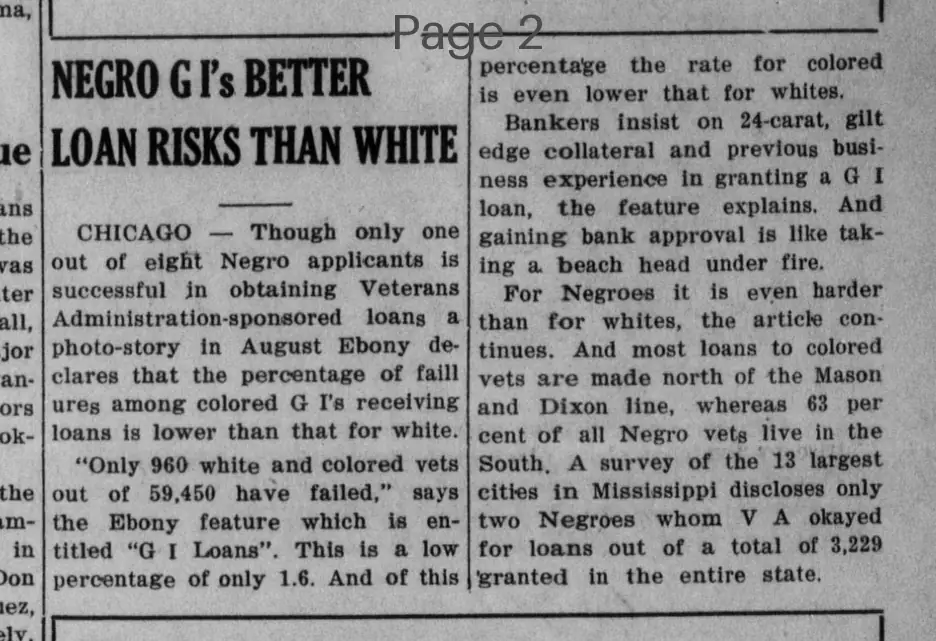
NEGRO GI'S BETTER
LOAN RISKS THAN WHITE
CHICAGO - Though only one
out of eight Negro applicants is
successful in obtaining Veterans
Administration-sponsored loans a
photo-story in August Ebony de-
clares that the percentage of fail-
ures among colored GI's receiving
loans is lower than that for white.
"Only 960 white and colored vets
out of 59,450 have failed," says
the Ebony feature which is en-
titled "GI Loans". This is a low
percentage of only 1.6. And of this
percentage the rate for colored
is even lower that for whites.
Bankers insist on 24-carat, gilt
edge collateral and previous busi-
ness experience in granting a GI
loan, the feature explains. And
gaining bank approval is like tak-
ing a beach head under fire.
For Negroes it is even harder
than for whites, the article con-
tinues. And most loans to colored
vets are made north of the Mason
and Dixon line, whereas 63 per
cent of all Negro vets live in the
South. A survey of the 13 largest
cities in Mississippi discloses only
two Negroes whom VA okayed
for loans out of a total of 3.229
granted in the entire state.
LOAN RISKS THAN WHITE
CHICAGO - Though only one
out of eight Negro applicants is
successful in obtaining Veterans
Administration-sponsored loans a
photo-story in August Ebony de-
clares that the percentage of fail-
ures among colored GI's receiving
loans is lower than that for white.
"Only 960 white and colored vets
out of 59,450 have failed," says
the Ebony feature which is en-
titled "GI Loans". This is a low
percentage of only 1.6. And of this
percentage the rate for colored
is even lower that for whites.
Bankers insist on 24-carat, gilt
edge collateral and previous busi-
ness experience in granting a GI
loan, the feature explains. And
gaining bank approval is like tak-
ing a beach head under fire.
For Negroes it is even harder
than for whites, the article con-
tinues. And most loans to colored
vets are made north of the Mason
and Dixon line, whereas 63 per
cent of all Negro vets live in the
South. A survey of the 13 largest
cities in Mississippi discloses only
two Negroes whom VA okayed
for loans out of a total of 3.229
granted in the entire state.
What sub-type of article is it?
Curiosity
What themes does it cover?
Social Manners
Justice
What keywords are associated?
Veterans Loans
Racial Disparity
Loan Failures
Ebony Magazine
Va Loans
Where did it happen?
Chicago
Story Details
Location
Chicago
Story Details
Ebony magazine reports that Negro GI veterans have a lower failure rate on VA-sponsored loans (1.6% overall, even lower for colored) than white veterans, despite only 1 in 8 Negro applicants succeeding and greater barriers, especially in the South where most live.