Thank you for visiting SNEWPapers!
Sign up free
National Republican (Washington City
Washington, District Of Columbia
What is this article about?
In Albany, NY, on June 13, Assemblyman Bradley testifies before a committee that Senator Sessions offered him $2,000 to switch his vote from Conkling and Platt to Depew in the U.S. senatorial election, amid bribery allegations against anti-Stalwart forces.
Merged-components note: These two components form a continuous narrative on the bribery investigation, with the first covering the morning session ending in a recess and the second resuming with the afternoon session.
Clipping
OCR Quality
Full Text
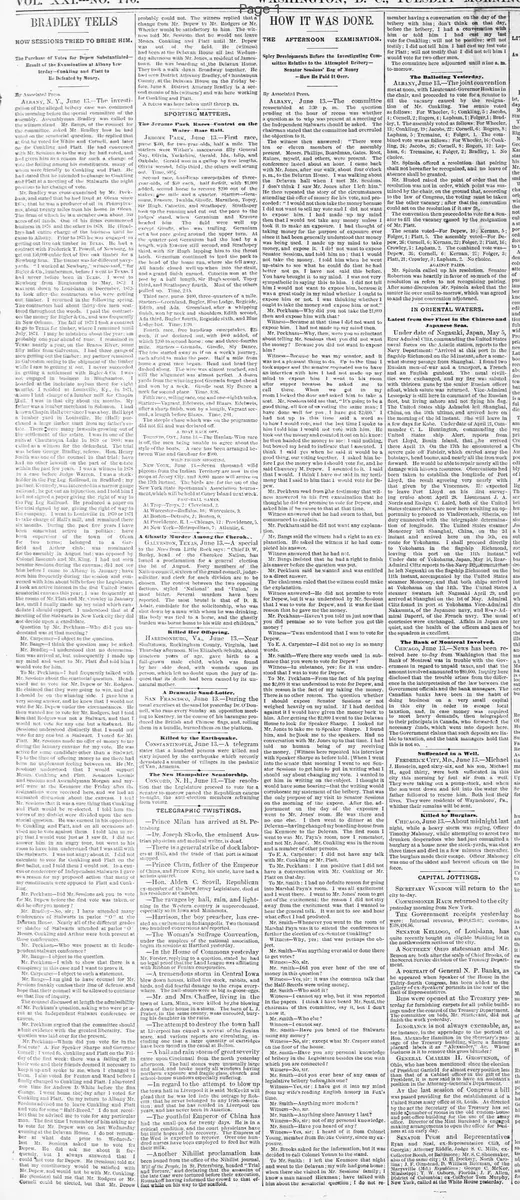
HOW SESSIONS TRIED TO BRIBE HIM.
The Purchase of Votes for Depew Substantiated—
Result of the Examination at Albany Yesterday—
Conkling and Platt to
Be Defeated by Money.
By Associated Press.
ALBANY, N. Y., June 13.—The investigation of the alleged bribery case was continued this morning before the special committee of the assembly. Assemblyman Bradley was called to the witness stand. Mr. Bangs, of the counsel for the committee, asked Mr. Bradley how he had voted on the senatorial question. He replied that at first he voted for White and Cornell, and later on for Conkling and Platt. He had conversed with Mr. Sessions as to the way he had voted, and had given him as a reason for such a change of vote the feeling among his constituents, many of whom were friendly to Conkling and Platt. He had stated that he intended to change to Conkling and Platt at a meeting of the Stalwarts the night previous to his change of vote.
Mr. Bradley was cross-examined by Mr. Peckham, and stated that he had lived at Olean since 1875, that he was a producer of oil in Pennsylvania, about twenty miles from his home in Olean. The firms of which he is a member own about 160 acres of oil lands. One of his firms commenced business in 1876 and the other in 1878. He (Bradley) had entire charge of the business until he came to Albany. Prior to 1875 he was engaged in getting out live oak timber in Texas. He had a contract with Frederick T. Powell, of Newburg, to get out 150,000 cubic feet of live oak timber for a Newburg firm. The timber was for different navy-yards. "I worked at Newburg," witness said, "for Bigler & Co., lumbermen, before I went to Texas. I had never before been in Texas. I went to Newburg from Binghamton in May, 1872. I was sent down to Louisiana in December, 1872, to look after the contractors who were getting out timber. I returned in the following spring. The contractors had about thirty-five men scattered throughout the woods. I paid the contractors the money for Bigler & Co., and was frequently in New Orleans. The fall of 1873 I took a contract to go to Texas for timber, where I remained until July, 1874. I may be mistaken about the year; am probably one year ahead of time. I remained in Texas nearly a year, on the Brazos River, some fifty miles from Galveston. I had three gangs of men getting out the timber; my partner remained in Galveston seeing to the shipment of the timber while I saw to getting it out. I never succeeded in getting a settlement with Bigler & Co. I was not engaged in business in Binghamton. I boarded at the inebriate asylum there for eight months. I resided at Louisville, Ky., in 1871, where I had charge of a lumber mill for Chapin & Hall. I was in that city about six months. My father was a lumber merchant in Solomon. I had known Chapin & Hall ever since I was a boy. Hall kept a lumber yard in Louisville. He (Hall) purchased a large timber tract from my father's estate. There were many lawsuits growing out of the settlement of the estate. I was in one of the suits at Chautauqua Lake in 1879 or 1880; was called as a witness for the defendant. The trial was before George Bradley, referee. Hon. Henry Smith was one of the counsel in that trial; have had no other lawsuit on the part of the estate within the past few years. I was a witness in 1878 in a case before Judge Warren. I was a stockholder in the Peg Leg Railroad, in Bradford; my partner, Kennedy, was interested in a narrow gauge railroad; he got out an injunction, and I told him I had not signed a paper giving the right of way to the Peg Leg Railroad. He produced a paper on the trial signed by me, giving the right of way to the company. I went to Louisville in 1870 or 1871 to take charge of Hall's mill, and remained there six months. During the past five years I have been somewhat active in politics; have been supervisor of the town of Olean for two terms; belonged to a Garfield and Arthur club; was nominated for the assembly in August last; was opposed by Colonel Bascomb and Mr. King. I had not seen Senator Sessions during the canvass; did not see him before I came to Albany in January; have seen him frequently during the session and conversed with him about bills before the Legislature. I took an active interest in the first United States senatorial canvass this year; I was frequently at the rooms of Mr. Platt and Mr. Crowley in January last, until I finally made up my mind which candidate I should support. I understood that at a meeting of the Stalwarts in New York city they did not decide upon a candidate.
Question by Mr. Peckham—Who did you understand was at that meeting?
Mr. Carpenter—I object to the question.
Mr. Bangs—I think the question may be asked.
Mr. Bradley—I understood that no determination was arrived at, but subsequently I made up my mind and went to Mr. Platt and told him I would vote for him.
To Mr. Peckham—I had frequently talked with Mr. Sessions about the senatorial question. He advised me to vote for Mr. Depew or Mr. Rodgers. He claimed that they were going to win, and that I should be on the winning side. I gave him a very strong answer, and he knew that I would not vote for Mr. Depew under the circumstances. He then wanted me to vote for Mr. Rodgers, but I told him that Rodgers was not a Stalwart, and that I would not vote for any one but a Stalwart. He (Sessions) understood distinctly that I would not vote for any one but a Stalwart. I voted for Mr. Platt. Mr. Sessions made no offer of money to me during the January canvass for my vote. He was active for some candidate other than a Stalwart. Up to the time of offering money to me there had been no unpleasant feeling between us. He (Mr. Sessions) understood that I would support Messrs. Conkling and Platt. Senators Loomis and Sessions and Assemblyman Morgan and myself were at the Kenmore the Friday after the resignations were received here, and we had an animated discussion about the canvass. I told Mr. Sessions that it was a sure thing that Conkling and Platt would be re-elected. I told him the voters of my district were divided upon the senatorial question. He was earnest in his opposition to Conkling and Platt, and on all occasions advised me to vote against them. I told him in reply that I would vote just as I saw fit. I did not answer him in an angry tone, but went to his room to have him understand that I was still with the Stalwarts. I was not angry about it. I did not calculate to vote for Conkling and Platt on the first ballot, and I told them I would not. In a caucus or conference of Independent Stalwarts I gave as a reason for my proposed action that many of my constituents were opposed to Platt and Conkling.
Mr. Peckham—Did Mr. Sessions ask you to vote for Mr. Depew before the first vote was taken, or did he offer you money?
Mr. Bradley—No, sir; I have attended many conferences of Stalwarts in parlor "O" at the Delavan House. Nearly all of the different grades or shades of Stalwarts attended at parlor "O." Messrs. Conkling and Arthur were both present at these conferences.
Mr. Peckham—Who was present at the Independent Stalwart conference?
Mr. Bangs—I object to the question.
Mr. Peckham—I wish to show that there is a conspiracy in this case and I want to prove it.
Mr. Carpenter—I object to such a statement.
Mr. Bangs—I am glad to have counsel for Mr. Sessions frankly confess their line of defense, and hope that their counsel will be allowed to continue on that line of inquiry.
The counsel discussed at length the admissibility of Mr. Peckham's question, asking who were present at the Independent Stalwart conference or caucus.
Mr. Peckham argued that the committee should admit evidence with the greatest liberality. The question was laid over for the present.
Mr. Peckham—Whom did you vote for in the first vote? A. For Speaker Sharpe and Governor Cornell; I voted for Conkling and Platt on the Friday of the first week; there was a falling off in their vote and their friends deemed it necessary to keep it up and spoke to me, when I changed to them. I also voted for Fenton and Ward before I finally changed to Conkling and Platt. I also voted one time for Andrew D. White before the final change. I went home the day after I voted for Conkling and Platt. On my return to Albany Mr. Sessions advised me to leave Conkling and Platt and vote for some "Half-Breed." I do not recollect that he advised me to vote for any particular man. The first time I remember of him asking me to vote for Mr. Depew was on last Wednesday evening at the Delavan House. I do not remember at what date prior to Wednesday last Mr. Sessions asked me to vote for Depew. He did ask me about it frequently, but I always answered that I could not vote for Depew. He (Sessions) told me that my constituency would be satisfied with Mr. Depew, and would not be with Mr. Conkling. He (Sessions) told me that Mr. Rodgers or Mr. Cornell could be elected, but that Mr. Depew probably could not. The witness replied that a change from Mr. Depew to Mr. Rodgers or Mr. Wheeler would be satisfactory to him. The witness told Mr. Sessions that he would not leave Messrs. Conkling and Platt until Mr. Depew was out of the field. He (witness) had been at the Delavan House all last Wednesday afternoon with Mr. Jones, a resident of Jamestown. He was boarding at the Delavan House. They took a walk down Broadway together. He had seen District Attorney Bradley, of Chautauqua County, at the Delavan House on the Friday before, June 3. District Attorney Bradley is a second cousin of his (witness') and was here working for Conkling and Platt.
A recess was here taken until three p. m.
HOW IT WAS DONE
THE
AFTERNOON
EXAMINATION.
Spicy Developments Before the Investigating Committee Relative to the Attempted Bribery—
Senator Sessions' Bag of Money
—How He Paid It Over.
By Associated Press.
ALBANY,
June 13.—The
committee
reassembled
at 3:30
p.
m.
The question
pending at the hour of recess was whether
a question as to who was present at a meeting of
the Independent Stalwarts should be asked. The
chairman stated that the committee had overruled
the objection to it.
The witness then answered:
"There were
ten
or eleven members of the assembly
present. Messrs. Phillips, Boardman, Gates, Root,
Raines, myself, and others were present. The
conference lasted about an hour. I came back
with Mr. Jones, after our walk, about four o'clock
p. m., to the Delavan House. I was walking about
the Delavan hall when I met Mr. Sessions.
I don't think I saw Mr. Jones after I left him."
He then repeated the story of the circumstances attending the offer of money for his vote, and proceeded: "I would not then take the money because I did not want to sell my vote and I did not want to expose him. I had made up my mind then that I would not take any money unless I took it to make an exposure. I had thought of taking money for the purpose of exposure ever since it had been generally understood that money was being used. I made up my mind to take money and expose it. I did not want to expose Senator Sessions, and told him no; that I would not take the money. I told him when he went up-stairs to see what he could do that he had better not go. I have not said this before. You have brought it to my mind. I was not very sympathetic in saying this to him. I did not tell him I would not want to expose him, because it was a great study in my mind whether I ought to expose him or not. I was thinking whether I ought to take the money and expose him or not."
Mr. Peckham—Why did you not take the $1,000 then and expose him with that?
Witness—Because at that time I did not want to expose him. I had not made up my mind then.
Mr. Peckham—Why, then, were you so reluctant about telling Mr. Sessions that you did not want the money? Because you did not want to expose him?
Witness—Because he was my senator, and it was not a pleasant thing to do. Up to the time I took supper and the senator requested me to have an interview with him I had not made up my
mind to expose
him
went to his room
after
supper
because
he asked
me
to
call
there.
When
we
got
in
my
room I locked the door and asked him to take a seat. Mr. Sessions told me that, "It's going to be a good thing, all five of us voting the same man; I have done well for you, I have got $2,000." I had not up to this time said a word as to how I would vote, and the last time I spoke to him I told him I would not vote with him. He took out the money and counted it out on his knee; he then handed the money to me; I said nothing, but bowed my head to indicate that I accepted. I think I said yes when he said it would be a good thing, our voting together. I asked him before I got the money who I should vote for, and he said Chauncey M. Depew. I assented to it. I said that I would. I think I have not said in my testimony that I said to him that I would vote for Depew.
Mr. Peckham read from the testimony that witness answered in his first examination that he thought he did not promise to vote for Depew, and asked him if he swore to that at that time.
Witness answered that he had sworn to that, but commenced to explain.
Mr. Peckham said he did not want any explanation.
Mr. Bangs said the witness had a right to an explanation. He asked the witness if he had completed his answer.
Witness answered that he had not.
Mr. Bangs insisted that he had a right to finish his answer before the question was put.
Mr. Peckham said he wanted and was entitled to a direct answer.
The chairman ruled that the witness could make the explanation.
Witness answered—He did not promise to vote for Depew, but it was understood by Mr. Sessions that I was to vote for Depew, and it was for that reason that he gave me the money.
Mr. Peckham—Haven't you told us just now that you did promise so to vote before you got the money?
Witness—'Twas understood that I was to vote for Depew.
To E. A. Carpenter—I did not so say in so many words.
Mr. Smith—Were there any words used in substance that you were to vote for Depew?
Witness—In substance, yes; for it was understood that I was to vote for Depew.
To Mr. Peckham—From the fact of his paying me $2,000 it was understood to vote for Depew, and this reason is the fact of my taking the money. There is no other reason. The question whether I should expose Senator Sessions or not weighed heavily on my mind. If I had decided against it I would have given the money back to him. After getting the $2,000 I went to the Delavan House to look for Speaker Sharpe. I looked for Mr. Jones to take me to Speaker Sharpe. I found him, and he took me to the speaker. Had no conversation with Mr. Jones up to that time. I had told no human being of my receiving the money. [Witness here repeated his interview with Speaker Sharpe as before told.] When I went into the senate that morning I went to see Senator Sessions to get him to put in writing what I should say about changing my vote. I wanted to get him in writing on the subject. I thought it would have some bearing—that the writing would corroborate my statement of the bribery. That was the only purpose of my visit to Senator Sessions on the morning of the expose. After the adjournment on the day of the exposure I went to Mr. Jones' room. He was there and no one else. I then went to dinner at the Delavan—having changed my boarding-house from the Kenmore to the Delavan. The first room I went to was Mr. Payn's room, now I remember, and not Mr. Jones'. Mr. Conkling was in the room and a number of other persons.
To E. A. Carpenter: I did not have any talk with Mr. Conkling or Mr. Platt.
To Mr. Peckham: I am positive that I did not have a conversation with Mr. Conkling or Mr. Platt on that day.
To Mr. Smith: I had no definite reason for going into Marshal Payn's room. I was all excitement and I went there. I went to Mr. Jones' room to get out of the excitement; the reason I did not stay away from the excitement was that I wanted to hear the general talk. It was not to see and hear what effect I had produced.
Mr. Smith—Whenever you went to the room of Marshal Payn was it to attend the conferences to further the election of ex-Senator Conkling?
Witness—Why, yes; that was perhaps the object.
Mr. Smith—Was anything ever said or done there to get votes?
Witness—No, sir.
Mr. Smith—Did you ever hear of the use of money in this question?
Witness—Yes, sir; it was the common talk that the Half-Breeds were using money.
Mr. Smith—Who said it?
Witness—I cannot say who, but it was reported in the papers. I think I have heard Mr. Scott, the chairman of this committee, say it, but I don't know it.
Mr. Smith—Who else?
Witness—I cannot say.
Mr. Smith—Have you heard of the Stalwarts using any money?
Witness—No, sir; except what Mr. Crapser stated on the floor of the house.
Mr. Smith—Have you any personal knowledge of bribery in the Legislature besides the one with which you are connected?
Witness—No, sir.
Mr. Smith—Did you ever hear of any cases of legislative bribery before this one?
Witness—Yes, sir; I have got it into my mind from my wife's reading English history in Fox's time.
Mr. Smith—Anything more modern?
Witness—No, sir.
Mr. Smith—Anything since January 1 last?
Witness—No, sir; not of my personal knowledge.
Mr. Smith—Have you heard of any?
Witness—Yes, sir; I heard of it from Colonel Young, member from Brooke County, since my exposure.
Mr. Brooks asked for the information, but it was decided to call Colonel Young to the stand.
To Mr. Smith: I left the Kenmore that night and went to the Delavan; my wife had gone home; when there she visited in Mr. Sessions' family; know a man named Hickman; have talked with him about the senatorial question; I do not remember having a conversation on the day of the bribery with him; don't think on that day. Before the bribery I had a conversation with him or told him I had cast my last vote for Conkling; will not be positive; will not testify; I did not tell him I had cast my last vote for Platt; will not testify that I did not tell him I would vote for two other men.
The committee here adjourned until nine a. m. to-morrow.
What sub-type of article is it?
What themes does it cover?
What keywords are associated?
What entities or persons were involved?
Where did it happen?
Story Details
Key Persons
Location
Albany, N. Y.
Event Date
June 13
Story Details
Assemblyman Bradley testifies that Senator Sessions offered him $2,000 to change his vote from Conkling and Platt to Depew during the U.S. senatorial election, intending to expose the bribery; detailed cross-examination covers Bradley's background and political interactions.