Thank you for visiting SNEWPapers!
Sign up free
Litchfield Enquirer
Litchfield, Litchfield County, Connecticut
What is this article about?
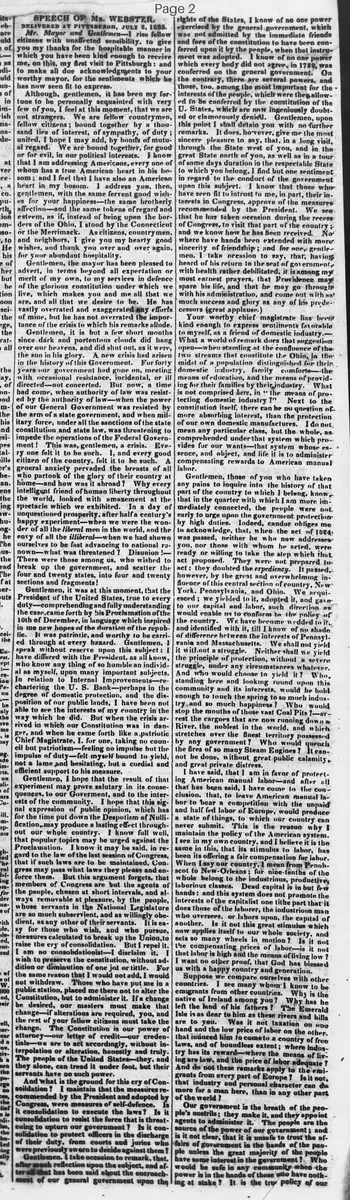
Daniel Webster's speech in Pittsburgh on July 8, 1833, expresses gratitude to hosts, defends the U.S. Constitution against nullification, praises President Jackson's proclamation, advocates protective tariffs for domestic industry, supports internal improvements like canals and roads, and emphasizes the importance of education.
Merged-components note: Continuation of Mr. Webster's speech across pages 2 and 3; the page 3 portion was incorrectly labeled as 'story' but is part of the same political opinion piece, so relabeled to 'editorial'.
Clippings
1 of 2
OCR Quality
Full Text
DELIVERED AT PITTSBURGH, JULY 8, 1833.
Mr. Mayor and Gentlemen—I rise, fellow citizens, with unaffected sensibility, to give you my thanks for the hospitable manner in which you have been kind enough to receive me, on this, my first visit to Pittsburgh: and to make all due acknowledgments to your worthy mayor, for the sentiments which he has now seen fit to express.
Although, gentlemen, it has been my fortune to be personally acquainted with very few of you, I feel at this moment, that we are not strangers. We are fellow countrymen, fellow citizens; bound together by a thousand ties of interest, of sympathy, of duty; united, I hope I may add, by bonds of mutual regard. We are bound together, for good or evil, in our political interests. I know that I am addressing Americans, every one of whom has a true American heart in his bosom; and I feel that I have also an American heart in my bosom. I address you, then, gentlemen, with the same fervent good wishes for your happiness—the same brotherly affection—and the same tokens of regard and esteem, as if, instead of being upon the borders of the Ohio, I stood by the Connecticut or the Merrimack. As citizens, countrymen, and neighbors, I give you my hearty good wishes, and thank you over and over again, for your abundant hospitality.
Gentlemen, the mayor has been pleased to advert, in terms beyond all expectation or merit of my own, to my services in defence of the glorious constitution under which we live, which makes you and me all that we are, and all that we desire to be. He has vastly overrated and exaggerated any efforts of mine, but he has not overrated the importance of the crisis to which his remarks allude.
Gentlemen, it is but a few short months since dark and portentous clouds did hang over our heavens, and did shut out, as it were, the sun in his glory. A new crisis had arisen in the history of this Government. For forty years our government had gone on, meeting with occasional resistance, incidental, or ill directed—not concerted. But now, a time had come, when authority of law was resisted by the authority of law—when the power of our General Government was resisted by the arm of a state government, and when military force, under all the sanctions of the state constitution and state law, was threatening to impede the operations of the Federal Government! This was, gentlemen, a crisis: Every one felt it to be such. I, and every good citizen of the country, felt it to be such. A general anxiety pervaded the breasts of all who partook of the glory of their country at home—and how was it abroad? Why every intelligent friend of human liberty throughout the world, looked with amazement at the spectacle which we exhibited. In a day of unquestioned prosperity, after half a century's happy experiment—when we were the wonder of all the liberal men in the world, and the envy of all the illiberal—when we had shown ourselves to be fast advancing to national renown—what was threatened? Disunion! There were those among us, who wished to break up the government, and scatter the four and twenty states, into four and twenty sections and fragments!
Gentlemen, it was at this moment, that the President of the United States, true to every duty—comprehending and fully understanding the case, came forth by his Proclamation of the 10th of December, in language which inspired in me new hopes of the duration of the republic. It was patriotic, and worthy to be carried through at every hazard. Gentlemen, I speak without reserve upon this subject: I have differed with the President, as all know, who know any thing of so humble an individual as myself, upon many important subjects. In relation to Internal Improvements—re-chartering the U. S. Bank—perhaps in the degree of domestic protection. and the disposition of our public lands, I have been not able to see the interests of my country in the way which he did. But when the crisis arrived in which our Constitution was in danger, and when he came forth like a patriotic Chief Magistrate, I, for one, taking no counsel but patriotism—feeling no impulse but the impulse of duty—felt myself bound to yield, not a lame and hesitating, but a cordial and efficient support to his measure.
Gentlemen, I hope that the result of that experiment may prove salutary in its consequences, to our Government, and to the interests of the community. I hope that this signal expression of public opinion, which has for the time put down the Despotism of Nullification, may produce a lasting effect throughout our whole country. I know full well, that popular topics may be urged against the Proclamation. I know it may be said, in regard to the law of the last session of Congress, that if such laws are to be maintained, Congress may pass what laws they please and enforce them. But this argument forgets, that members of Congress are but the agents of the people, chosen at short intervals, and always removable at pleasure, by the people, whose servants in the National Legislature are so much subservient, and as willingly obedient, as any other of their servants. It is easy for those who wish, and who pursue, measures calculated to break up the Union, to raise the cry of consolidation. But I repel it. I am no consolidationist—I disclaim it. I wish to preserve the constitution, without addition or diminution of one jot or tittle. For the same reason that I would not add, I would not withdraw. Those who have put me in a public station, placed me there not to alter the Constitution, but to administer it. If a change be desired, our masters must make that change—if alterations are required, you, and the rest of your fellow citizens must take the change. The Constitution is our power of attorney—our letter of credit—our credentials—we are to act accordingly, without interpolation or alteration, honestly and truly. The people of the United States—they, and they alone, can tread it under foot, but their servants have no such power.
And what is the ground for this cry of Consolidation? I maintain that the measures recommended by the President and adopted by Congress, were measures of self-defence. Is it consolidation to execute the laws? Is it consolidation to resist the force that is threatening to upturn our government? Is it consolidation to protect officers in the discharge of their duty from courts and juries who were previously sworn to decide against them?
Gentlemen, I take occasion to remark, that, after much reflection upon the subject, and after all that has been said about the encroachment of our general government upon the rights of the States, I know of no one power exercised by the general government, which was not admitted by the immediate friends and foes of the constitution to have been conferred upon it by the people, when that instrument was adopted. I know of no one power which every body did not agree, in 1789, was conferred on the general government. On the contrary, there are several powers, and those, too, among the most important of the interests of the people, which were then allowed to be conferred by the constitution of the U. States, which are now ingeniously doubted or clamorously denied. Gentlemen, upon this point I shall detain you with no further remarks. It does, however, give me the most sincere pleasure to say, that, in a long visit, through the State west of you, and in the great State north of you, as well as in a tour of some days duration in the respectable State to which you belong, I find but one sentiment in regard to the conduct of the government upon this subject. I know that those who have seen fit to intrust to me, in part, their interests in Congress, approve of the measures recommended by the President. We see that he has taken occasion during the recess of Congress, to visit that part of the country; and we know how he has been received. No where have hands been extended with more sincerity of friendship; and for one, gentlemen, I take occasion to say, that, having heard of his return to the seat of government, with health rather debilitated, it is among my most earnest prayers, that Providence may spare his life, and that he may go through with his administration, and come out with as much success and glory as any of his predecessors (great applause.)
Your worthy chief magistrate has been kind enough to express sentiments favorable to myself, as a friend of domestic industry. What a world of remark does that suggestion open—when standing at the confluence of the two streams that constitute the Ohio, in the midst of a population distinguished for their domestic industry, family comforts—the means of education, and the means of providing for their families by their industry. What is not comprised here, in "the means of protecting domestic industry?" Next to the constitution itself, there can be no question of more absorbing interest, than the protection of our own domestic manufactures. I do not mean any particular class, but the whole, as comprehended under that system which provides for our wants—that system whose essence, and object, and life it is to administer compensating rewards to American manual labor.
Gentlemen, those of you who have taken any pains to inquire into the history of that part of the country to which I belong, know, that in the quarter with which I am more immediately connected, the people were not early to urge upon the government protection by high duties. Indeed, candor obliges me to acknowledge, that, when the act of 1824 was passed, neither he who now addresses you, nor those with whom he acted, were ready or willing to take the step which that act proposed. They were not prepared to act: they doubted the expediency. It passed, however, by the great and overwhelming influence of this central section of country, New York, Pennsylvania, and Ohio. We acquiesced; we yielded to it, adopted it, and gave to our capital and labor, such direction as would enable us to conform to the policy of the country. We have become wedded to it, and identified with it, till I know of no shade of difference between the interests of Pennsylvania and Massachusetts. We shall not yield it without a struggle. Neither shall we yield the principle of protection, without a severe struggle, under any circumstances whatever. And who would choose to yield it? Who, standing here and looking round upon this community and its interests, would be bold enough to touch the spring to so much industry and so much happiness? Who would stop the mouths of those vast Coal Pits?—arrest the cargoes that are now running down a River, the noblest in the world, and which stretches over the finest territory possessed by any government? Who would quench the fires of so many Steam Engines? It cannot be done, without great public calamity, and great private distress.
I have said, that I am in favor of protecting American manual labor—and after all that has been said, I have come to the conclusion, that, to leave American manual labor to bear a competition with the unpaid and half fed labor of Europe, would produce a state of things, to which our country can never submit. This is the reason why I maintain the policy of the American system. I see in my own country, and I believe it is the same in this, that its stimulus to labor, has been its offering a fair compensation for labor. When I say our country, I mean from Penobscot to New-Orleans; or nine-tenths of the whole belong to the industrious, productive, laborious classes. Dead capital is in but few hands: and this system does not promote the interests of the capitalist one tithe part that it does those of the laborer, the industrious man who oversees, or labors upon, the capital of another. Is it not this great stimulus which now applies itself to our whole society, and sets so many wheels in motion? Is it not the compensating prices of labor—is it not that labor is high and the means of living low? I want no other proof, that God has blessed us with a happy country and generation.
Suppose we compare ourselves with other countries. I see many whom I know to be emigrants from other countries. Why is the native of Ireland among you? Why has he left the land of his fathers? The Emerald Isle is as dear to him as these rivers and hills are to you. Was it not taxation on one hand and the low price of labor on the other, that induced him to come to a country of free laws, and of boundless extent; where industry has its reward—where the means of living are low, and the price of labor adequate? And do not these remarks apply to the emigrants from every part of Europe? Is it not, that industry and personal character can do more for a man here, than in any other part of the world?
Our government is the breath of the people's nostrils; they make it, and they appoint agents to administer it. The people are the source of the power of our government; and is it not clear, that it is unsafe to trust the affairs of government in the hands of the people unless the great majority of the people have some interest in the government? Who would be safe in any community—when the power is in the hands of those you have nothing at stake? It is the true policy of our
Gentlemen, it appears to me so plain a proposition, that the industry of this country ought to be protected, and must be protected against the pauper labor of England and other parts of Europe, that argument is superfluous.
Were it not of trespassing upon your patience, I would state, as a historical truth—or it is beyond all question—that a leading object of establishing the Constitution was to devise a system of laws to protect artisans against the cheap pauper labor of Great Britain. In the town in which I live it is as notorious as the Revolution itself.
Soon after the peace of '83, there came on a period of distress over the whole Atlantic coast, far exceeding anything that had been felt during the war. Importation in British ships was free—American ships there were none. The cheaper labor of England supplied the inhabitants of the Atlantic with everything from the crown of the head to the sole of the foot.
The merchants of Boston appointed a committee, at the head of which was the name ever venerable to the mind of all true Americans, John Hancock, by whom strong resolutions were reported, declaring that the inhabitants would not use any articles imported in British ships. The merchants of Boston met and recommended the inhabitants not to use British articles at all. [Great applause.]
"For," said they, "with regard to you, Mr. Hancock, what odds does it make, whether our shoes, boots, hats, handkerchiefs, or shirts come in British ships, or American ships—they take away our bread, come in what ships they may."
This state, the state of Massachusetts, and even the state of Virginia passed laws to protect their own people by import. But it could not be effectually done. One state would pass a law—another would not—there being no general system, there could be no protection.
And it is a historical truth, plain beyond doubt, that our great object along the Atlantic coast, in adopting the Constitution, was, that by establishing a regular and uniform system of imports, the various artisans and handicrafts would be permitted to earn their bread.
There, were at that time, no manufactories in the interior, or there were no inhabitants. Here was Fort Pitt—upon the map to be sure—but no people.
Among the mechanics—the workers in leather, tin, iron, &c. there was a greater depression and poverty than there had been during the war. And I hope you will pardon me for another anecdote which is brought to my recollection. Massachusetts was the ninth state to adopt the constitution. If she adopted it would go into effect; but it was matter of great doubt whether she would. The mechanics of Boston met and passed resolutions. They said it was necessary for them. They elected delegates to adopt the constitution. Their proceedings were communicated to Samuel Adams.
He had doubts—he was a friend of liberty, but he had honest and sincere doubts about the practicability of a general government. Paul Revere, a worker in brass, read to him the resolutions of the mechanics. He was asked how many mechanics passed these resolutions, (the meeting was held at the old Green Dragon) was the room full? Oh, yes, overflowing. Were there any in the streets? Many. How many? More than the stars of heaven. [Laughter and applause.]
It was thus the constitution of the United States was carried. Any gentleman desirous of pushing the historical inquiry, will find that the great and prevailing interest was where there were mechanics and mechanics. There was a natural hesitation about the adoption of the constitution, and it was only urged through by the interests to which I have adverted.
Under these circumstances, it cannot be expected that we, of New-England, will readily abandon our ground. We are ready to do more work with less protection, if that will answer—but we yet believe that the power is in the constitution. And I do not believe that it is within my competency to draw my pen across that power, nor I have no more power to diminish than I have to add. And, acting in the situation in which we are placed—as a portion of the great American family—having the same interests as these great and safe central districts—we shall go on attached to the Union, attached to all the great interests of the government, and attached to the Constitution.
Your worthy Mayor has alluded to the subject of Internal Improvement. Gentlemen, it has always seemed extremely strange to me, that in the progress of human knowledge and human virtue—for I believe that human virtue is making rapid progress—it has always seemed extremely strange to me, that the objects of government should be limited so much to belligerent operations, that its duties should seem to be considered as referrable so exclusively to wars with other nations. Certainly, in a day of Christianity, in a day of light and knowledge, of benevolent feeling and action, it should be the business of government to turn its attention inward; to remember, that the objects of its supervision are rational, immortal beings; and to seek to promote all great interests, so far as it may be within its constitutional power, and, surely, within that range, are objects far more worthy of zeal and assiduity, than such as look to our external relations—to war, or victory, or triumph.
What, in our day, has not been done by voluntary associations? Our whole government is a voluntary association. Why should it not direct its attention to those things which look to peace? Upon this subject, I will observe, that when I came into Congress, on taking a view of the country, and its interests, and concerns, at the close of the late war, I thought it to be my duty, to say, that a suitable time had come for government to turn its attention inward—to survey the vast, and particularly this vast Western country—to take a comprehensive view of the whole, and to promote the interests of the whole, by the construction of roads, canals and other means of internal communication—to adopt a liberal system of internal improvement, in whatsoever unites man to man, in whatsoever opens a better market by clearing the way between the producer and the consumer, in whatsoever connects more intimately the various parts of our country, and binds us closer and closer together.
The West, with which I am no more connected than with all my fellow-citizens, is the great theatre for these internal improvements. The east is old—not only old but small. Our rivers can be measured, yours cannot. Our forests can be surveyed, yours cannot. We are bounded, you are boundless.
It has appeared to me, that the West, the fertile, the opening, the soliciting West, was a proper object for the regard of government. To clear the rivers, to improve the harbors upon our lakes, to open roads and canals, to do whatever might unite the people, and bring him who sells and him who buys nearer together, appear to me to be objects worthy of all regard.
I claim no particular merit upon this subject—it is from no partiality to the West that I would lend aid to all these objects. My affections know no West—no East—no North—no South. I would comprehend them all in one great and connected whole, and then consider it my country.
I see this place, gentlemen, surrounded with circumstances strongly enforcing these truths—you have vast internal improvements—the most prominent of which is your canal, which connects you with the Atlantic ocean; others are projected, not less important than those completed.
The Ohio canal, which does so much credit to our young sister of the west and with which your city needs a direct connection—The Ohio and Baltimore rail road an arm or branch of which, extending to your city, would be peculiarly beneficial and which is as much entitled to aid from the General Government as the Ohio and Chesapeake Canal: with respect to these, and many others, it has always appeared to me, and I make no merit of it, that it is the duty of our government to lend generous countenance.
One word more, gentlemen, and I have done. The Mayor has spoken of Education and can any man doubt, as a social being, as an immortal being, as a being interested in the world that is—as a being vastly more interested in that which is to be—that Education is the great business of man? I make no back one jot or tittle of the expression.
Education—the formation of the mind and character, by instruction in knowledge, and instruction in righteousness the great end of human being.
Gentlemen, it is most gratifying to witness the attention which has been aroused, not confined to latitude or longitude upon this subject. In the progress of some five or six weeks in the State west of you, and a part of the time in your own State, I have marked it with delight. The western world, our whole west, is full, beyond all comparison full, of aptitude and claims to instruction. The country is young, and settled with parents who have many children—whose means are not affluent, but who eagerly seek education. The demands are fast increasing, and becoming more and more urgent and imperative.
Under free institutions, literature, knowledge and morals, might well be expected to flourish; but we are setting the great example which all Europe may look upon with astonishment—that, with popular institutions, and under a system of absolute toleration, we see no indifference to the great cause of Religion. We have denied a political sanction to any sect; yet places of worship are seen to spring up in every direction, and of every denomination. Toleration begets no indifference; but zeal, rather than indifference. It is connected with education, with the intellectual and moral culture of the mind: and wheresoever men meet, to worship the God of their fathers, I wish them the means of instruction and the means of adequately conducting the great and good work.
Gentlemen, I have detained you too long. My friends, my fellow-citizens, my countrymen, I must now take a respectful leave of you. I have spent a period of five or six weeks west of the Alleghany, for the first time in my life. It has been a series of happy days. I have seen much which I shall always remember—much to inform, as well as delight me. I return you again and again my unfeigned thanks, for the frankness, and kindness, and neighborliness, with which you have made me welcome: and wherever I may go, or wherever I may be, I pray you, my friends, to believe, I shall never lose the recollection of your kindness. May God bless you all.
What sub-type of article is it?
What keywords are associated?
What entities or persons were involved?
Editorial Details
Primary Topic
Defense Of The Union Against Nullification And Advocacy For Protective Tariffs And Internal Improvements
Stance / Tone
Patriotic Support For The Constitution, Union, Protective Economic Policies, And National Development
Key Figures
Key Arguments