Thank you for visiting SNEWPapers!
Sign up free
Rutland Weekly Herald
Rutland, Rutland County, Vermont
What is this article about?
In New Orleans, Mr. Tweed sues to recover 800 bales of cotton from a government agent. Gen. Canby refuses to release it under martial law, leading Judge Durell to adjourn court, citing inability to enforce civil law against military power, raising issue of courts vs. military in Louisiana.
Clipping
OCR Quality
Full Text
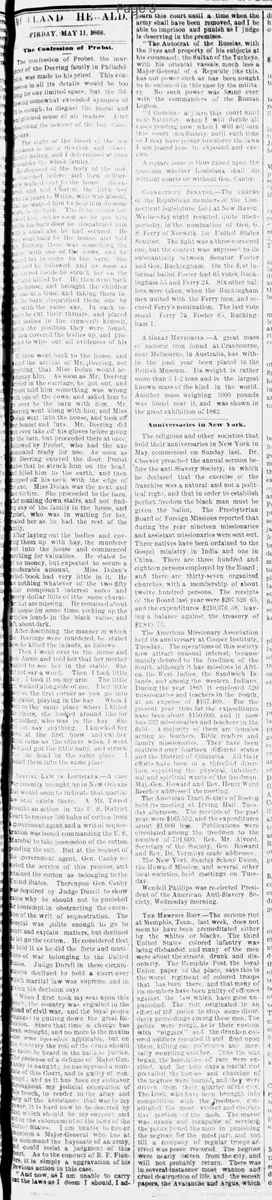
"When I first took my seat upon this bench, the country was engulfed in the cloud of civil war, and the loyal people engaged in putting down the great Rebellion. Since that time a change has been wrought, and no more is the maxim inter arma leges silent applicable, but on the contrary the roll of the drum should no more be heard in the halls of justice. The pretense of a defense of Major-Gen. Canby is naught; he has opposed a mandate of this Court, and is guilty of contempt; and as it has been my endeavor throughout my judicial occupation of this bench, to render to the army and navy all the assistance that was in my power, it is hard now to be deserted by that which should be my support and aid in the enforcement of the laws of the United States. I am unable to fine or imprison a Major-General who has at his command the bayonets of an army, and could resist a judgment of this court. As to the conduct of B. F. Flanders, it is simply an aggravation of his previous action in this case."
"And now, as I am unable to carry out the laws as I deem I should, I adjourn this court until a time when the army shall have been removed, and I be able to imprison and punish as I judge is deserving in the premises."
"The Autocrat of the Russias, with the lives and property of his subjects at his command; the Sultan of the Turks, with his oriental vassals, much less a Major General of a Republic like this, has not power such as has been sought to be enforced in this case by the military. No such power was found ever with the commanders of the Roman Legions."
"I therefore adjourn this court until next Saturday, when I will decide all cases pending now, when I will adjourn this court indefinitely until such time as I may have power to enforce the laws I am placed here to expound and execute."
A square issue is thus raised upon the question whether Louisiana shall do without courts or without Gen. Canby.
What sub-type of article is it?
What themes does it cover?
What keywords are associated?
What entities or persons were involved?
Where did it happen?
Story Details
Key Persons
Location
New Orleans, Louisiana
Event Date
Recently
Story Details
Mr. Tweed sues in U.S. District Court to recover 800 bales of cotton held by government agent. Gen. Canby refuses writ of sequestration, claiming it as U.S. property under military authority. Judge Durell finds Canby in contempt but adjourns court, unable to enforce against army, highlighting conflict between martial and civil law.