Thank you for visiting SNEWPapers!
Sign up free
Story
May 11, 1905
Pocahontas Times
Marlinton, Huntersville, Pocahontas County, West Virginia
What is this article about?
A chemist describes hydrofluoric acid, a colorless liquid used for glass etching on thermometers, as the most dangerous substance, capable of boring through flesh and requiring storage in gold bottles with strict precautions to prevent volatility and bursting.
Clipping
OCR Quality
98%
Excellent
Full Text
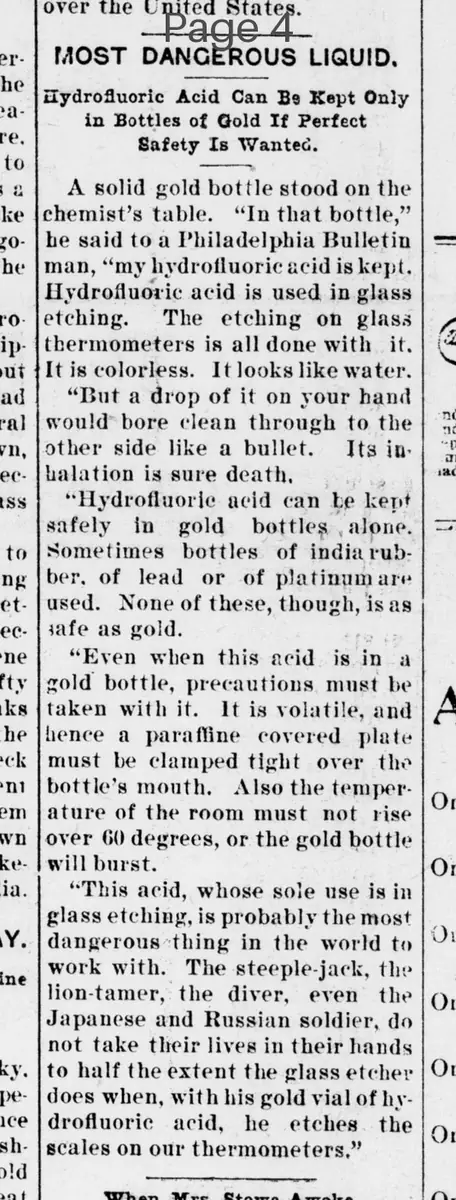
MOST DANGEROUS LIQUID.
Hydrofluoric Acid Can Be Kept Only in Bottles of Gold If Perfect Safety Is Wanted.
A solid gold bottle stood on the chemist's table. "In that bottle," he said to a Philadelphia Bulletin man, "my hydrofluoric acid is kept. Hydrofluoric acid is used in glass etching. The etching on glass thermometers is all done with it. It is colorless. It looks like water.
"But a drop of it on your hand would bore clean through to the other side like a bullet. Its inhalation is sure death.
"Hydrofluoric acid can be kept safely in gold bottles alone. Sometimes bottles of india rubber, of lead or of platinum are used. None of these, though, is as safe as gold.
"Even when this acid is in a gold bottle, precautions must be taken with it. It is volatile, and hence a paraffine covered plate must be clamped tight over the bottle's mouth. Also the temperature of the room must not rise over 60 degrees, or the gold bottle will burst.
"This acid, whose sole use is in glass etching, is probably the most dangerous thing in the world to work with. The steeple-jack, the lion-tamer, the diver, even the Japanese and Russian soldier, do not take their lives in their hands to half the extent the glass etcher does when, with his gold vial of hydrofluoric acid, he etches the scales on our thermometers."
Hydrofluoric Acid Can Be Kept Only in Bottles of Gold If Perfect Safety Is Wanted.
A solid gold bottle stood on the chemist's table. "In that bottle," he said to a Philadelphia Bulletin man, "my hydrofluoric acid is kept. Hydrofluoric acid is used in glass etching. The etching on glass thermometers is all done with it. It is colorless. It looks like water.
"But a drop of it on your hand would bore clean through to the other side like a bullet. Its inhalation is sure death.
"Hydrofluoric acid can be kept safely in gold bottles alone. Sometimes bottles of india rubber, of lead or of platinum are used. None of these, though, is as safe as gold.
"Even when this acid is in a gold bottle, precautions must be taken with it. It is volatile, and hence a paraffine covered plate must be clamped tight over the bottle's mouth. Also the temperature of the room must not rise over 60 degrees, or the gold bottle will burst.
"This acid, whose sole use is in glass etching, is probably the most dangerous thing in the world to work with. The steeple-jack, the lion-tamer, the diver, even the Japanese and Russian soldier, do not take their lives in their hands to half the extent the glass etcher does when, with his gold vial of hydrofluoric acid, he etches the scales on our thermometers."
What sub-type of article is it?
Curiosity
Extraordinary Event
What themes does it cover?
Misfortune
What keywords are associated?
Hydrofluoric Acid
Glass Etching
Dangerous Liquid
Gold Bottle
Chemical Hazard
What entities or persons were involved?
Chemist
Philadelphia Bulletin Man
Where did it happen?
Chemist's Table
Story Details
Key Persons
Chemist
Philadelphia Bulletin Man
Location
Chemist's Table
Story Details
A chemist explains to a reporter that hydrofluoric acid, used for etching glass thermometers, is extremely dangerous, looking like water but capable of boring through flesh or killing by inhalation, and must be stored in gold bottles with precautions against volatility.