Thank you for visiting SNEWPapers!
Sign up free
The Enquirer
Richmond, Henrico County, Virginia
What is this article about?
A defense of James Madison against minority protests to his election, refuting charges over the Yazoo land compromise as expedient rather than corrupt, his response to alien and sedition laws, and collaboration on the Federalist papers. Argues his actions preserved public confidence and constitutional principles.
Clipping
OCR Quality
Full Text
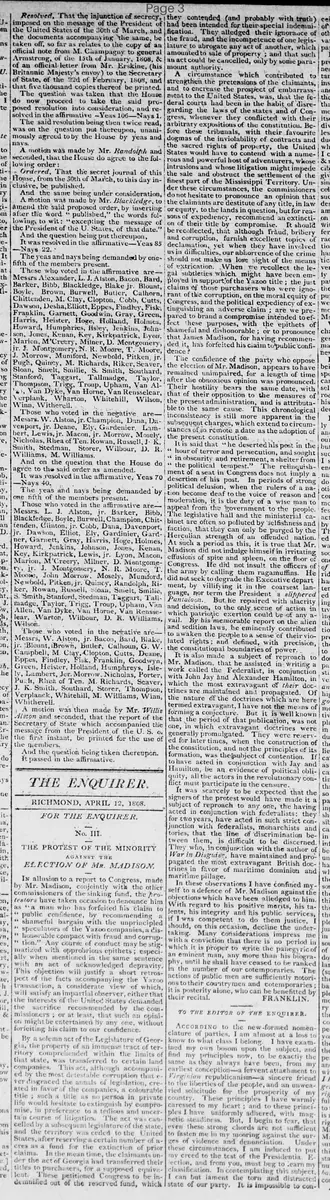
RICHMOND, APRIL 12, 1808.
FOR THE ENQUIRER.
No. III.
THE PROTEST OF THE MINORITY AGAINST THE ELECTION OF MR. MADISON.
In allusion to a report to Congress, made by Mr. Madison, conjointly with the other commissioners of the sinking fund, the protesters have taken occasion to denounce him as "a man who has forfeited his claim to "public confidence, by recommending a "shameful bargain with the unprincipled "speculators of the Yazoo companies, a dis- "honorable compact with fraud and corrup- "tion." Any course of conduct may be stig- matized with opprobrious epithets; especi- ally when mentioned in the same sentence with an act of acknowledged depravity. This objection will justify a short retros- pect of the facts accompanying the Yazoo transaction, a considerate view of which, will satisfy an impartial observer, either that the interests of the United States demanded the sacrifice recommended by the com- missioners; or at least, that such an opini- on might be entertained by any one, without forfeiting his claim to our confidence.
By a solemn act of the Legislature of Geor- gia, the property of an immense tract of ter- ritory comprehended within the limits of that state, was transferred to certain land companies. This act, although accompani- ed by the most detestable corruption that e- ver disgraced the annals of legislation, cre- ated in favor of the companies, a colorable title; such a title as no person in private life would hesitate to extinguish by compro- mise, in preference to a tedious and uncer- tain course of litigation. The act was can- celled by a subsequent legislature of the state, and the territory was ceded to the United States, after reserving a certain number of a- cres as a fund for the extinction of prior claims. In the mean time, the claimants un- der the act of Georgia had transferred their titles to purchasers, for a supposed equiva- lent. These petitioned Congress to be in- demnified out of the reserved fund, which ther contended (and probably with truth) had been intended for their special indemni- fication. They alleged their ignorance of the fraud, and the incompetence of one legis- lature to abrogate any act of another, which amounted to sale of property; and that such an act could be cancelled, only by some para- mount authority.
A circumstance which contributed to strengthen the pretensions of the claimants, and to increase the prospect of embarrass- ment to the United States, was, that the fe- deral courts had been in the habit of disre- garding the laws of the states and of Con- gress, whenever they conflicted with their arbitrary expositions of the constitution. Be- fore these tribunals, with their favourite dogmas of the inviolability of contracts and the sacred rights of property, the United States would have to contend with a nume- rous and powerful host of adventurers, whose intrusions and whose litigation might impede the sale and obstruct the settlement of the finest part of the Mississippi Territory. Un- der these circumstances, the commissioners do not hesitate to pronounce an opinion that the claimants are destitute of any title, in law or equity, to the lands in question, but for rea- sons of expediency, recommend an extincti- on of their title by compromise. It should be recollected, that although fraud, bribery and corruption, furnish excellent topics of declamation, yet when they have involved us in difficulties, our abhorrence of the crime should not make us lose sight of the means of extrication. When we recollect the le- gal subtleties which might have been em- ployed in support of the Yazoo title; the just claims of those purchasers who were igno- rant of the corruption, on the moral equity of Congress, and the political expediency of ex- tinguishing an adverse claim; are we pre- pared to brand a compromise intended to ef- fect these purposes, with the epithets of shameful and dishonorable; or to pronounce that James Madison, for having recommen- ded it, has forfeited his claim to public confi- dence?
The confidence of the party who oppose the election of Mr. Madison, appears to have remained unimpaired, for a length of time after the obnoxious opinion was pronounced. Their hostility bears the same date, with that of their opposition to the measures of the present administration, and is attributa- ble to the same cause. This chronological inconsistency is still more apparent in the subsequent charges, which extend to circum- stances of so remote a date as the adoption of the present constitution.
It is said that "he deserted his post in the "hour of terror and persecution, and sought "in obscurity and retirement, a shelter from "the political tempest." The relinquish- ment of a seat in Congress does not imply a desertion of his post. In periods of strong political delusion, when the rulers of a na- tion become deaf to the voice of reason and moderation, it is the duty of a wise man to appeal from the government to the people. The legislative hall and the ministerial ca- binet are often so polluted by selfishness and faction, that they can only be purged by the Herculian strength of an offended nation. At such a period as this, it is true that Mr. Madison did not indulge himself in irritating effusions of spite and spleen, on the floor of Congress. He did not insult the officers of the army by calling them ragamuffins. He did not seek to degrade the Executive depart- ment, by villifying it in the coarsest lan- guage, nor term the President a sliffered Pantaloon. But, he repaired with alacrity and decision, to the only scene of action in which patriotic exertion could be of any a- vail. By his memorable report on the alien and sedition laws, he eminently contributed to awaken the people to a sense of their vio- lated rights; and defined, with precision, the constitutional boundaries of power.
It is also made a subject of reproach to Mr. Madison, that he assisted in writing a work called the Federalist, in conjunction with John Jay and Alexander Hamilton, in which the most extravagant of their doc- trines are maintained and propagated. Of the nature of the doctrines which are here termed extravagant, I have not the means of forming a conjecture. But it is well known that the period of that publication, was not one, in which extravagant doctrines were generally promulgated. They were reserv- ed for later times, when the construction of the constitution, and not the principles of its formation, was the subject of contention. If to have acted in conjunction with Jay and Hamilton, be an evidence of political obli- quity, all the actors in the revolutionary con- flict must participate in the censure.
It was scarcely to be expected that the signers of the protest would have made it a subject of reproach to any one, the having acted in conjunction with federalists: they for two years, have acted in such strict con- junction with federalists, monarchists and tories, that the line of discrimination be- tween them, is difficult to be discerned. They who, in conjunction with the author of War in Disguise, have maintained and pro- pagated the most extravagant British doc- trines in favor of maritime dominion and maritime pillage.
In these observations I have confined my- self to a defence of Mr. Madison against the objections which have been alleged to him. With regard to his positive merits, his ta- lents, his integrity and his public services, if I was competent to do them justice, I should, on this occasion, decline the under- taking. Many considerations impress me with a conviction that there is no period in which it is proper to write the panegyric of an eminent man, any more than his biogra- phy, until he shall have ceased to be ranked in the number of our contemporaries. The actions of public men are sufficiently notori- ous to their countrymen and contemporaries; it is posterity alone, who can be benefitted by their recital.
FRANKLIN.
What sub-type of article is it?
What themes does it cover?
What keywords are associated?
What entities or persons were involved?
Letter to Editor Details
Author
Franklin
Recipient
For The Enquirer
Main Argument
james madison has not forfeited public confidence through the yazoo compromise, which was an expedient measure to avoid litigation and embarrassment; his actions on alien and sedition laws and the federalist were patriotic and justified, countering partisan attacks tied to opposition against the administration.
Notable Details