Thank you for visiting SNEWPapers!
Sign up free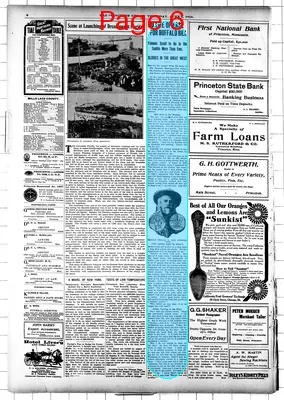
Story
June 2, 1910
The Princeton Union
Princeton, Mille Lacs County, Minnesota
What is this article about?
Colonel William F. Cody, known as Buffalo Bill, announces retirement from his Wild West show after the season, planning to spend time on his Wyoming ranch and Arizona mining properties. In a New York interview, he reflects on his active life, the taming of the Wild West, and the Indians' transition to farming.
Clipping

OCR Quality
98%
Excellent
Full Text
NO LIFE OF EASE FOR BUFFALO BILL
Famous Scout to Be In the Saddle More Than Ever.
GLORIES IN THE GREAT WEST
But It's No Longer Wild, He Says In His Farewell Message--The Indian, He Asserts, Is Laying Down the Bow and Arrow and Taking Up the Rake.
At the end of this season's tour of Buffalo Bill's Wild West show Colonel William F. Cody (Buffalo Bill), the famous scout and showman, will retire to his ranch at Cody, Wyo., and divide his time thereafter between the ranges and his mining property in Arizona.
Just before he waved his last farewell with his broad brimmed hat to New York at Madison Square Garden he was interviewed by Charles Darnton for the New York Evening World.
When asked whether he would leave the saddle for the rocking chair Colonel Cody pulled up abruptly with this answer:
Will Hike to the Rockies.
"No, sir! No one will ever find me in a rocking chair. As a matter of fact, I'll be in the saddle during the rest of my days more than I am now in this business. I'm not going to settle down and sit in a corner. Any one that comes out west looking for me will be pretty apt to find me on the back of a horse. I couldn't lead anything but an active life. I never hang around a city when I'm through with my season. I hike for the Rockies and go shooting and hunting. That's the life for me."
Although the colonel refused to say he was tired of life in the arena, he shot this question at me:
"Do you think a man can run on in this business for 300 or 400 years? Now, I've been a pretty steady man in my public career. It began in 1872 at Niblo's Garden, when I appeared in 'The Scouts of the Plains,' not counting the years that I was before the public in a way as a real scout. Then in 1883 I organized 'The Wild West,' and I've been keeping it up ever since. When a man has a million dollars' worth of property around him and horses eating their heads off he's got to keep it up, I can tell you! And two shows a day are harder on a man than a long dash across the plains. But the excitement of it all has kept me up."
"There's no more wild west. The last of it went when I settled up the Big Horn basin, the 'metropolis of which, you know, is named after me. A lot of people here in the east think the west is fit only for coyotes and rattlesnakes, but one of these days they'll realize that it is the richest part of this whole country. The brainiest men of the country come from the west. We raise the healthiest and brainiest children on the face of the earth, and they broaden with nature. What chance does a person have to broaden in a city, with its narrow streets and brick walls? You have to go west to find room in which to do that. Why, out there you throw out your arms and holler! You feel so good you just have to holler. You're glad you're alive, and you're thanking God that you're in a healthy country."
"But, holler as you may, it is no longer the wild west?"
Indian Turning to the Plow.
"No," said the colonel slowly. "That has practically passed away. I am the only man living who actually represents that life, who has really lived it. But it was not to kill Indians that I became a part of it. I stood between civilization and savagery. Today the Indian is laying down the bow and arrow and picking up the rake. He is turning his hand from the hunting knife to the plow. It is hard for him to give up the chase and dig his living out of the ground, but he is gradually becoming a farmer."
"But I do not intend to hunt all the time. In fact, I'll have enough work to keep me busy. I have got a lot of mining property to look after, and any one who comes out looking for me will find me in Nebraska, Wyoming or Arizona. They'll find me almost anywhere except in a rocking chair. I may come east for a visit occasionally, but this is my farewell appearance so far as the wild west show is concerned, and now I want to take off my hat to the public. It's been very kind to me. I guess that's about all I've got to say - just Thank you and goodbye."
COLONEL WILLIAM F. CODY (BUFFALO BILL):
["No rocking chair for mine."]
Famous Scout to Be In the Saddle More Than Ever.
GLORIES IN THE GREAT WEST
But It's No Longer Wild, He Says In His Farewell Message--The Indian, He Asserts, Is Laying Down the Bow and Arrow and Taking Up the Rake.
At the end of this season's tour of Buffalo Bill's Wild West show Colonel William F. Cody (Buffalo Bill), the famous scout and showman, will retire to his ranch at Cody, Wyo., and divide his time thereafter between the ranges and his mining property in Arizona.
Just before he waved his last farewell with his broad brimmed hat to New York at Madison Square Garden he was interviewed by Charles Darnton for the New York Evening World.
When asked whether he would leave the saddle for the rocking chair Colonel Cody pulled up abruptly with this answer:
Will Hike to the Rockies.
"No, sir! No one will ever find me in a rocking chair. As a matter of fact, I'll be in the saddle during the rest of my days more than I am now in this business. I'm not going to settle down and sit in a corner. Any one that comes out west looking for me will be pretty apt to find me on the back of a horse. I couldn't lead anything but an active life. I never hang around a city when I'm through with my season. I hike for the Rockies and go shooting and hunting. That's the life for me."
Although the colonel refused to say he was tired of life in the arena, he shot this question at me:
"Do you think a man can run on in this business for 300 or 400 years? Now, I've been a pretty steady man in my public career. It began in 1872 at Niblo's Garden, when I appeared in 'The Scouts of the Plains,' not counting the years that I was before the public in a way as a real scout. Then in 1883 I organized 'The Wild West,' and I've been keeping it up ever since. When a man has a million dollars' worth of property around him and horses eating their heads off he's got to keep it up, I can tell you! And two shows a day are harder on a man than a long dash across the plains. But the excitement of it all has kept me up."
"There's no more wild west. The last of it went when I settled up the Big Horn basin, the 'metropolis of which, you know, is named after me. A lot of people here in the east think the west is fit only for coyotes and rattlesnakes, but one of these days they'll realize that it is the richest part of this whole country. The brainiest men of the country come from the west. We raise the healthiest and brainiest children on the face of the earth, and they broaden with nature. What chance does a person have to broaden in a city, with its narrow streets and brick walls? You have to go west to find room in which to do that. Why, out there you throw out your arms and holler! You feel so good you just have to holler. You're glad you're alive, and you're thanking God that you're in a healthy country."
"But, holler as you may, it is no longer the wild west?"
Indian Turning to the Plow.
"No," said the colonel slowly. "That has practically passed away. I am the only man living who actually represents that life, who has really lived it. But it was not to kill Indians that I became a part of it. I stood between civilization and savagery. Today the Indian is laying down the bow and arrow and picking up the rake. He is turning his hand from the hunting knife to the plow. It is hard for him to give up the chase and dig his living out of the ground, but he is gradually becoming a farmer."
"But I do not intend to hunt all the time. In fact, I'll have enough work to keep me busy. I have got a lot of mining property to look after, and any one who comes out looking for me will find me in Nebraska, Wyoming or Arizona. They'll find me almost anywhere except in a rocking chair. I may come east for a visit occasionally, but this is my farewell appearance so far as the wild west show is concerned, and now I want to take off my hat to the public. It's been very kind to me. I guess that's about all I've got to say - just Thank you and goodbye."
COLONEL WILLIAM F. CODY (BUFFALO BILL):
["No rocking chair for mine."]
What sub-type of article is it?
Biography
Personal Triumph
What themes does it cover?
Bravery Heroism
Exploration
Triumph
What keywords are associated?
Buffalo Bill
Wild West Show
Retirement
Rockies
Indian Assimilation
Scout Life
Western Expansion
What entities or persons were involved?
Colonel William F. Cody
Buffalo Bill
Charles Darnton
Where did it happen?
Cody, Wyo.; Arizona; New York; Rockies; Nebraska; Wyoming
Story Details
Key Persons
Colonel William F. Cody
Buffalo Bill
Charles Darnton
Location
Cody, Wyo.; Arizona; New York; Rockies; Nebraska; Wyoming
Event Date
End Of This Season's Tour
Story Details
Buffalo Bill retires from Wild West show to ranch and mining, vows active life in saddle, reflects on career since 1872, end of wild west, Indians becoming farmers, praises western opportunities.