Thank you for visiting SNEWPapers!
Sign up free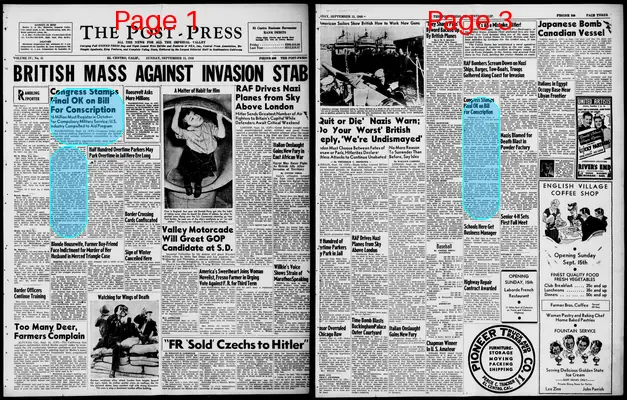
Imperial Valley Press
El Centro, Imperial County, California
What is this article about?
On Sept. 14, 1940, U.S. Congress passed the Selective Training and Service Act, requiring 16.5 million men aged 21-35 to register for potential military service in October. President Roosevelt to sign, compelling industry to aid defense. Votes: Senate 47-25, House 232-124.
Merged-components note: Continuation of conscription bill story across pages.
Clippings
1 of 2
OCR Quality
Full Text
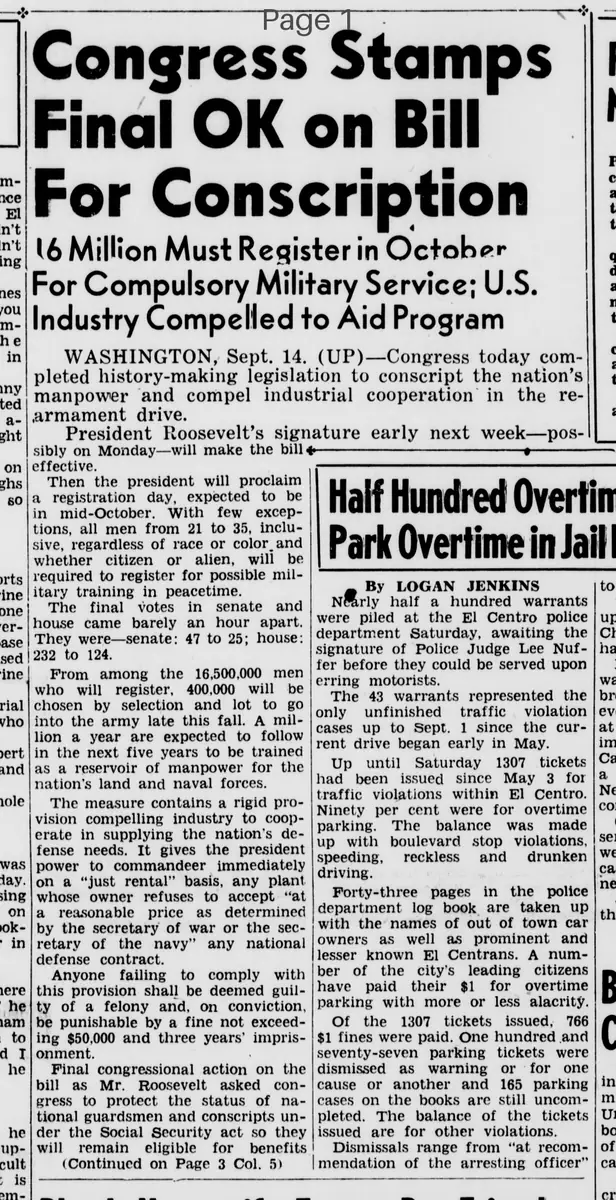
16 Million Must Register in October For Compulsory Military Service; U.S. Industry Compelled to Aid Program
WASHINGTON, Sept. 14. (UP)--Congress today completed history-making legislation to conscript the nation's manpower and compel industrial cooperation in the rearmament drive.
President Roosevelt's signature early next week-possibly on Monday-will make the bill
Then the president will proclaim a registration day, expected to be in mid-October. With few exceptions, all men from 21 to 35, inclusive, regardless of race or color and whether citizen or alien, will be required to register for possible military training in peacetime.
The final votes in senate and house came barely an hour apart. They were-senate: 47 to 25; house: 232 to 124.
From among the 16,500,000 men who will register, 400,000 will be chosen by selection and lot to go into the army late this fall. A million a year are expected to follow in the next five years to be trained as a reservoir of manpower for the nation's land and naval forces.
The measure contains a rigid provision compelling industry to cooperate in supplying the nation's defense needs. It gives the president power to commandeer immediately on a "just rental" basis, any plant whose owner refuses to accept "at a reasonable price as determined by the secretary of war or the secretary of the navy" any national defense contract.
Anyone failing to comply with this provision shall be deemed guilty of a felony and, on conviction, be punishable by a fine not exceeding $50,000 and three years' imprisonment.
Final congressional action on the bill as Mr. Roosevelt asked congress to protect the status of national guardsmen and conscripts under the Social Security act so they will remain eligible for benefits
(Continued on Page 3 Col. 5)
Congress Stamps Final OK on Bill For Conscription
(Continued From Page 1)
when they return to civil life after service in the army.
Adoption came on the 86th day after the bill was introduced. As originally introduced, the measure called for registration of all men between 18 and 65, with those between 21 and 45 being subject to the draft for eight months of military service at a pay of $5 a month. Those between 18 and 21, and 45 and 65 would have been subject to service in "home defense" units.
The senate, after three weeks of bitter debate, finally approved a bill calling for registration and possible conscription for a year of training of all men between 21 and 31. It also carried a provision—known as the Russell-Overton amendment—giving the president power to commandeer any recalcitrant plant on a condemnation basis.
The house worked on its own version of the bill for a week. It then approved a measure calling for registration and possible draft of all men between 21 and 45. The house also approved Fish's 60-day amendment.
It likewise approved a provision—by Rep. J. J. Smith, D., Conn.—giving the president power to commandeer non-cooperating plants, but on a "just rental" rather than a condemnation basis. This was the provision adopted in the final form of the bill.
When the bill emerged from a senate-house conference, the age range of those required to register and be subject to the draft was compromised at 21 to 35, inclusive.
The 60-day delay clause was thrown out. Pay of conscripts was fixed at $21 a month for the first four months and $30 a month for the remaining eight months.
What sub-type of article is it?
What keywords are associated?
What entities or persons were involved?
Where did it happen?
Domestic News Details
Primary Location
Washington
Event Date
Sept. 14
Key Persons
Outcome
congress passed the bill with senate vote 47-25 and house 232-124. requires registration of 16.5 million men aged 21-35 in mid-october, selecting 400,000 for army service. industry compelled to cooperate or face fines up to $50,000 and 3 years imprisonment. conscripts paid $21/month first 4 months, $30/month remaining 8 months.
Event Details
Congress completed legislation for peacetime conscription and industrial cooperation in rearmament. President to sign next week and proclaim registration day in mid-October. All men 21-35 must register regardless of citizenship. From registrants, 400,000 selected by lot for fall army service, followed by 1 million/year for 5 years. Bill gives president power to commandeer non-cooperating plants on 'just rental' basis. Protects national guardsmen and conscripts' Social Security benefits. Original bill modified through debates and conference: age range compromised at 21-35, 60-day delay removed, Russell-Overton and Smith provisions adopted.