Thank you for visiting SNEWPapers!
Sign up free
Portland Gazette, And Maine Advertiser
Portland, Cumberland County, Maine
What is this article about?
Summary of London news to January 3, 1809, on the Peninsular War: French capture Madrid on December 4; bulletins predict restored tranquility; Spanish forces retreat honorably after Tudela and Somosierra without being subdued; British join Romana's army; rumors of Madrid massacre and British political changes dismissed.
Clipping
OCR Quality
Full Text
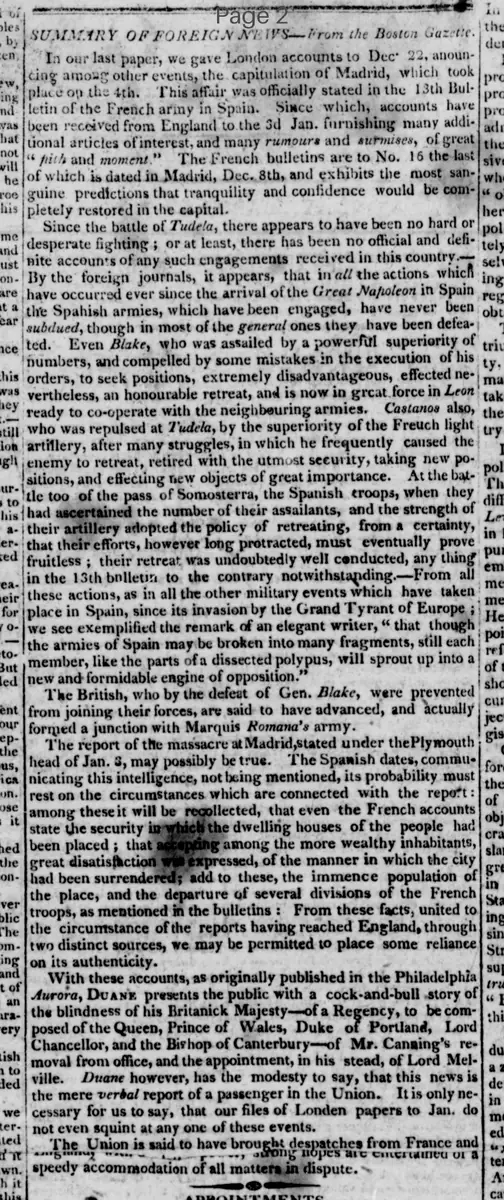
In our last paper, we gave London accounts to Dec. 22, announcing among other events, the capitulation of Madrid, which took place on the 4th. This affair was officially stated in the 13th Bulletin of the French army in Spain. Since which, accounts have been received from England to the 3d Jan. furnishing many additional articles of interest, and many rumours and surmises, of great worth and moment. The French bulletins are to No. 16 the last of which is dated in Madrid, Dec. 8th, and exhibits the most sanguine predictions that tranquility and confidence would be completely restored in the capital.
Since the battle of Tudela, there appears to have been no hard or desperate fighting; or at least, there has been no official and definite accounts of any such engagements received in this country.—By the foreign journals, it appears, that in all the actions which have occurred ever since the arrival of the Great Napoleon in Spain the Spanish armies, which have been engaged, have never been subdued, though in most of the general ones they have been defeated. Even Blake, who was assailed by a powerful superiority of numbers, and compelled by some mistakes in the execution of his orders, to seek positions, extremely disadvantageous, effected nevertheless, an honourable retreat, and is now in great force in Leon ready to co-operate with the neighbouring armies. Castanos also, who was repulsed at Tudela, by the superiority of the French light artillery, after many struggles, in which he frequently caused the enemy to retreat, retired with the utmost security, taking new positions, and effecting new objects of great importance. At the battle too of the pass of Somosterra, the Spanish troops, when they had ascertained the number of their assailants, and the strength of their artillery adopted the policy of retreating, from a certainty, that their efforts, however long protracted, must eventually prove fruitless; their retreat was undoubtedly well conducted, any thing in the 13th bulletin to the contrary notwithstanding.—From all these actions, as in all the other military events which have taken place in Spain, since its invasion by the Grand Tyrant of Europe; we see exemplified the remark of an elegant writer, "that though the armies of Spain may be broken into many fragments, still each member, like the parts of a dissected polypus, will sprout up into a new and formidable engine of opposition."
The British, who by the defeat of Gen. Blake, were prevented from joining their forces, are said to have advanced, and actually formed a junction with Marquis Romana's army.
The report of the massacre at Madrid, stated under the Plymouth head of Jan. 3, may possibly be true. The Spanish dates, communicating this intelligence, not being mentioned, its probability must rest on the circumstances which are connected with the report: among these it will be recollected, that even the French accounts state the security in which the dwelling houses of the people had been placed; that excepting among the more wealthy inhabitants, great dissatisfaction was expressed, of the manner in which the city had been surrendered; add to these, the immense population of the place, and the departure of several divisions of the French troops, as mentioned in the bulletins: From these facts, united to the circumstance of the reports having reached England, through two distinct sources, we may be permitted to place some reliance on its authenticity.
With these accounts, as originally published in the Philadelphia Aurora, Duane presents the public with a cock-and-bull story of the blindness of his Britannick Majesty—of a Regency, to be composed of the Queen, Prince of Wales, Duke of Portland, Lord Chancellor, and the Bishop of Canterbury—of Mr. Canning's removal from office, and the appointment, in his stead, of Lord Melville. Duane however, has the modesty to say, that this news is the mere verbal report of a passenger in the Union. It is only necessary for us to say, that our files of London papers to Jan. do not even squint at any one of these events.
The Union is said to have brought despatches from France and wrong news and current speedy accommodation of all matters in dispute.—
What sub-type of article is it?
What keywords are associated?
What entities or persons were involved?
Where did it happen?
Foreign News Details
Primary Location
Spain
Event Date
December 1808
Key Persons
Outcome
capitulation of madrid on december 4; honorable spanish retreats after defeats at tudela and somosierra; no subduing of spanish armies; possible massacre in madrid; british junction with romana's army.
Event Details
London accounts to January 3 report French bulletins on Madrid's capitulation and predicted restoration of tranquility. Since Tudela battle, Spanish forces under Blake and Castanos retreated honorably without being subdued, despite defeats. At Somosierra pass, Spaniards retreated strategically. British forces joined Marquis Romana's army. Rumors of Madrid massacre considered plausible based on circumstances. British political rumors dismissed as unfounded.