Thank you for visiting SNEWPapers!
Sign up free
The Rhode Island American, And General Advertiser
Providence, Providence County, Rhode Island
What is this article about?
General Caulaincourt publishes in Paris papers to clear himself of role in 1804 arrest of Duke d'Enghien at Ettenheim, backed by 1808 note from Emperor Alexander. General Ordener, who carried out the order, died soon after from grief-induced heart ailment.
Clipping
OCR Quality
Full Text
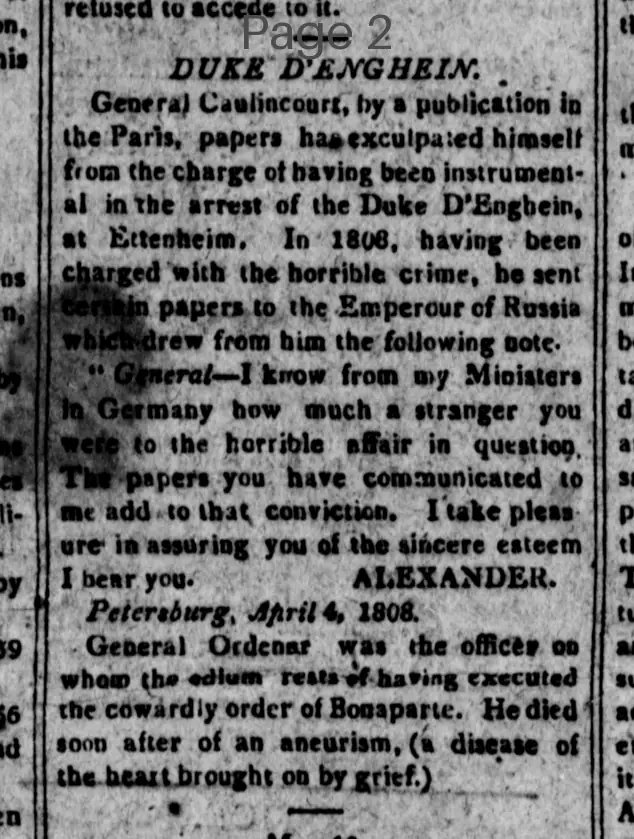
General Caulaincourt, by a publication in the Paris papers has exculpated himself from the charge of having been instrumental in the arrest of the Duke d'Enghien, at Ettenheim. In 1808, having been charged with the horrible crime, he sent certain papers to the Emperor of Russia which drew from him the following note.
"General,--I know from my Ministers in Germany how much a stranger you were to the horrible affair in question. The papers you have communicated to me add to that conviction. I take pleasure in assuring you of the sincere esteem I bear you.
ALEXANDER.
Petersburg, April 4, 1808."
General Ordener was the officer on whom the odium rests of having executed the cowardly order of Bonaparte. He died soon after of an aneurism, (a disease of the heart brought on by grief.)
What sub-type of article is it?
What keywords are associated?
What entities or persons were involved?
Where did it happen?
Foreign News Details
Primary Location
Ettenheim
Event Date
April 4, 1808
Key Persons
Outcome
execution of the duke d'enghien; general ordener died soon after of an aneurism brought on by grief
Event Details
General Caulaincourt exculpated himself via publication in Paris papers from involvement in the arrest of the Duke d'Enghien at Ettenheim. In 1808, he sent papers to the Emperor of Russia, receiving a note of esteem confirming his non-involvement. General Ordener executed Bonaparte's order for the arrest.