Thank you for visiting SNEWPapers!
Sign up free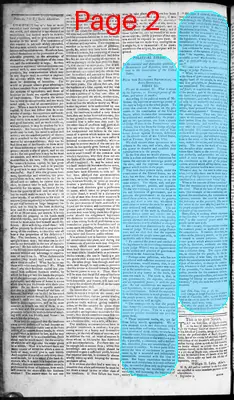
Literary
September 12, 1805
Alexandria Daily Advertiser
Alexandria, Virginia
What is this article about?
Essay XI from The Baltimore Republican critiques Mr. Duane's view that supreme power resides in the people, distinguishing it from the state's active governmental power. Uses quotes from Judges Wilson and Patterson to argue the people's power is dormant, applicable only to altering the constitution.
Clipping
OCR Quality
96%
Excellent
Full Text
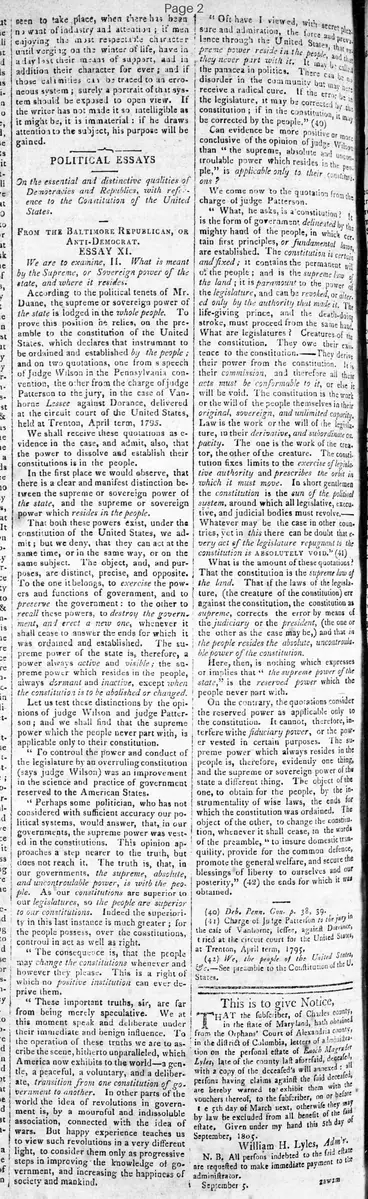
POLITICAL ESSAYS
On the essential and distinctive qualities of Democracies and Republics, with reference to the Constitution of the United States.
From The Baltimore Republican, or Anti-Democrat.
ESSAY XI.
We are to examine, II. What is meant by the Supreme, or Sovereign power of the state, and where it resides:
According to the political tenets of Mr. Duane, the supreme or sovereign power of the state is lodged in the whole people. To prove this position he relies, on the preamble to the constitution of the United States, which declares that instrument to be ordained and established by the people; and on two quotations, one from a speech of Judge Wilson in the Pennsylvania convention, the other from the charge of Judge Patterson to the jury, in the case of Vanhorne's Lessee against Dorrance, delivered at the circuit court of the United States, held at Trenton, April term, 1795.
We shall receive these quotations as evidence in the case, and admit, also, that the power to dissolve and establish their constitutions is in the people.
In the first place we would observe, that there is a clear and manifest distinction between the supreme or sovereign power of the state, and the supreme or sovereign power which resides in the people. That both these powers exist, under the constitution of the United States, we admit; but we deny, that they can act at the same time, or in the same way, or on the same subject. The object, and purposes, are distinct, precise, and opposite. To the one it belongs, to exercise the powers and functions of government, and to preserve the government: to the other to recall these powers, to destroy the government, and erect a new one, whenever it shall cease to answer the ends for which it was ordained and established. The supreme power of the state is, therefore, a power always active and visible; the supreme power which resides in the people, always dormant and inactive, except when the constitution is to be abolished or changed.
Let us test these distinctions by the opinions of Judge Wilson and Judge Patterson; and we shall find that the supreme power which the people never part with, is applicable only to their constitution.
"To controul the power and conduct of the legislature by an overruling constitution (says Judge Wilson) was an improvement in the science and practice of government reserved to the American States.
"Perhaps some politician, who has not considered with sufficient accuracy our political systems, would answer, that, in our governments, the supreme power was vested in the constitutions. This opinion approaches a step nearer to the truth, but does not reach it. The truth is, that, in our governments, the supreme, absolute, and uncontroulable power, is with the people. As our constitutions are superior to our legislatures, so the people are superior to our constitutions. Indeed the superiority in this last instance is much greater; for the people possess, over the constitutions, controul in act as well as right.
"The consequence is, that the people may change the constitutions whenever and however they please. This is a right of which no positive institution can ever deprive them.
"These important truths, sir, are far from being merely speculative. We at this moment speak and deliberate under their immediate and benign influence. To the operation of these truths we are to ascribe the scene, hitherto unparalleled, which America now exhibits to the world—a gentle, a peaceful, a voluntary, and a deliberate, transition from one constitution of government to another. In other parts of the world the idea of revolutions in government is, by a mournful and indissoluble association, connected with the idea of wars. But happy experience teaches us to view such revolutions in a very different light, to consider them only as progressive steps in improving the knowledge of government, and increasing the happiness of society and mankind."
Oft have I viewed, with secret pleasure and admiration, the force and prevalence through the United States, of the supreme power reside in the people, and that they never part with it. It may be called the panacea in politics. There can be no disorder in the community but may here receive a radical cure. If the error be in the legislature, it may be corrected by the constitution; if in the constitution, it may be corrected by the people." (40)
Can evidence be more positive or more conclusive of the opinion of Judge Wilson than "the supreme, absolute and uncontroulable power which resides in the people," is applicable only to their constitutions?
We come now to the quotation from the charge of Judge Patterson.
"What, he asks, is a constitution? It is the form of government delineated by the mighty hand of the people, in which certain first principles, or fundamental laws, are established. The constitution is certain and fixed; it contains the permanent will of the people; and is the supreme law of the land; it is paramount to the power of the legislature, and can be revoked, or altered only by the authority that made it. The life-giving principle, and the death-doing stroke, must proceed from the same hand. What are legislatures? Creatures of the constitution. They owe their existence to the constitution.—They derive their powers from the constitution. It is their commission, and therefore all their acts must be conformable to it, or else it will be void. The constitution is the work or the will of the people themselves in their original, sovereign, and unlimited capacity. Law is the work or the will of the legislature, in their derivative, and subordinate capacity. The one is the work of the creator, the other of the creature. The constitution fixes limits to the exercise of legislative authority and prescribes the orbit in which it must move. In short gentlemen the constitution is the sun of the political system, around which all legislative, executive, and judicial bodies must revolve,—Whatever may be the case in other countries, yet in this there can be no doubt that every act of the legislature repugnant to the constitution is ABSOLUTELY VOID." (41)
What is the amount of these quotations! That the constitution is the supreme law of the land. That if the laws of the legislature, (the creature of the constitution) err against the constitution, the constitution as supreme, corrects the error by means of the judiciary or the president, (the one or the other as the case may be,) and that in the people resides the absolute, uncontroulable power of the constitution.
Here, then, is nothing which expresses or implies that "the supreme power of the state," is the reserved power which the people never part with.
On the contrary, the quotations consider the reserved power as applicable only to the constitution. It cannot, therefore, interfere with the fiduciary power, or the power vested in certain persons. The supreme power which always resides in the people is, therefore, evidently one thing, and the supreme or sovereign power of the state a different thing. The object of the one, to obtain for the people, by the instrumentality of wise laws, the ends for which the constitution was ordained. The object of the other, to change the constitution, whenever it shall cease, in the words of the preamble, "to insure domestic tranquility, provide for the common defence, promote the general welfare, and secure the blessings of liberty to ourselves and our posterity," (42) the ends for which it was obtained.
(40) Deb. Penn. Conv. p. 38, 39.
(41) Charge of Judge Patterson to the jury in the case of Vanhorne's Lessee, against Dorrance tried at the circuit court for the United States at Trenton, April term, 1795.
(42) We, the people of the United States... [preamble excerpt].
On the essential and distinctive qualities of Democracies and Republics, with reference to the Constitution of the United States.
From The Baltimore Republican, or Anti-Democrat.
ESSAY XI.
We are to examine, II. What is meant by the Supreme, or Sovereign power of the state, and where it resides:
According to the political tenets of Mr. Duane, the supreme or sovereign power of the state is lodged in the whole people. To prove this position he relies, on the preamble to the constitution of the United States, which declares that instrument to be ordained and established by the people; and on two quotations, one from a speech of Judge Wilson in the Pennsylvania convention, the other from the charge of Judge Patterson to the jury, in the case of Vanhorne's Lessee against Dorrance, delivered at the circuit court of the United States, held at Trenton, April term, 1795.
We shall receive these quotations as evidence in the case, and admit, also, that the power to dissolve and establish their constitutions is in the people.
In the first place we would observe, that there is a clear and manifest distinction between the supreme or sovereign power of the state, and the supreme or sovereign power which resides in the people. That both these powers exist, under the constitution of the United States, we admit; but we deny, that they can act at the same time, or in the same way, or on the same subject. The object, and purposes, are distinct, precise, and opposite. To the one it belongs, to exercise the powers and functions of government, and to preserve the government: to the other to recall these powers, to destroy the government, and erect a new one, whenever it shall cease to answer the ends for which it was ordained and established. The supreme power of the state is, therefore, a power always active and visible; the supreme power which resides in the people, always dormant and inactive, except when the constitution is to be abolished or changed.
Let us test these distinctions by the opinions of Judge Wilson and Judge Patterson; and we shall find that the supreme power which the people never part with, is applicable only to their constitution.
"To controul the power and conduct of the legislature by an overruling constitution (says Judge Wilson) was an improvement in the science and practice of government reserved to the American States.
"Perhaps some politician, who has not considered with sufficient accuracy our political systems, would answer, that, in our governments, the supreme power was vested in the constitutions. This opinion approaches a step nearer to the truth, but does not reach it. The truth is, that, in our governments, the supreme, absolute, and uncontroulable power, is with the people. As our constitutions are superior to our legislatures, so the people are superior to our constitutions. Indeed the superiority in this last instance is much greater; for the people possess, over the constitutions, controul in act as well as right.
"The consequence is, that the people may change the constitutions whenever and however they please. This is a right of which no positive institution can ever deprive them.
"These important truths, sir, are far from being merely speculative. We at this moment speak and deliberate under their immediate and benign influence. To the operation of these truths we are to ascribe the scene, hitherto unparalleled, which America now exhibits to the world—a gentle, a peaceful, a voluntary, and a deliberate, transition from one constitution of government to another. In other parts of the world the idea of revolutions in government is, by a mournful and indissoluble association, connected with the idea of wars. But happy experience teaches us to view such revolutions in a very different light, to consider them only as progressive steps in improving the knowledge of government, and increasing the happiness of society and mankind."
Oft have I viewed, with secret pleasure and admiration, the force and prevalence through the United States, of the supreme power reside in the people, and that they never part with it. It may be called the panacea in politics. There can be no disorder in the community but may here receive a radical cure. If the error be in the legislature, it may be corrected by the constitution; if in the constitution, it may be corrected by the people." (40)
Can evidence be more positive or more conclusive of the opinion of Judge Wilson than "the supreme, absolute and uncontroulable power which resides in the people," is applicable only to their constitutions?
We come now to the quotation from the charge of Judge Patterson.
"What, he asks, is a constitution? It is the form of government delineated by the mighty hand of the people, in which certain first principles, or fundamental laws, are established. The constitution is certain and fixed; it contains the permanent will of the people; and is the supreme law of the land; it is paramount to the power of the legislature, and can be revoked, or altered only by the authority that made it. The life-giving principle, and the death-doing stroke, must proceed from the same hand. What are legislatures? Creatures of the constitution. They owe their existence to the constitution.—They derive their powers from the constitution. It is their commission, and therefore all their acts must be conformable to it, or else it will be void. The constitution is the work or the will of the people themselves in their original, sovereign, and unlimited capacity. Law is the work or the will of the legislature, in their derivative, and subordinate capacity. The one is the work of the creator, the other of the creature. The constitution fixes limits to the exercise of legislative authority and prescribes the orbit in which it must move. In short gentlemen the constitution is the sun of the political system, around which all legislative, executive, and judicial bodies must revolve,—Whatever may be the case in other countries, yet in this there can be no doubt that every act of the legislature repugnant to the constitution is ABSOLUTELY VOID." (41)
What is the amount of these quotations! That the constitution is the supreme law of the land. That if the laws of the legislature, (the creature of the constitution) err against the constitution, the constitution as supreme, corrects the error by means of the judiciary or the president, (the one or the other as the case may be,) and that in the people resides the absolute, uncontroulable power of the constitution.
Here, then, is nothing which expresses or implies that "the supreme power of the state," is the reserved power which the people never part with.
On the contrary, the quotations consider the reserved power as applicable only to the constitution. It cannot, therefore, interfere with the fiduciary power, or the power vested in certain persons. The supreme power which always resides in the people is, therefore, evidently one thing, and the supreme or sovereign power of the state a different thing. The object of the one, to obtain for the people, by the instrumentality of wise laws, the ends for which the constitution was ordained. The object of the other, to change the constitution, whenever it shall cease, in the words of the preamble, "to insure domestic tranquility, provide for the common defence, promote the general welfare, and secure the blessings of liberty to ourselves and our posterity," (42) the ends for which it was obtained.
(40) Deb. Penn. Conv. p. 38, 39.
(41) Charge of Judge Patterson to the jury in the case of Vanhorne's Lessee, against Dorrance tried at the circuit court for the United States at Trenton, April term, 1795.
(42) We, the people of the United States... [preamble excerpt].
What sub-type of article is it?
Essay
What themes does it cover?
Political
Liberty Freedom
What keywords are associated?
Supreme Power
Sovereign Power
Constitution
United States
Judge Wilson
Judge Patterson
Democracy
Republic
What entities or persons were involved?
From The Baltimore Republican, Or Anti Democrat.
Literary Details
Title
Essay Xi.
Author
From The Baltimore Republican, Or Anti Democrat.
Subject
On The Essential And Distinctive Qualities Of Democracies And Republics, With Reference To The Constitution Of The United States.
Key Lines
The Truth Is, That, In Our Governments, The Supreme, Absolute, And Uncontroulable Power, Is With The People. As Our Constitutions Are Superior To Our Legislatures, So The People Are Superior To Our Constitutions.
The Constitution Is The Work Or The Will Of The People Themselves In Their Original, Sovereign, And Unlimited Capacity. Law Is The Work Or The Will Of The Legislature, In Their Derivative, And Subordinate Capacity.
The Supreme Power Of The State Is, Therefore, A Power Always Active And Visible; The Supreme Power Which Resides In The People, Always Dormant And Inactive, Except When The Constitution Is To Be Abolished Or Changed.