Thank you for visiting SNEWPapers!
Sign up free
Editorial
July 15, 1799
Gazette Of The United States, & Philadelphia Daily Advertiser
Philadelphia, Philadelphia County, Pennsylvania
What is this article about?
An editorial from the Portland Gazette, reprinted in Philadelphia, critiques France's historical and revolutionary policies toward the United States, portraying the French Revolution as a morally corrupt 'war of religion' driven by brute force and atheism, predicting its inevitable downfall and global resistance.
Clipping
OCR Quality
95%
Excellent
Full Text
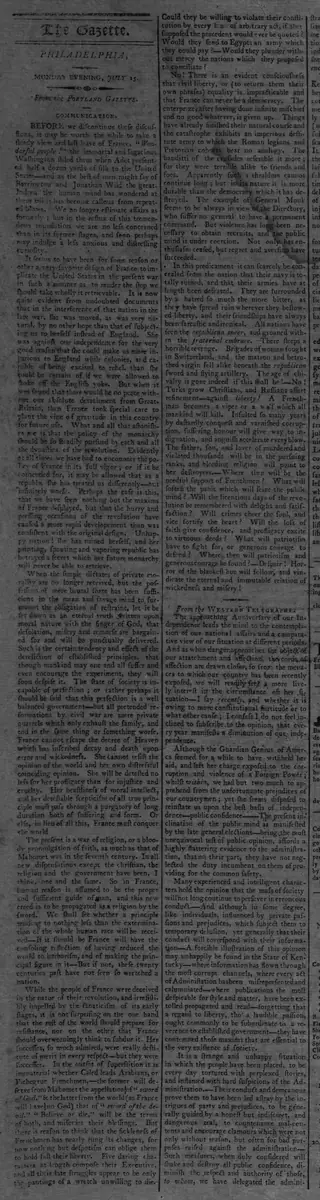
The Gazette.
PHILADELPHIA, MONDAY EVENING, JULY 15.
From the PORTLAND GAZETTE.
COMMUNICATION.
BEFORE we discontinue these discussions, it may be worth the while to take a steady view and last leave of France. "Wonderful people!" the immortal and sagacious Washington styled them when Adet presented half a dozen yards of silk to the United States; and as the best of men might say of Barrington and Jonathan Wild—the great. Indeed the human mind has wondered at them till it has become callous from repeated blows. We no longer estimate affairs as formerly; but in the reflux of this tremendous inundation we are no less concerned than in its former stages, and soon perhaps may indulge a less anxious and distressing curiosity.
It seems to have been for some reason or other a very favorite design of France to implicate the United States in the present war in such a manner as to render the step we should take wholly its irretrievable. It is now quite evident from undoubted documents that in the interference of that nation in the late war, she was moved, as was very natural, by no other hope than that of subjecting us to herself instead of England. She was against our independence for the very good reason that she could make us more injurious to England while colonies, and capable of being excited to rebel, than she could be certain of if we were allowed to shake off the English yoke. But when it was found that there would be no peace without our absolute detachment from Great Britain, then France took special care to plant the vine of gratitude in this country for future use. What and all that astonishes me is that the policy of the monarchy should be so steadily pursued by each and all the dynasties of the revolution. Evidently at all times we have had to encounter the policy of France in its full vigor; or if it be contended for, it may be allowed that as a republic she has treated us differently—but infinitely worse. Perhaps the case is this, that we have seen nothing but the maxims of France displayed, but that the hurry and pressing occasions of the revolution have caused a more rapid development than was consistent with the original design. Unhappy nation! she has ruined herself, and her puny, pouting and vaporing republic has betrayed a secret which her future monarchy will never be able to retrieve.
When the simple dictates of private morality are no longer received, but the possession of mere brutal force has been sufficient in the mean and savage mind to surmount the obligation of restraint, let it be set down as an eternal truth written upon moral nature with the finger of God, that desolation, misery and remorse are bargained for and will be punctually delivered. Such is the certain tendency and effect of the dereliction of established principles, that though mankind may one and all offer and even encourage the experiment, they will soon despise it. The state of society is incapable of perfection; or rather perhaps it should be said that this perfection is a well balanced government—but all pretended reformations by civil war are mere private quarrels which only exhaust the family, and end in the same thing or something worse.
France cannot escape the decree of Heaven which has inscribed decay and death upon error and wickedness. She cannot resist the opinion of the world and her own distressing coinciding opinion. She will be detested no less for her profligacy than for injustice and cruelty. Her beatitudes of moral intellect, and her detestable skepticism of all true principle must pass through a purgatory of long duration both of suffering and form. Or else, in lieu of all this, France must conquer the world.
The present is a war of religion, or a bloody promulgation of faith, as much as that of Mahomet was in the seventh century. In all new dispensations except the Christian, the religion and the government have been, I think, one and the same. So in France, human reason is assumed to be the proper and sufficient guide of man, and this new creed is to be propagated as a religion by the sword. We shall see whether a principle tending to nothing less than the extermination of the whole human race will be received—If it should be France will have the consoling reflection of having reduced the world to barbarism, and of making the principal figure in it—But if not, these twenty centuries past have not seen so wretched a nation.
While the people of France were deceived in the nature of their revolution, and irresistibly impelled by the fanaticism of its early stages, it is not surprising on the one hand that the rest of the world should prepare for resistance, nor on the other that France should overweeningly think to subdue it. Her successes, so much admired, were really destitute of merit in every respect—but they were successes. In the outset of superstition it is immaterial whether Caled leads Arabians, or Pichegru Frenchmen, the former will deserve from Mahomet the appellation of "sword of God," & the latter from the world (as France will have no God) that of "sword of the devil." "Believe or die," will be the terms of both, and miseries their blessings. But there is reason to think that the fickleness of Frenchmen has nearly rung its changes, for now nothing but despotism can oblige them to hold fast their liberty. Five daring characters at length compose their Executive, and all their late struggles appear to be only the pantings of a wretch unwilling to die.
Could they be willing to violate their constitution by every kind of arbitrary act, if they supposed the precedent would ever be quoted? Would they send to Egypt an army which they could pay?—Would they plunder without mercy the nations which they proposed to conciliate?
No! There is an evident consciousness that civil liberty, or (to return them their own phrases) equality is impracticable and that France can never be a democracy. The enterprize, after having done infinite mischief and no good whatever, is given up. Things have already finished their natural course and the catastrophe exhibits an imperious destitute army to which the Roman legions and Pretorian cohorts bear no analogy. The banditti of the crusades resemble it more; for they were terrible alike to friends and foes. Apparently such a thraldom cannot continue long; but in its nature it is more durable than the democracy which it has destroyed. The example of General Monk seems to be always in view of the Directory, who suffer no general to have a permanent command. But violence has long been necessary to obtain recruits, and the public mind is under coercion. Not only has enthusiasm ceased, but regret and aversion have succeeded.
In this predicament it can scarcely be concealed from the nation that their navy is totally ruined, and that their armies have at length been defeated. They are surrounded by a hatred so much the more bitter, as they have spread ruin wherever they bestowed liberty, and their friendships have always been sarcastic and ironical. All nations have seen the republican sneer, and groaned within the fraternal embrace… There sleeps a horrible revenge. Brigades of women fought in Switzerland, and the matron and betrothed virgin fell alike beneath the republican sword and flying artillery. The age of chivalry is gone indeed if this shall be! No! Turks grow Christians, and Russians assert refinement—against liberty! A Frenchman becomes a viper or a wolf which all mankind will kill. Insulted so many years by dastardly conquest and varnished corruption, suffering honour will give way to indignation, and anguish accelerate every blow. The father, son, and lover of murdered and violated thousands will be in the pursuing ranks, and bleeding religion will point to her destroyers. Where then will be the needful support of Frenchmen? What will often the panic which will seize the public mind? Will the licentious days of the revolution be remembered with delight and satisfaction? Will crimes cheer the soul, and vice fortify the heart? Will the loss of faith give confidence, and profligacy excite to virtuous deeds? What will patriotism have to fight for, or generous courage to defend? Where, then will patriotism and generous courage be found? Despair! Horror of the blackest hue will follow, and vindicate the eternal and immutable relation of wickedness and misery!
PHILADELPHIA, MONDAY EVENING, JULY 15.
From the PORTLAND GAZETTE.
COMMUNICATION.
BEFORE we discontinue these discussions, it may be worth the while to take a steady view and last leave of France. "Wonderful people!" the immortal and sagacious Washington styled them when Adet presented half a dozen yards of silk to the United States; and as the best of men might say of Barrington and Jonathan Wild—the great. Indeed the human mind has wondered at them till it has become callous from repeated blows. We no longer estimate affairs as formerly; but in the reflux of this tremendous inundation we are no less concerned than in its former stages, and soon perhaps may indulge a less anxious and distressing curiosity.
It seems to have been for some reason or other a very favorite design of France to implicate the United States in the present war in such a manner as to render the step we should take wholly its irretrievable. It is now quite evident from undoubted documents that in the interference of that nation in the late war, she was moved, as was very natural, by no other hope than that of subjecting us to herself instead of England. She was against our independence for the very good reason that she could make us more injurious to England while colonies, and capable of being excited to rebel, than she could be certain of if we were allowed to shake off the English yoke. But when it was found that there would be no peace without our absolute detachment from Great Britain, then France took special care to plant the vine of gratitude in this country for future use. What and all that astonishes me is that the policy of the monarchy should be so steadily pursued by each and all the dynasties of the revolution. Evidently at all times we have had to encounter the policy of France in its full vigor; or if it be contended for, it may be allowed that as a republic she has treated us differently—but infinitely worse. Perhaps the case is this, that we have seen nothing but the maxims of France displayed, but that the hurry and pressing occasions of the revolution have caused a more rapid development than was consistent with the original design. Unhappy nation! she has ruined herself, and her puny, pouting and vaporing republic has betrayed a secret which her future monarchy will never be able to retrieve.
When the simple dictates of private morality are no longer received, but the possession of mere brutal force has been sufficient in the mean and savage mind to surmount the obligation of restraint, let it be set down as an eternal truth written upon moral nature with the finger of God, that desolation, misery and remorse are bargained for and will be punctually delivered. Such is the certain tendency and effect of the dereliction of established principles, that though mankind may one and all offer and even encourage the experiment, they will soon despise it. The state of society is incapable of perfection; or rather perhaps it should be said that this perfection is a well balanced government—but all pretended reformations by civil war are mere private quarrels which only exhaust the family, and end in the same thing or something worse.
France cannot escape the decree of Heaven which has inscribed decay and death upon error and wickedness. She cannot resist the opinion of the world and her own distressing coinciding opinion. She will be detested no less for her profligacy than for injustice and cruelty. Her beatitudes of moral intellect, and her detestable skepticism of all true principle must pass through a purgatory of long duration both of suffering and form. Or else, in lieu of all this, France must conquer the world.
The present is a war of religion, or a bloody promulgation of faith, as much as that of Mahomet was in the seventh century. In all new dispensations except the Christian, the religion and the government have been, I think, one and the same. So in France, human reason is assumed to be the proper and sufficient guide of man, and this new creed is to be propagated as a religion by the sword. We shall see whether a principle tending to nothing less than the extermination of the whole human race will be received—If it should be France will have the consoling reflection of having reduced the world to barbarism, and of making the principal figure in it—But if not, these twenty centuries past have not seen so wretched a nation.
While the people of France were deceived in the nature of their revolution, and irresistibly impelled by the fanaticism of its early stages, it is not surprising on the one hand that the rest of the world should prepare for resistance, nor on the other that France should overweeningly think to subdue it. Her successes, so much admired, were really destitute of merit in every respect—but they were successes. In the outset of superstition it is immaterial whether Caled leads Arabians, or Pichegru Frenchmen, the former will deserve from Mahomet the appellation of "sword of God," & the latter from the world (as France will have no God) that of "sword of the devil." "Believe or die," will be the terms of both, and miseries their blessings. But there is reason to think that the fickleness of Frenchmen has nearly rung its changes, for now nothing but despotism can oblige them to hold fast their liberty. Five daring characters at length compose their Executive, and all their late struggles appear to be only the pantings of a wretch unwilling to die.
Could they be willing to violate their constitution by every kind of arbitrary act, if they supposed the precedent would ever be quoted? Would they send to Egypt an army which they could pay?—Would they plunder without mercy the nations which they proposed to conciliate?
No! There is an evident consciousness that civil liberty, or (to return them their own phrases) equality is impracticable and that France can never be a democracy. The enterprize, after having done infinite mischief and no good whatever, is given up. Things have already finished their natural course and the catastrophe exhibits an imperious destitute army to which the Roman legions and Pretorian cohorts bear no analogy. The banditti of the crusades resemble it more; for they were terrible alike to friends and foes. Apparently such a thraldom cannot continue long; but in its nature it is more durable than the democracy which it has destroyed. The example of General Monk seems to be always in view of the Directory, who suffer no general to have a permanent command. But violence has long been necessary to obtain recruits, and the public mind is under coercion. Not only has enthusiasm ceased, but regret and aversion have succeeded.
In this predicament it can scarcely be concealed from the nation that their navy is totally ruined, and that their armies have at length been defeated. They are surrounded by a hatred so much the more bitter, as they have spread ruin wherever they bestowed liberty, and their friendships have always been sarcastic and ironical. All nations have seen the republican sneer, and groaned within the fraternal embrace… There sleeps a horrible revenge. Brigades of women fought in Switzerland, and the matron and betrothed virgin fell alike beneath the republican sword and flying artillery. The age of chivalry is gone indeed if this shall be! No! Turks grow Christians, and Russians assert refinement—against liberty! A Frenchman becomes a viper or a wolf which all mankind will kill. Insulted so many years by dastardly conquest and varnished corruption, suffering honour will give way to indignation, and anguish accelerate every blow. The father, son, and lover of murdered and violated thousands will be in the pursuing ranks, and bleeding religion will point to her destroyers. Where then will be the needful support of Frenchmen? What will often the panic which will seize the public mind? Will the licentious days of the revolution be remembered with delight and satisfaction? Will crimes cheer the soul, and vice fortify the heart? Will the loss of faith give confidence, and profligacy excite to virtuous deeds? What will patriotism have to fight for, or generous courage to defend? Where, then will patriotism and generous courage be found? Despair! Horror of the blackest hue will follow, and vindicate the eternal and immutable relation of wickedness and misery!
What sub-type of article is it?
Foreign Affairs
War Or Peace
Moral Or Religious
What keywords are associated?
French Revolution
Us France Relations
Moral Decay
War Of Religion
Revolutionary Failures
Global Resistance
What entities or persons were involved?
France
United States
Washington
Adet
Great Britain
Directory
Pichegru
Editorial Details
Primary Topic
Critique Of French Revolution And Its Designs On The United States
Stance / Tone
Strongly Anti French Revolution, Moral Condemnation
Key Figures
France
United States
Washington
Adet
Great Britain
Directory
Pichegru
Key Arguments
France Sought To Implicate The Us In The Current War To Make Involvement Irretrievable
French Aid In The American Revolution Was Aimed At Subjecting The Us To France Instead Of England
The French Revolution's Policy Continues Monarchical Designs But Worse As A Republic
Dereliction Of Moral Principles Leads To Desolation And Misery
The French Revolution Is A War Of Religion Propagating Atheism By The Sword
French Successes Lack Merit And Are Driven By Fanaticism
France's Democracy Has Failed, Leading To Despotism And Military Defeats
Global Hatred Against France Will Lead To Its Downfall And Despair