Thank you for visiting SNEWPapers!
Sign up free
Gazette Of The United States And Daily Evening Advertiser
Philadelphia, Philadelphia County, Pennsylvania
What is this article about?
A Philadelphia citizen writes to a Pittsburgh inhabitant in 1794, responding to reports of western opposition to the federal excise law. He urges adherence to constitutional government, opposes armed resistance, and cites historical precedents for excise taxes in Pennsylvania to advocate for peaceful resolution.
Clipping
OCR Quality
Full Text
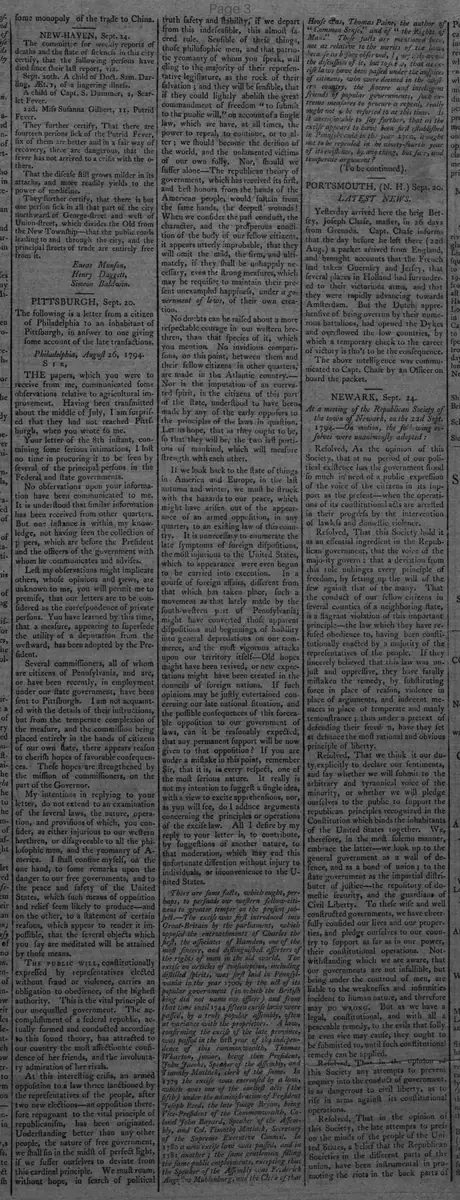
The following is a letter from a citizen of Philadelphia to an inhabitant of Pittsburgh, in answer to one giving some account of the late transactions.
Philadelphia, August 26, 1794.
SIR,
THE papers, which you were to receive from me, communicated some observations relative to agricultural improvement. Having been transmitted about the middle of July, I am surprised that they had not reached Pittsburgh, when you wrote to me.
Your letter of the 8th instant, containing some serious intimations, I lost no time in procuring it to be seen by several of the principal persons in the Federal and State governments.
No observations upon your information have been communicated to me. It is understood that similar information has been received from other quarters. But one instance is within my knowledge, not having seen the collection of papers, which are before the President and the officers of the government with whom he communicates and advises.
Lest my observations might implicate others, whose opinions and views, are unknown to me, you will permit me to premise, that our letters are to be considered as the correspondence of private persons. You have learned by this time, that a measure, appearing to supersede the utility of a deputation from the westward, has been adopted by the President.
Several commissioners, all of whom are citizens of Pennsylvania, and are or have been recently, in employment under our state government, have been sent to Pittsburgh. I am not acquainted with the details of their instructions, but from the temperate complexion of the measure, and the commission being placed entirely in the hands of citizens of our own state, there appears reason to cherish hopes of favorable consequences. These hopes are strengthened by the mission of commissioners, on the part of the Governor.
My intentions in replying to your letter, do not extend to an examination of the several laws, the nature, operation, and provisions of which, you consider, as either injurious to our western brethren, or disagreeable to all the philosophic men, and the yeomanry of America. I shall confine myself, on the one hand, to some remarks upon the danger to our free governments, and to the peace and safety of the United States, which such means of opposition and relief seem likely to produce—and on the other, to a statement of certain reasons, which appear to render it impossible, that the several objects which you say are meditated will be attained by those means.
The PUBLIC WILL, constitutionally expressed by representatives elected without fraud or violence, carries an obligation to obedience, of the highest authority. This is the vital principle of our unequalled government. The accomplishment of a federal republic, actually formed and conducted according to this sound theory, has attracted to our country the most affectionate confidence of her friends, and the involuntary admiration of her rivals.
At this interesting crisis, an armed opposition to a law thrice sanctioned by the representatives of the people, after two new elections—an opposition therefore repugnant to the vital principle of republicanism, has been originated. Understanding better than any other people, the nature of free government, we shall sin in the midst of perfect light, if we suffer ourselves to deviate from this cardinal principle. We must roam, without hope, in search of political truth safety and stability, if we depart from this indefeasible, this almost sacred rule. Sensible of these things, those philosophic men, and that patriotic yeomanry of whom you speak, will cling to the majority of their representative legislature, as the rock of their salvation; and they will be sensible, that if they could lightly abolish the great commandment of freedom "to submit to the public will," on account of a single law, which we have, at all times, the power to repeal, to continue, or to alter; we should become the derision of the world, and the unlamented victims of our own folly. Nor, should we suffer alone—The republican theory of government, which has received its first and best honors from the hands of the American people would sustain from the same hands, the deepest wounds!
When we consider the past conduct, the character, and the prosperous condition of the body of our fellow citizens, it appears utterly improbable, that they will omit the mild, the firm, and ultimately, if they shall be unhappily necessary, even the strong measures, which may be requisite to maintain their present unexampled happiness, under a government of laws, of their own creation.
No doubts can be raised about a more respectable courage in our western brethren, than that species of it, which you mention. No invidious comparisons, on this point, between them and their fellow citizens in other quarters, are made in the Atlantic country. Nor is the imputation of an enervated spirit, in the citizens of this part of the state, understood to have been made by any of the early opposers to the principles of the laws in question. Let us hope, that as they ought to be, so that they will be, the two last portions of mankind, which will measure strength with each other.
If we look back to the state of things in America and Europe, in the last autumn and winter, we must be struck with the hazards to our peace, which might have arisen out of the appearance of an armed opposition, in any quarter, to an existing law of this country. It is unnecessary to enumerate the late symptoms of foreign dispositions, the most injurious to the United States, which to appearance were even begun to be carried into execution. In a course of foreign affairs, different from that which has taken place, such a movement as that lately made by the south-western part of Pennsylvania; might have converted those apparent dispositions and beginnings of hostility into general depredations on our commerce, and the most vigorous attacks upon our territory itself—Old hopes might have been revived, or new expectations might have been created in the councils of foreign nations. If such opinions may be justly entertained concerning our late national situation, and the possible consequences of this forced opposition to our government of laws, can it be reasonably expected, that any permanent support will be now given to that opposition? If you are under a mistake in this point, remember Sir, that it is, in every respect, one of the most serious nature. It really is not my intention to suggest a single idea, with a view to excite apprehensions, nor, as you will see, do I adduce arguments concerning the principles or operations of the excise law. All I desire by my reply to your letter is, to contribute, by suggestions of another nature, to that moderation, which may end this unfortunate dissension without injury to individuals, or inconvenience to the United States.
There are some facts, which ought, perhaps, to persuade our western fellow-citizens to greater temper on the present subject. The excise was first introduced into Great-Britain by the parliament, which opposed the encroachments of Charles the first, the associates of Hamden, one of the most sincere, and distinguished assertors of the rights of man in the old world. The excise on articles of consumption, including distilled spirits, was first laid in Pennsylvania in the year 1700, by the act of its popular government (in which the British king did not name one officer) and from that time until 1744 fifteen excise laws were passed, by a truly popular assembly, often at variance with the proprietors. A law, confirming the excise of the late province, was passed in the first year of the independence of this commonwealth, Thomas Wharton, junior, being then President, John Jacobs, Speaker of the Assembly, and Timothy Matlack, clerk of the same. In 1779 the excise was increased by a law, which was one of the earliest acts (the fifth) under the administration of President Joseph Reed, the late judge Bryan, being Vice-President of the Commonwealth, Colonel John Bayard, Speaker of the Assembly, and Col. Timothy Matlack, Secretary of the Supreme Executive Council. In 1780 a new excise law was passed, and in 1781 another; the same gentleman filling the same public employments, excepting that the Speaker of the Assembly was Frederick Augustus Muhlenberg, and the Clerk of that House was, Thomas Paine, the author of "Common Sense," and of "the Rights of Man." These facts are mentioned here, not as relative to the merits of the law, because as before observed, I purposely avoid the discussion of it, but to show, that as excise laws have been passed under the auspices of citizens, who were deemed in the western country, the sincere and intelligent friends of popular governments, such extreme measures to procure a repeal, really ought not to be resorted to at this time. Is it unreasonable to say further, that as the excise appears to have been first established in Pennsylvania in the year 1700, it ought not to be repealed in the ninety-fourth year of its existence, by any thing, but fair, and temperate argument?
(To be continued).
What sub-type of article is it?
What themes does it cover?
What keywords are associated?
What entities or persons were involved?
Letter to Editor Details
Author
A Citizen Of Philadelphia
Recipient
An Inhabitant Of Pittsburgh
Main Argument
armed opposition to the federal excise law undermines republican principles and risks national stability; historical precedents show excise taxes have long been accepted in pennsylvania, urging moderation and constitutional obedience for peaceful resolution.
Notable Details