Thank you for visiting SNEWPapers!
Sign up free
Brownlow's Knoxville Whig, And Rebel Ventilator
Knoxville, Knox County, Tennessee
What is this article about?
Report from Hood's Medical Director details horrific conditions at Andersonville prison in Georgia, including inadequate food, shelter, water, medical care, leading to 20% mortality from scurvy and related diseases among 34,000 Union prisoners in 1864.
Clipping
OCR Quality
Full Text
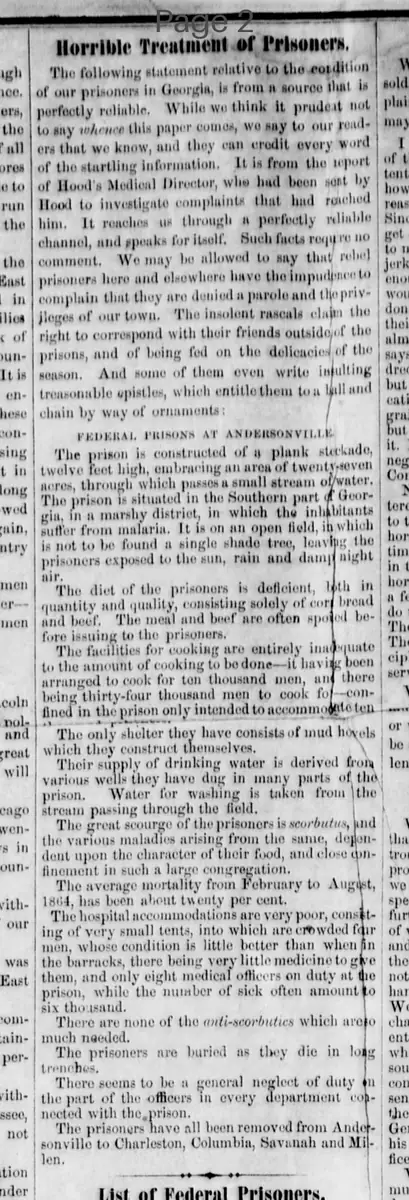
The following statement relative to the condition of our prisoners in Georgia, is from a source that is perfectly reliable. While we think it prudent not to say whence this paper comes, we say to our readers that we know, and they can credit every word of the startling information. It is from the report of Hood's Medical Director, who had been sent by Hood to investigate complaints that had reached him. It reaches us through a perfectly reliable channel, and speaks for itself. Such facts require no comment. We may be allowed to say that rebel prisoners here and elsewhere have the impudence to complain that they are denied a parole and the privileges of our town. The insolent rascals claim the right to correspond with their friends outside of the prisons, and of being fed on the delicacies of the season. And some of them even write insulting treasonable epistles, which entitle them to a ball and chain by way of ornaments:
FEDERAL PRISONS AT ANDERSONVILLE.
The prison is constructed of a plank stockade twelve feet high, embracing an area of twenty-seven acres, through which passes a small stream of water. The prison is situated in the Southern part of Georgia, in a marshy district, in which the inhabitants suffer from malaria. It is on an open field, in which is not to be found a single shade tree, leaving the prisoners exposed to the sun, rain and damp night air.
The diet of the prisoners is deficient, both in quantity and quality, consisting solely of corn bread and beef. The meal and beef are often spoiled before issuing to the prisoners.
The facilities for cooking are entirely inadequate to the amount of cooking to be done—it having been arranged to cook for ten thousand men, and there being thirty-four thousand men to cook for—confined in the prison only intended to accommodate ten.
The only shelter they have consists of mud hovels which they construct themselves.
Their supply of drinking water is derived from various wells they have dug in many parts of the prison. Water for washing is taken from the stream passing through the field.
The great scourge of the prisoners is scorbutus, and the various maladies arising from the same, dependent upon the character of their food, and close confinement in such a large congregation.
The average mortality from February to August, 1864, has been about twenty per cent.
The hospital accommodations are very poor, consisting of very small tents, into which are crowded four men, whose condition is little better than when in the barracks, there being very little medicine to give them, and only eight medical officers on duty at the prison, while the number of sick often amount to six thousand.
There are none of the anti-scorbutics which are so much needed.
The prisoners are buried as they die in long trenches.
There seems to be a general neglect of duty on the part of the officers in every department connected with the prison.
The prisoners have all been removed from Andersonville to Charleston, Columbia, Savannah and Millen.
What sub-type of article is it?
What keywords are associated?
What entities or persons were involved?
Where did it happen?
Domestic News Details
Primary Location
Andersonville, Georgia
Event Date
February To August 1864
Key Persons
Outcome
average mortality of twenty per cent; prisoners buried in long trenches; prisoners removed to charleston, columbia, savannah, and millen.
Event Details
The prison at Andersonville is a plank stockade twelve feet high enclosing twenty-seven acres with a small stream, in a marshy, malarial district without shade trees. Diet is deficient corn bread and spoiled beef. Cooking facilities inadequate for 34,000 prisoners in space for 10,000. Shelter is self-constructed mud hovels. Water from wells and stream. Main scourge is scorbutus and related maladies from food and confinement. Hospital tents overcrowded with little medicine and only eight medical officers for up to 6,000 sick. No anti-scorbutics. General neglect by officers.