Thank you for visiting SNEWPapers!
Sign up free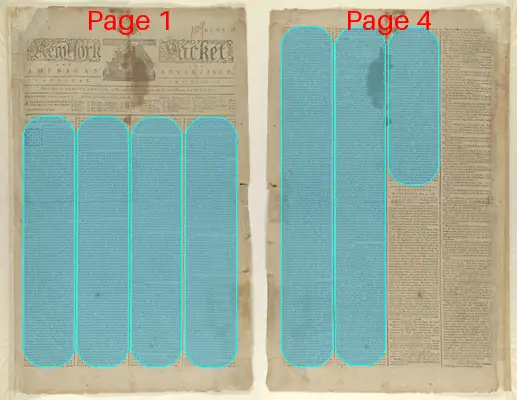
The New York Packet, And The American Advertiser
New York, Fishkill, New York County, Dutchess County, New York
What is this article about?
In the House of Lords, the Duke of Richmond criticizes military supersessions, coercive measures against America, the burning of Norfolk, defective treaties for German mercenaries, and Britain's defenseless state. Other lords defend the treaties and coercive policies, debating the necessity of foreign aid and prospects of the American war.
Merged-components note: These two components are parts of the same ongoing debate in the House of Lords, continued across pages, with sequential reading order and coherent topic on British policy towards America.
Clippings
1 of 2
OCR Quality
Full Text
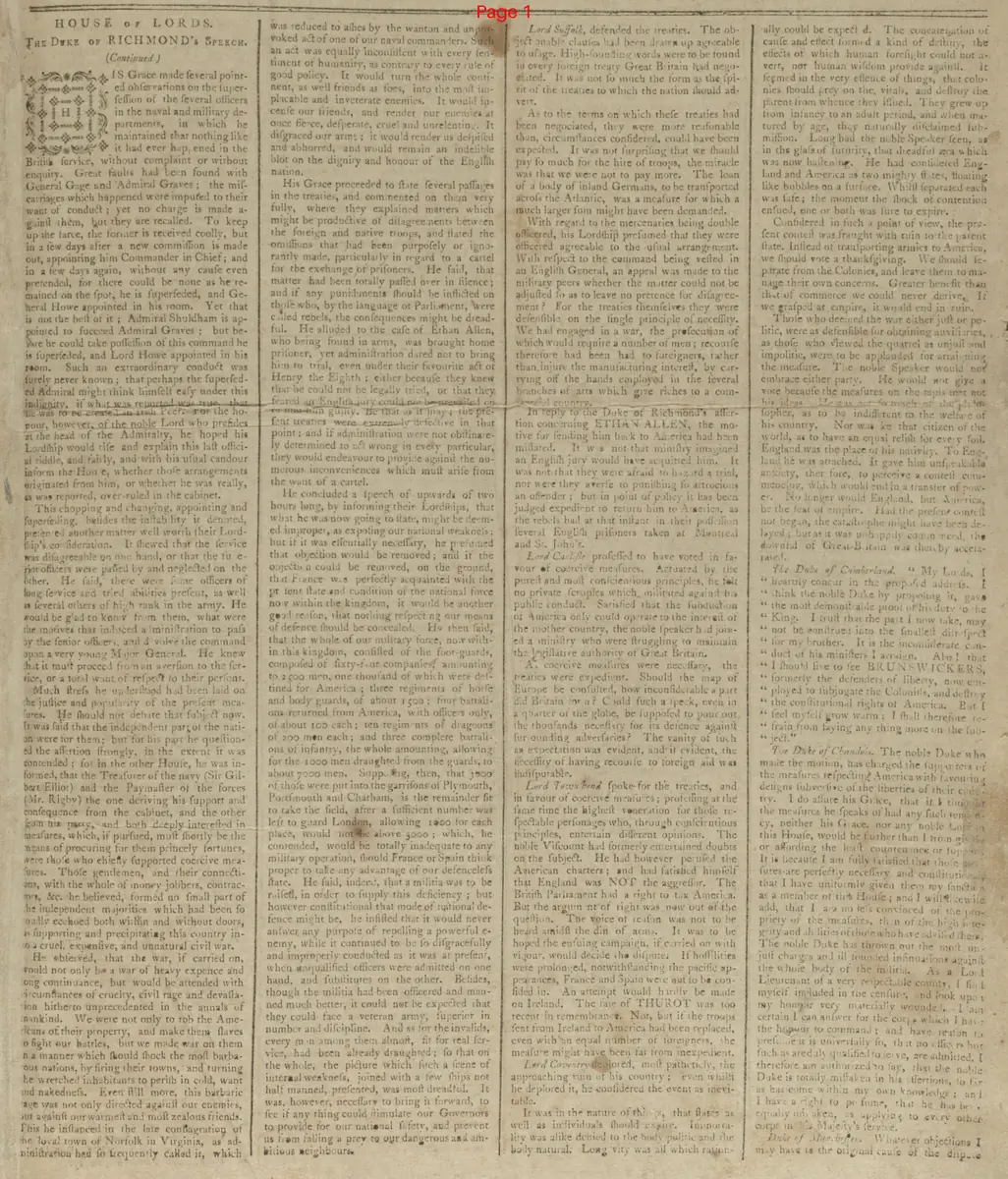
THE DUKE OF RICHMOND'S SPEECH.
(Continued.)
His Grace made several pointed observations on the supersession of the several officers in the naval and military departments, in which he maintained that nothing like it had ever happened in the British service, without complaint or without enquiry. Great faults had been found with General Gage and Admiral Graves; the miscarriages which happened were imputed to their want of conduct; yet no charge is made against them, but they are recalled. To keep up the farce, the former is received coolly, but in a few days after a new commission is made out, appointing him Commander in Chief; and in a few days again, without any cause even pretended, for there could be none as he remained in the post, he is superseded, and General Howe appointed in his room. Yet that is not the best of it; Admiral Shuldham is appointed to succeed Admiral Graves; but before he could take possession of this command he is superseded, and Lord Howe appointed in his room. Such an extraordinary conduct was surely never known; that perhaps the superseded Admiral might think himself easy under this indignity, if what was reported was true that he was to be created a British Peer. For the honour, however, of the noble Lord who presides at the head of the Admiralty, he hoped his Lordship would rise and explain this last official riddle, and fairly, and with his usual candour inform the House, whether those arrangements originated from him, or whether he was really, as was reported, over-ruled in the cabinet.
This chopping and changing, appointing and superseding, besides the instability it denoted, presented another matter well worth their Lordships' consideration. It shewed that the service was disagreeable on one hand, or that the superior officers were passed by and neglected on the other. He said, there were some officers of long service and tried abilities present, as well as several others of high rank in the army. He would be glad to know from them, what were the motives that induced administration to pass by the senior officers, and devolve the command upon a very young Major General. He knew that it must proceed from an aversion to the service, or a total want of respect to their persons.
Much stress he understood had been laid on the justice and popularity of the present measures. He should not debate that subject now. It was said that the independent part of the nation were for them; but for his part he questioned the assertion strongly, in the extent it was contended; for in the other House, he was informed, that the Treasurer of the navy (Sir Gilbert Elliot) and the Paymaster of the forces (Mr. Rigby) the one deriving his support and consequence from the cabinet, and the other from his merry, and both deeply interested in measures, which, if pursued, must shortly be the means of procuring for them princely fortunes, were those who chiefly supported coercive measures. Those gentlemen, and their connections, with the whole of money jobbers, contractors, &c. he believed, formed no small part of the independent majorities which had been so loudly echoed both within and without doors, supporting and precipitating this country into a cruel, expensive, and unnatural civil war.
He observed, that the war, if carried on, would not only be a war of heavy expense and long continuance, but would be attended with circumstances of cruelty, civil rage and devastation hitherto unprecedented in the annals of mankind. We were not only to rob the Americans of their property, and make them slaves to fight our battles, but we made war on them in a manner which would shock the most barbarous nations, by firing their towns, and turning the wretched inhabitants to perish in cold, want and nakedness. Even still more, this barbaric rage was not only directed against our enemies, but against our warmest and most zealous friends. This he instanced in the late conflagration of the loyal town of Norfolk in Virginia, as administration had so frequently called it, which was reduced to ashes by the wanton and unprovoked act of one of our naval commanders. Such an act was equally inconsistent with every sentiment of humanity, as contrary to every rule of good policy. It would turn the whole continent, as well friends as foes, into the most implacable and inveterate enemies. It would incense our friends, and render our enemies at once fierce, desperate, cruel and unrelenting. It disgraced our arms; it would render us despised and abhorred, and would remain an indelible blot on the dignity and honour of the English nation.
His Grace proceeded to state several passages in the treaties, and commented on them very fully, where they explained matters which might be productive of disagreements between the foreign and native troops, and stated the omissions that had been purposely or ignorantly made, particularly in regard to a cartel for the exchange of prisoners. He said, that matter had been totally passed over in silence; and if any punishments should be inflicted on those who, by the language of Parliament, were called rebels, the consequences might be dreadful. He alluded to the case of Ethan Allen, who being found in arms, was brought home prisoner, yet administration dared not to bring him to trial, even under their favourite act of Henry the Eighth; either because they knew that he could not be legally tried, or that they feared an English jury could not be prevailed on to find him guilty. Be that as it may; the present treaties were extremely defective in that point; and if administration were not obstinately determined to do wrong in every particular, they would endeavour to provide against the numerous inconveniences which must arise from the want of a cartel.
He concluded a speech of upwards of two hours long, by informing their Lordships, that what he was now going to state, might be deemed improper, as exposing our national weakness; but if it was essentially necessary, he presumed that objection would be removed; and if the objection could be removed, on the ground, that France was perfectly acquainted with the present state and condition of the national force now within the kingdom, it would be another good reason, that nothing respecting our means of defence should be concealed. He then said, that the whole of our military force, now within this kingdom, consisted of the foot-guards, composed of sixty-four companies, amounting to 2000 men, one thousand of which were destined for America; three regiments of horse and body guards, of about 1000; four battalions returned from America, with officers only, of about 100 each; ten regiments of dragoons of 200 men each; and three complete battalions of infantry, the whole amounting, allowing for the 1000 men draughted from the guards, to about 7000 men. Suppose, then, that 6000 of those were put into the garrisons of Plymouth, Portsmouth and Chatham, is the remainder fit to take the field, after a sufficient number was left to guard London, allowing 1000 for each place, would not be above 3000; which, he contended, would be totally inadequate to any military operation, should France or Spain think proper to take any advantage of our defenceless state. He said, indeed, that a militia was to be raised, in order to supply this deficiency; but however constitutional that mode of national defence might be, he insisted that it would never answer any purpose of repelling a powerful enemy, while it continued to be so disgracefully and improperly conducted as it was at present, when unqualified officers were admitted on one hand, and substitutes on the other. Besides, though the militia had been officered and manned much better, it could not be expected that they could face a veteran army, superior in number and discipline. And as for the invalids, every man among them almost, fit for real service, had been already draughted; so that on the whole, the picture which such a scene of internal weakness, joined with a few ships not half manned, presented, was most dreadful. It was, however, necessary to bring it forward, to see if any thing could stimulate our Governors to provide for our national safety, and prevent us from falling a prey to our dangerous and ambitious neighbours.
Lord Suffolk defended the treaties. The objectionable clauses had been drawn up agreeable to usage. High-sounding words were to be found in every foreign treaty Great Britain had negotiated. It was not so much the form as the spirit of the treaties to which the nation should advert.
As to the terms on which these treaties had been negotiated, they were more reasonable than, circumstances considered, could have been expected. It was not surprising that we should pay so much for the hire of troops, the miracle was that we were not to pay more. The loan of a body of inland Germans, to be transported across the Atlantic, was a measure for which a much larger sum might have been demanded.
With regard to the mercenaries being double officered, his Lordship presumed that they were officered agreeable to the usual arrangement. With respect to the command being vested in an English General, an appeal was made to the military peers whether the matter could not be adjusted so as to leave no pretence for disagreement? For the treaties themselves they were defensible on the single principle of necessity. We had engaged in a war, the prosecution of which would require a number of men; recourse therefore had been had to foreigners, rather than injure the manufacturing interest, by carrying off the hands employed in the several branches of arts which give riches to a commercial country.
In reply to the Duke of Richmond's assertion concerning ETHAN ALLEN, the motive for sending him back to America had been misstated. It was not that ministry imagined an English jury would have acquitted him. It was not that they were afraid to hazard a trial, nor were they averse to punishing so atrocious an offender; but in point of policy it has been judged expedient to return him to America, as the rebels had at that instant in their possession several English prisoners taken at Montreal and St. John's.
Lord Carlisle professed to have voted in favour of coercive measures. Actuated by the purest and most conscientious principles, he felt no private scruples which militated against his public conduct. Satisfied that the subduing of America only could operate to the interest of the mother country, the noble speaker had joined a ministry who were struggling to maintain the legislative authority of Great Britain. As coercive measures were necessary, the treaties were expedient. Should the map of Europe be consulted, how inconsiderable a part did Britain hold? Could such a speck, even in a quarter of the globe, be supposed to pour out the thousands necessary for its defence against surrounding adversaries? The vanity of such an expectation was evident, and it evident, the necessity of having recourse to foreign aid was indisputable.
Lord Townsend spoke for the treaties, and in favour of coercive measures; professing at the same time the highest veneration for those respectable personages who, through conscientious principles, entertain different opinions. The noble Viscount had formerly entertained doubts on the subject. He had however perused the American charters; and had satisfied himself that England was not the aggressor. The British Parliament had a right to tax America. But the argument of right was now out of the question. The voice of reason was not to be heard amidst the din of arms. It was to be hoped the ensuing campaign, if carried on with vigour, would decide the dispute. If hostilities were prolonged, notwithstanding the pacific appearances, France and Spain were not to be confided in. An attempt would hardly be made on Ireland. The fate of THURO T was too recent in remembrance. Not, but if the troops sent from Ireland to America had been replaced, even with an equal number of foreigners, the measure might have been far from inexpedient.
Lord Coventry deplored, most pathetically, the approaching ruin of his country; even whilst he deplored it, he considered the event as inevitable. It was in the nature of things, that states as well as individuals should expire. Immortality was alike denied to the body politic and the body natural. Longevity was all which rational
ally could be expected. The concatenation of cause and effect formed a kind of destiny, the effects of which human foresight could not avert, nor human wisdom provide against. It seemed in the very essence of things, that colonies should prey on the vitals, and destroy the parent from whence they issued. They grew up from infancy to an adult period, and when matured by age, they naturally disclaimed submission. Long had the noble Speaker seen, as in the glass of futurity, that dreadful scene which was now hastening. He had considered England and America as two mighty states, floating like bubbles on a surface. Whilst separated each was safe; the moment the shock of contention ensued, one or both was sure to expire.
Considered in such a point of view, the present contest was fraught with ruin to the parent state. Instead of transporting armies to America, we should vote a thanksgiving. We should separate from the Colonies, and leave them to manage their own concerns. Greater benefit than that of commerce we could never derive. If we grasped at empire, it would end in ruin. Those who deemed the war either just or politic, were as defensible for obtaining auxiliaries, as those who viewed the quarrel as unjust and impolitic, were to be applauded for arraigning the measure. The noble Speaker would not embrace either party. He would not give a vote because the measures on the tapis met not his ideas even at so much of the philosopher, as to be indifferent to the welfare of his country. Nor was it that citizen of the world, as to have an equal relish for every form. England was the place of his nativity. To England he was attached. It gave him unspeakable anxiety, therefore, to perceive a contest commencing, which would end in a transfer of power. No longer would England, but America, be the seat of empire. Had the present contest not began, the catastrophe might have been delayed; but as it was unhappily commenced, the downfall of Great-Britain was thereby accelerated.
The Duke of Cumberland. "My Lords, I heartily concur in the proposed address. I think the noble Duke by proposing it, gave the most demonstrable proof of his duty to the King. I trust that the part I now take, may not be construed into the smallest disrespect for my brother. It is the inconsiderate conduct of his ministers I arraign. All that I should wish to see BRUNSWICKERS, formerly the defenders of liberty, now employed to subjugate the Colonies, and destroy the constitutional rights of America. But I feel myself grow warm; I shall therefore refrain from saying any thing more on the subject."
The Duke of Chandos. The noble Duke who made the motion, has charged the supporters of the measures respecting America with favouring designs subversive of the liberties of their country. I do assure his Grace, that if I thought the measures he speaks of had any such tendency, neither his Grace, nor any noble Lord in this House, would be further than I to give or affording the least countenance or support. It is because I am fully satisfied that those measures are perfectly necessary and constitutional, that I have uniformly given them my sanction as a member of this House; and I will likewise add, that I am no less convinced of the propriety of the measures, than of the high integrity and abilities of those who have advised them. The noble Duke has thrown out the most unjust charges and ill founded insinuations against the whole body of the militia. As a Lord Lieutenant of a very respectable county, I find myself included in the censure, and look upon my honour very materially wounded. I am certain I can answer for the corps which I have the honour to command; and have reason to believe it is universally so, that no officers such as are duly qualified to serve, are admitted. I therefore am authorized to say, that the noble Duke is totally mistaken in his assertions, so far as has come within my own knowledge; and I have a right to presume, that he has been equally mistaken, as applying to every other corps in his Majesty's service.
Duke of Manchester. Whatever objections I may have to the original cause of the dispute
between both countries. however I may condemn the mode in which it has been little to conducted, or how much soever I may disapprove of the measure of employing foreigners to make a conquest of our own subjects, and commission them to carry all the horrors of a war into a part of the dominions of the British Crown ; I own I have still, if possible, stronger and more material objections against some matters which make their appearance in the treaties now before your Lordships. I think I perceive something which bears the strongest, nay most unequivocal marks of that secret influence, that black complexion, which openly or covertly, as opportunities served, or circumstances concurred, have pervaded our Councils for some years back. America is to be conquered, no matter by what means. The blood and treasure of this country is to be lavishly thrown away in effecting this purpose. A set of beggarly, insignificant German Princes are to be doubly subsidized to give this extraordinary measure success. But that is not all : the commander of this body of mercenaries is to be invested with the supreme command, independent of the control of either King or Parliament. In any dispute that should arise, where are the parties to appeal? not to the King, for he has no power over them; not to the Parliament, for they can pretend to none. Where then, as no provision is made in the treaty, but to the Prince to whom they belong? Thus you will have a body of 12,000 men with a veteran general at their head, free from any control whatever. Suppose any dispute should arise between our commanders and theirs, who is to decide it ? The foreign general knows no superior but his master ; and the consequence will be; that in such event, all operations will cease till he receive instructions from home; and thus the very end for which those foreigners are brought into the kingdom will be defeated, and the nation put to a monstrous expense for nothing. Lansdowne. I should not have troubled your Lordships upon a subject which has been so fully and repeatedly discussed in all its parts, did not three points which naturally present themselves on the present occasion, strike me very strongly. Those are, the force which America is able to oppose to ours, with their resources for maintaining that force, the prospect of success on our part, and the means of defence against the attacks of our natural enemies. The first may be considered in two lights, the number of troops America will be able to bring into the field, and the mode adopted for paying them. This, my Lords, is a point which calls for your Lordships most serious consideration. With such as deny the justice of the war, it will operate as proving its impracticability, as well as injustice; with such as contend for its justice, it will create a very strong objection as to the expediency. By the measures proposed by the Continental Congress for obliging every province to contribute a certain number of men, and a certain specific sum of money for their support, it was directed that the inhabitants of each province should be numbered, and the men and money proportioned to such returns. On this occasion, as might be expected, the returns were short, considerably, of the real number of souls; notwithstanding this, they amounted to three millions and a half, which is more by almost one half than any gross computation had mounted to. To pay those men, the Congress gave orders to strike off four millions of dollars in paper currency, which sum, accordingly as the paper is emitted, is to pass current in the respective provinces where the revenue arises. Thus, though paper be emitted, it is fully paid away without incurring a debt; for the supplies by this means are raised within the year, every man contributing his own share, and the whole state, as one body, still left free of any debt or incumbrance whatever. On the second point it is plain, including the foreigners, and supposing the British corps complete, which I am sure they are not, the whole force acting on the part of Great-Britain, will not much exceed 20,000 effective men. Will any of your Lordships assert, or be persuaded to believe, that an army of 20,000 men will be able in one campaign, or in any given time, to make a complete conquest of three millions and a half of people, zealous for their liberties, and resolutely determined to defend them to the last extremity? I am sure there is not. If so, then every pretence to expedition and putting a speedy end to the present civil war, is at once over. The force will be inadequate; and I will say more, any force you will or can send will be so. As to the last point of domestic defence, how does that stand ? Let us presume, for a minute, that the military force remaining in this kingdom, aided by the militia, was sufficient for the purpose of defending this island; will it be pretended that Ireland, with a force in it of only 8,000 men, will be equally secure? I am confident such a monstrous assertion will not be made; 12,000 men, even in times of peace, has been at all times thought necessary for the preservation of its internal tranquility. I would appeal to a noble Lord near me (Lord Townshend) supposing no attack had been made from without, whether the military establishment, after the embarkation, would be equal even to the suppression of domestic riot or disturbance, much less if a body of French or Spaniards should make a descent there. For my part, I think and believe, the noble Viscount who presided there so many years as chief Governor, is of the same opinion, that 10,000 men might march from one end of the kingdom to the other without molestation, there being no barrier, natural or artificial to prevent them but the Shannon ; so that on the whole, pursuing the justice of the war out of the question, I am persuaded that the present measures are big with ruin in every light, and cu.
What sub-type of article is it?
What keywords are associated?
What entities or persons were involved?
Where did it happen?
Foreign News Details
Primary Location
America
Key Persons
Event Details
The Duke of Richmond delivers a lengthy speech criticizing the supersession of naval and military officers like Gage, Graves, Howe, Shuldham, and Lord Howe without inquiry; coercive measures supported by Elliot and Rigby; the burning of Norfolk, Virginia by a British naval commander; defects in treaties for hiring German mercenaries, including lack of prisoner exchange provisions and issues with Ethan Allen; and Britain's weak domestic military force of about 7000 men, inadequate against France or Spain, with poorly conducted militia. Lords Suffolk, Carlisle, Townsend, Chandos defend the treaties as necessary for the American war, citing usage, policy on Allen's return for prisoner exchange, Britain's limited resources, and right to tax America. Lords Coventry and Manchester oppose, predicting ruin, separation from colonies, and issues with mercenary command independence. Duke of Cumberland concurs in address but criticizes ministers for using Brunswickers against colonies. Lansdowne highlights America's 3.5 million population, paper currency funding, British force inadequacy of 20,000, and Ireland's vulnerability with 8000 men.