Thank you for visiting SNEWPapers!
Sign up free
Story
April 1, 1915
The Pickens Sentinel
Pickens, Pickens County, South Carolina
What is this article about?
Historical account of William L. Keith, first clerk of Old Pickens District court, his family, successor James E. Hagood, and early punishment practices including pillory, whipping post, and public hangings at the gallows lot.
Clipping
OCR Quality
98%
Excellent
Full Text
Some More History of Old Pickens District
By N. Boone Carey
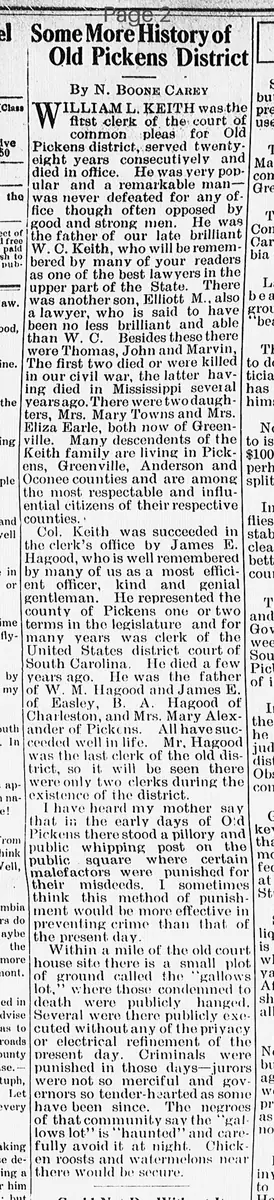
William L. Keith was the first clerk of the court of common pleas for Old Pickens district. Served twenty eight years consecutively and died in office. He was very popular and a remarkable man-was never defeated for any office though often opposed by good and strong men. He was the father of our late brilliant W. C. Keith, who will be remembered by many of your readers as one of the best lawyers in the upper part of the State. There was another son, Elliott M., also a lawyer, who is said to have been no less brilliant and able than W. C. Besides these there were Thomas, John and Marvin. The first two died or were killed in our civil war, the latter having died in Mississippi several years ago. There were two daughters, Mrs. Mary Towns and Mrs. Eliza Earle, both now of Greenville. Many descendants of the Keith family are living in Pickens, Greenville, Anderson and Oconee counties and are among the most respectable and influential citizens of their respective counties.
Col. Keith was succeeded in the clerk's office by James E. Hagood, who is well remembered by many of us as a most efficient officer, kind and genial gentleman. He represented the county of Pickens one or two terms in the legislature and for many years was clerk of the United States district court of South Carolina. He died a few years ago. He was the father of W. M. Hagood and James E. of Easley, B. A. Hagood of Charleston, and Mrs. Mary Alexander of Pickens. All have succeeded well in life. Mr. Hagood was the last clerk of the old district, so it will be seen there were only two clerks during the existence of the district.
I have heard my mother say that in the early days of Old Pickens there stood a pillory and public whipping post on the public square where certain malefactors were punished for their misdeeds. I sometimes think this method of punishment would be more effective in preventing crime than that of the present day.
Within a mile of the old court house site there is a small plot of ground called the "gallows lot," where those condemned to death were publicly hanged. Several were there publicly executed without any of the privacy or electrical refinement of the present day. Criminals were punished in those days-jurors were not so merciful and governors so tender-hearted as some have been since. The negroes of that community say the "gallows lot" is "haunted" and carefully avoid it at night. Chicken roosts and watermelons near there would be secure.
By N. Boone Carey
William L. Keith was the first clerk of the court of common pleas for Old Pickens district. Served twenty eight years consecutively and died in office. He was very popular and a remarkable man-was never defeated for any office though often opposed by good and strong men. He was the father of our late brilliant W. C. Keith, who will be remembered by many of your readers as one of the best lawyers in the upper part of the State. There was another son, Elliott M., also a lawyer, who is said to have been no less brilliant and able than W. C. Besides these there were Thomas, John and Marvin. The first two died or were killed in our civil war, the latter having died in Mississippi several years ago. There were two daughters, Mrs. Mary Towns and Mrs. Eliza Earle, both now of Greenville. Many descendants of the Keith family are living in Pickens, Greenville, Anderson and Oconee counties and are among the most respectable and influential citizens of their respective counties.
Col. Keith was succeeded in the clerk's office by James E. Hagood, who is well remembered by many of us as a most efficient officer, kind and genial gentleman. He represented the county of Pickens one or two terms in the legislature and for many years was clerk of the United States district court of South Carolina. He died a few years ago. He was the father of W. M. Hagood and James E. of Easley, B. A. Hagood of Charleston, and Mrs. Mary Alexander of Pickens. All have succeeded well in life. Mr. Hagood was the last clerk of the old district, so it will be seen there were only two clerks during the existence of the district.
I have heard my mother say that in the early days of Old Pickens there stood a pillory and public whipping post on the public square where certain malefactors were punished for their misdeeds. I sometimes think this method of punishment would be more effective in preventing crime than that of the present day.
Within a mile of the old court house site there is a small plot of ground called the "gallows lot," where those condemned to death were publicly hanged. Several were there publicly executed without any of the privacy or electrical refinement of the present day. Criminals were punished in those days-jurors were not so merciful and governors so tender-hearted as some have been since. The negroes of that community say the "gallows lot" is "haunted" and carefully avoid it at night. Chicken roosts and watermelons near there would be secure.
What sub-type of article is it?
Biography
Historical Event
What themes does it cover?
Family
Justice
What keywords are associated?
Old Pickens District
William Keith
James Hagood
Court Clerks
Family History
Public Punishments
Gallows Lot
What entities or persons were involved?
William L. Keith
W. C. Keith
Elliott M. Keith
Thomas Keith
John Keith
Marvin Keith
Mrs. Mary Towns
Mrs. Eliza Earle
James E. Hagood
W. M. Hagood
B. A. Hagood
Mrs. Mary Alexander
N. Boone Carey
Where did it happen?
Old Pickens District, South Carolina
Story Details
Key Persons
William L. Keith
W. C. Keith
Elliott M. Keith
Thomas Keith
John Keith
Marvin Keith
Mrs. Mary Towns
Mrs. Eliza Earle
James E. Hagood
W. M. Hagood
James E. Hagood
B. A. Hagood
Mrs. Mary Alexander
N. Boone Carey
Location
Old Pickens District, South Carolina
Event Date
Early Days Of Old Pickens
Story Details
William L. Keith served 28 years as first clerk of Old Pickens court, died in office, father of notable lawyers and others; succeeded by James E. Hagood, efficient officer and legislator; early punishments included pillory, whipping post, and public hangings at gallows lot, believed haunted by locals.