Thank you for visiting SNEWPapers!
Sign up free
Story
April 6, 1874
The Wheeling Daily Register
Wheeling, Ohio County, West Virginia
What is this article about?
Dr. Brown-Sequard's Boston lecture discusses methods to stop coughing, sneezing, hiccoughs, and respiratory spasms using pressure on nerves, cold water, tickling, or willpower, highlighting their importance in treating lung ailments like bronchitis and pneumonia.
Clipping
OCR Quality
95%
Excellent
Full Text
Hints for Curing Coughing, Sneezing, etc.
Lecture of Dr. Brown-Sequard at Boston.
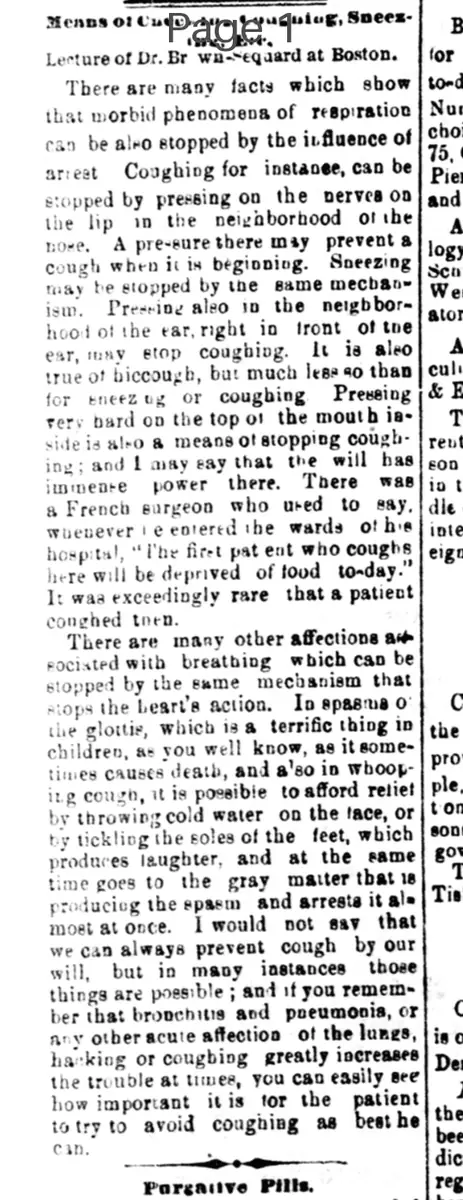
There are many facts which show that morbid phenomena of respiration can also be stopped by the influence of arrest. Coughing for instance, can be stopped by pressing on the nerves on the lip in the neighborhood of the nose. A pressure there may prevent a cough when it is beginning. Sneezing may be stopped by the same mechanism. Pressing also in the neighborhood of the ear, right in front of the ear, may stop coughing. It is also true of hiccough, but much less so than for sneezing or coughing. Pressing very hard on the top of the mouth inside is also a means of stopping coughing; and I may say that the will has immense power there. There was a French surgeon who used to say, whenever he entered the wards of his hospital, 'The first patient who coughs here will be deprived of food to-day.' It was exceedingly rare that a patient coughed then.
There are many other affections connected with breathing which can be stopped by the same mechanism that stops the heart's action. In spasm of the glottis, which is a terrific thing in children, as you well know, as it sometimes causes death, and also in whooping cough, it is possible to afford relief by throwing cold water on the face, or by tickling the soles of the feet, which produces laughter, and at the same time goes to the gray matter that is producing the spasm and arrests it almost at once. I would not say that we can always prevent cough by our will, but in many instances those things are possible; and if you remember that bronchitis and pneumonia, or any other acute affection of the lungs, harking or coughing greatly increases the trouble at times, you can easily see how important it is for the patient to try to avoid coughing as best he can.
Lecture of Dr. Brown-Sequard at Boston.
There are many facts which show that morbid phenomena of respiration can also be stopped by the influence of arrest. Coughing for instance, can be stopped by pressing on the nerves on the lip in the neighborhood of the nose. A pressure there may prevent a cough when it is beginning. Sneezing may be stopped by the same mechanism. Pressing also in the neighborhood of the ear, right in front of the ear, may stop coughing. It is also true of hiccough, but much less so than for sneezing or coughing. Pressing very hard on the top of the mouth inside is also a means of stopping coughing; and I may say that the will has immense power there. There was a French surgeon who used to say, whenever he entered the wards of his hospital, 'The first patient who coughs here will be deprived of food to-day.' It was exceedingly rare that a patient coughed then.
There are many other affections connected with breathing which can be stopped by the same mechanism that stops the heart's action. In spasm of the glottis, which is a terrific thing in children, as you well know, as it sometimes causes death, and also in whooping cough, it is possible to afford relief by throwing cold water on the face, or by tickling the soles of the feet, which produces laughter, and at the same time goes to the gray matter that is producing the spasm and arrests it almost at once. I would not say that we can always prevent cough by our will, but in many instances those things are possible; and if you remember that bronchitis and pneumonia, or any other acute affection of the lungs, harking or coughing greatly increases the trouble at times, you can easily see how important it is for the patient to try to avoid coughing as best he can.
What sub-type of article is it?
Medical Curiosity
What themes does it cover?
Recovery
What keywords are associated?
Coughing Control
Sneezing Prevention
Respiratory Spasms
Willpower Medicine
Medical Lecture
What entities or persons were involved?
Dr. Brown Sequard
French Surgeon
Where did it happen?
Boston
Story Details
Key Persons
Dr. Brown Sequard
French Surgeon
Location
Boston
Story Details
Dr. Brown-Sequard lectures on stopping respiratory issues like coughing, sneezing, hiccoughs, glottis spasms, and whooping cough via nerve pressure, cold water, tickling, or willpower, emphasizing benefits for lung disease patients.