Thank you for visiting SNEWPapers!
Sign up free
Editorial
February 9, 1782
The New Hampshire Gazette And General Advertiser
Portsmouth, Exeter, Rockingham County, New Hampshire
What is this article about?
This editorial concludes an argument against eastern New Hampshire towns' claims to independence or allegiance to Vermont, citing historical land grants annexed to New Hampshire, inhabitants' acquiescence to its laws, and participation in the revolution as evidence of their subjection to NH jurisdiction.
Clipping
OCR Quality
92%
Excellent
Full Text
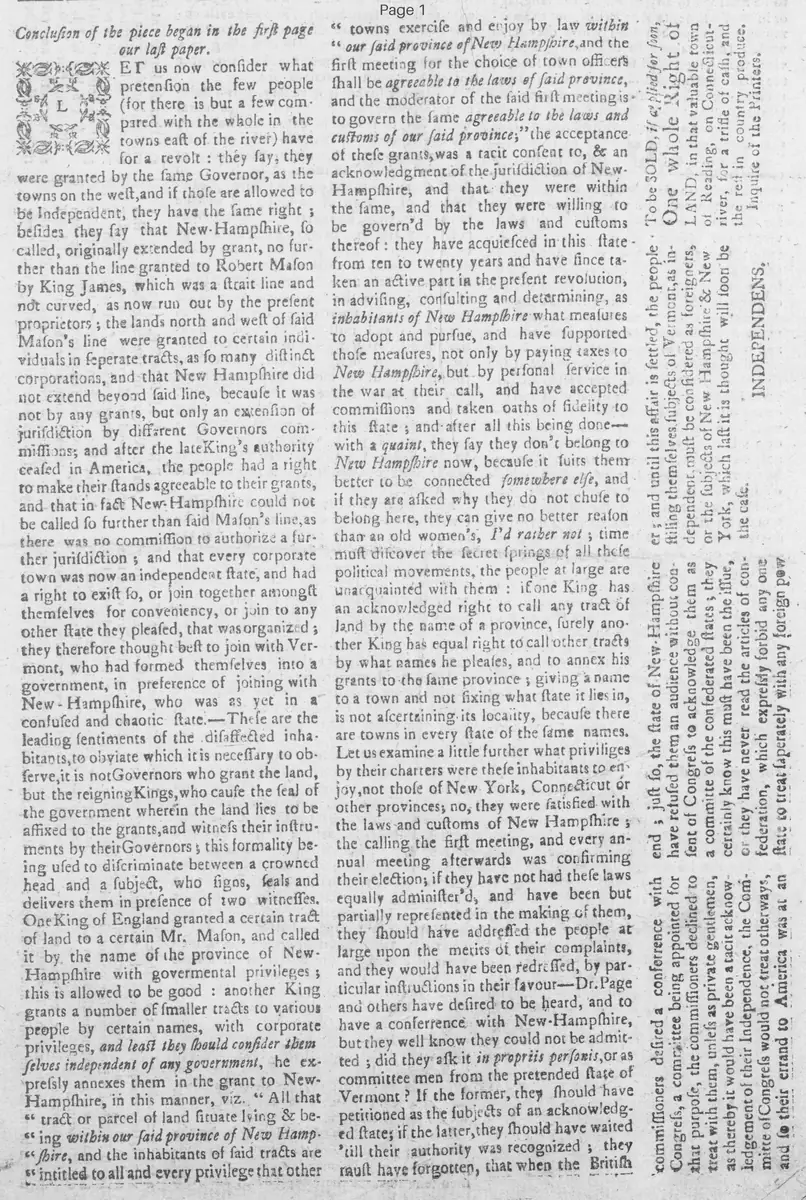
Conclusion of the piece began in the first page our last paper.
Let us now consider what pretension the few people (for there is but a few compared with the whole in the towns east of the river) have for a revolt: they say, they were granted by the same Governor, as the towns on the west, and if those are allowed to be Independent, they have the same right; besides they say that New-Hampshire, so called, originally extended by grant, no further than the line granted to Robert Mason by King James, which was a straight line and not curved, as now run out by the present proprietors; the lands north and west of said Mason's line were granted to certain individuals in separate tracts, as so many distinct corporations, and that New Hampshire did not extend beyond said line, because it was not by any grants, but only an extension of jurisdiction by different Governors commissions; and after the late King's authority ceased in America, the people had a right to make their stands agreeable to their grants, and that in fact New-Hampshire could not be called so further than said Mason's line, as there was no commission to authorize a further jurisdiction; and that every corporate town was now an independent state, and had a right to exist so, or join together amongst themselves for conveniency, or join to any other state they pleased, that was organized; they therefore thought best to join with Vermont, who had formed themselves into a government, in preference of joining with New-Hampshire, who was as yet in a confused and chaotic state. These are the leading sentiments of the disaffected inhabitants, to obviate which it is necessary to observe, it is not Governors who grant the land, but the reigning Kings, who cause the seal of the government wherein the land lies to be affixed to the grants, and witness their instruments by their Governors; this formality being used to discriminate between a crowned head and a subject, who signs, seals and delivers them in presence of two witnesses. One King of England granted a certain tract of land to a certain Mr. Mason, and called it by the name of the province of New-Hampshire with governmental privileges; this is allowed to be good: another King grants a number of smaller tracts to various people by certain names, with corporate privileges, and lest they should consider themselves independent of any government, he expressly annexes them in the grant to New-Hampshire, in this manner, viz. "All that tract or parcel of land situate lying & being within our said province of New Hampshire, and the inhabitants of said tracts are intitled to all and every privilege that other
" towns exercise and enjoy by law within s' our said province of New Hampshire, and the first meeting for the choice of town officers shall be agreeable to the laws of said province, and the moderator of the said first meeting is to govern the same agreeable to the laws and customs of our said province;" the acceptance of these grants, was a tacit consent to, & an acknowledgment of the jurisdiction of New. Hampshire, and that they were within the same, and that they were willing to be govern'd by the laws and customs thereof: they have acquiesced in this state-from ten to twenty years and have since ta-ken an active part in the present revolution, in advising, consulting and determining, as inhabitants of New Hampshire what measures to adopt and pursue, and have supported those measures, not only by paying taxes to New Hampshire, but by personal service in the war at their call, and have accepted commissions and taken oaths of fidelity to this state; and after all this being done--with a quibble, they say they don't belong to New Hampshire now, because it suits them better to be connected somewhere else, and if they are asked why they do not choose to belong here, they can give no better reason than an old woman's, I'd rather not; time must discover the secret springs of all these political movements, the people at large are unacquainted with them: if one King has an acknowledged right to call any tract of land by the name of a province, surely ano-ther King has equal right to call other tracts by what names he pleases, and to annex his grants to the same province; giving a name to a town and not fixing what state it lies in, is not ascertaining its locality, because there are towns in every state of the same names. Let us examine a little further what privileges by their charters were these inhabitants to en-joy, not those of New York, Connecticut or other provinces; no, they were satisfied with the laws and customs of New Hampshire; the calling the first meeting, and every an-nual meeting afterwards was confirming their election; if they have not had these laws equally adminiter'd, and have been but partially represented in the making of them, they should have addressed the people at large upon the merits of their complaints, and they would have been redressed, by par-ticular instructions in their favour--Dr. Page and others have desired to be heard, and to have a conference with New-Hampshire, but they well know they could not be admit-ted; did they ask it in propriis personis, or as committee men from the pretended state of Vermont? If the former, they should have petitioned as the subjects of an acknowledg-ed state; if the latter, they should have waited till their authority was recognized; they must have forgotten, that when the British
commissioners desired a conference with Congress, a committee being appointed for that purpose, the commissioners declined to treat with them, unless as private gentlemen, as thereby it would have been a tacit acknowledgement of their Independence, the Com-mittee of Congress would not treat otherwise, and so their errand to America was at an end; just so, the state of New-Hampshire have refused them an audience without con-sent of Congress to acknowledge them as a committee of the confederated states; they certainly know this must have been the issue, or they have never read the articles of con-federation, which expressly forbid any one state to treat separately with any foreign pow-er; and until this affair is settled, the people stilling themselves subjects of Vermont, as in-dependent, must be considered as foreigners, or the subjects of New Hampshire & New York, which last it is thought will soon be the case.
INDEPENDENCE.
Let us now consider what pretension the few people (for there is but a few compared with the whole in the towns east of the river) have for a revolt: they say, they were granted by the same Governor, as the towns on the west, and if those are allowed to be Independent, they have the same right; besides they say that New-Hampshire, so called, originally extended by grant, no further than the line granted to Robert Mason by King James, which was a straight line and not curved, as now run out by the present proprietors; the lands north and west of said Mason's line were granted to certain individuals in separate tracts, as so many distinct corporations, and that New Hampshire did not extend beyond said line, because it was not by any grants, but only an extension of jurisdiction by different Governors commissions; and after the late King's authority ceased in America, the people had a right to make their stands agreeable to their grants, and that in fact New-Hampshire could not be called so further than said Mason's line, as there was no commission to authorize a further jurisdiction; and that every corporate town was now an independent state, and had a right to exist so, or join together amongst themselves for conveniency, or join to any other state they pleased, that was organized; they therefore thought best to join with Vermont, who had formed themselves into a government, in preference of joining with New-Hampshire, who was as yet in a confused and chaotic state. These are the leading sentiments of the disaffected inhabitants, to obviate which it is necessary to observe, it is not Governors who grant the land, but the reigning Kings, who cause the seal of the government wherein the land lies to be affixed to the grants, and witness their instruments by their Governors; this formality being used to discriminate between a crowned head and a subject, who signs, seals and delivers them in presence of two witnesses. One King of England granted a certain tract of land to a certain Mr. Mason, and called it by the name of the province of New-Hampshire with governmental privileges; this is allowed to be good: another King grants a number of smaller tracts to various people by certain names, with corporate privileges, and lest they should consider themselves independent of any government, he expressly annexes them in the grant to New-Hampshire, in this manner, viz. "All that tract or parcel of land situate lying & being within our said province of New Hampshire, and the inhabitants of said tracts are intitled to all and every privilege that other
" towns exercise and enjoy by law within s' our said province of New Hampshire, and the first meeting for the choice of town officers shall be agreeable to the laws of said province, and the moderator of the said first meeting is to govern the same agreeable to the laws and customs of our said province;" the acceptance of these grants, was a tacit consent to, & an acknowledgment of the jurisdiction of New. Hampshire, and that they were within the same, and that they were willing to be govern'd by the laws and customs thereof: they have acquiesced in this state-from ten to twenty years and have since ta-ken an active part in the present revolution, in advising, consulting and determining, as inhabitants of New Hampshire what measures to adopt and pursue, and have supported those measures, not only by paying taxes to New Hampshire, but by personal service in the war at their call, and have accepted commissions and taken oaths of fidelity to this state; and after all this being done--with a quibble, they say they don't belong to New Hampshire now, because it suits them better to be connected somewhere else, and if they are asked why they do not choose to belong here, they can give no better reason than an old woman's, I'd rather not; time must discover the secret springs of all these political movements, the people at large are unacquainted with them: if one King has an acknowledged right to call any tract of land by the name of a province, surely ano-ther King has equal right to call other tracts by what names he pleases, and to annex his grants to the same province; giving a name to a town and not fixing what state it lies in, is not ascertaining its locality, because there are towns in every state of the same names. Let us examine a little further what privileges by their charters were these inhabitants to en-joy, not those of New York, Connecticut or other provinces; no, they were satisfied with the laws and customs of New Hampshire; the calling the first meeting, and every an-nual meeting afterwards was confirming their election; if they have not had these laws equally adminiter'd, and have been but partially represented in the making of them, they should have addressed the people at large upon the merits of their complaints, and they would have been redressed, by par-ticular instructions in their favour--Dr. Page and others have desired to be heard, and to have a conference with New-Hampshire, but they well know they could not be admit-ted; did they ask it in propriis personis, or as committee men from the pretended state of Vermont? If the former, they should have petitioned as the subjects of an acknowledg-ed state; if the latter, they should have waited till their authority was recognized; they must have forgotten, that when the British
commissioners desired a conference with Congress, a committee being appointed for that purpose, the commissioners declined to treat with them, unless as private gentlemen, as thereby it would have been a tacit acknowledgement of their Independence, the Com-mittee of Congress would not treat otherwise, and so their errand to America was at an end; just so, the state of New-Hampshire have refused them an audience without con-sent of Congress to acknowledge them as a committee of the confederated states; they certainly know this must have been the issue, or they have never read the articles of con-federation, which expressly forbid any one state to treat separately with any foreign pow-er; and until this affair is settled, the people stilling themselves subjects of Vermont, as in-dependent, must be considered as foreigners, or the subjects of New Hampshire & New York, which last it is thought will soon be the case.
INDEPENDENCE.
What sub-type of article is it?
Constitutional
Partisan Politics
What keywords are associated?
New Hampshire Jurisdiction
Vermont Secession
Land Grants
Colonial Privileges
American Revolution
State Confederation
What entities or persons were involved?
New Hampshire
Vermont
Robert Mason
King James
Dr. Page
Congress
British Commissioners
Editorial Details
Primary Topic
Defense Of New Hampshire Jurisdiction Against Eastern Towns' Claims To Join Vermont
Stance / Tone
Defensive Of New Hampshire Authority, Critical Of Disaffected Inhabitants
Key Figures
New Hampshire
Vermont
Robert Mason
King James
Dr. Page
Congress
British Commissioners
Key Arguments
Land Grants Were Annexed To New Hampshire Province By Royal Decree
Inhabitants Accepted Nh Jurisdiction Through Grants And Participation In Revolution
Towns' Claims Ignore Historical Acquiescence And Oaths Of Fidelity To Nh
Conferences With Nh Refused Without Congressional Recognition Of Vermont
Articles Of Confederation Prohibit Separate State Treaties