Thank you for visiting SNEWPapers!
Sign up free
The Evening Bulletin
Maysville, Mason County, Kentucky
What is this article about?
In Canada's federal election on March 5, Sir John Macdonald's Conservatives were returned to power with a reduced majority of about 10 seats, down from 51, as Liberals gained 13 seats but fell short of overturning the government. Key ministers defeated, regional variations noted.
Merged-components note: The second component is a direct textual continuation of the Canadian election story from the first (ends with 'The Conservatives have, therefore' and starts with 'elected 108 members'), with sequential reading order.
Clipping
OCR Quality
Full Text
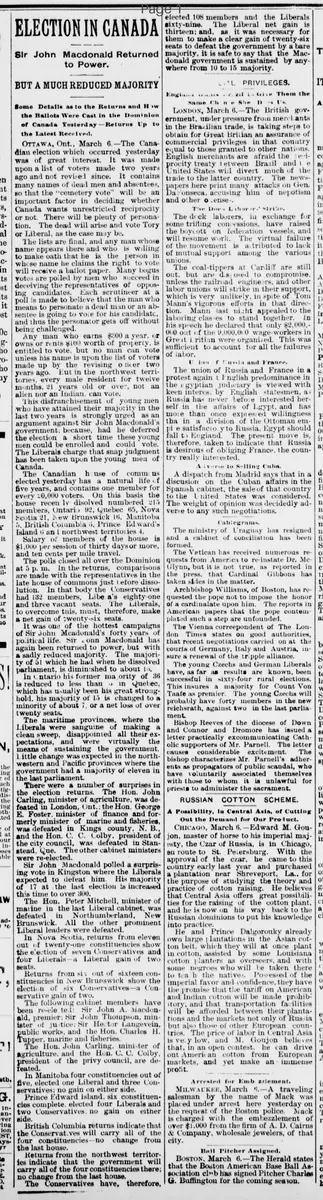
Sir John Macdonald Returned to Power.
BUT A MUCH REDUCED MAJORITY
Some Details as to the Returns and How the Ballots Were Cast in the Dominion of Canada Yesterday—Returns Up to the Latest Received.
OTTAWA, Ont., March 6.—The Canadian election which occurred yesterday was of great interest. It was made upon a list of voters made two years ago and not revised since. It contains many names of dead men and absentees, so that the "cemetery vote" will be an important factor in deciding whether Canada wants unrestricted reciprocity or not. There will be plenty of personation. The dead will arise and vote Tory or Liberal, as the case may be.
The lists are final, and any man whose name appears there and who is willing to make oath that he is the person in whose name he claims the right to vote will receive a ballot paper. Many bogus votes are polled by men who succeed in deceiving the representatives of opposing candidates. Each scrutineer at a poll is made to believe that the man who means to personate a dead man or an absentee is going to vote for his candidate, and thus the personator gets off without being challenged.
Any man who earns $300 a year, or owns or rents $100 worth of property, is entitled to vote, but no man can vote unless his name is upon the list of voters made up by the revising officer two years ago. But in the northwest territories, every male resident for twelve months, 21 years old or over, not an alien nor an Indian, can vote.
This disfranchisement of young men who have attained their majority in the last two years is strongly urged as an argument against Sir John Macdonald's government; because, had he deferred the election a short time these young men could be enrolled and could vote. The Liberals charge that snap judgment has been taken upon the young men of Canada.
The Canadian house of commons elected yesterday has a natural life of five years, and contains one member for every 20,000 voters. On this basis the house recently dissolved numbered 215 members. Ontario 92, Quebec 65, Nova Scotia 21, New Brunswick 16, Manitoba 5, British Columbia 7, Prince Edward's Island 6 and northwest territories 4.
Salary of members of the house is $1,000 per session of thirty days or more, and ten cents per mile travel.
The polls closed all over the Dominion at 5 p. m. In the returns, comparisons are made with the representatives in the late house of commons just before dissolution. In that body the Conservatives had 132 members, Liberals eighty-one and three vacant seats. The Liberals to overcome this, must, therefore, make a net gain of twenty-six seats.
It was one of the hottest campaigns of Sir John Macdonald's forty years of political life. Sir John Macdonald has again been returned to power, but with a sadly reduced majority. The majority of 51 which he had when he dissolved parliament, is diminished to about 10.
In Ontario his former majority of 36 is reduced to less than 5; in Quebec which has usually been his great stronghold, his majority of 15 is changed to a minority of about 7, or a net loss of over twenty seats.
The maritime provinces, where the Liberals were sanguine of making a clean sweep, disappointed all their expectations, and were virtually the means of sustaining the government. Little change was expected in the northwestern and Pacific provinces where the government had a majority of eleven in the last parliament.
There were a number of surprises in the election returns. The Hon. John Carling, minister of agriculture, was defeated in London, Ont.; the Hon. George E. Foster, minister of finance and formerly minister of marine and fisheries, was defeated in Kings county, N. B., and the Hon. C. C. Colby, president of the city council, was defeated in Stanstead, Que. The other cabinet ministers were re-elected.
Sir John Macdonald polled a surprising vote in Kingston where the Liberals expected to defeat him. His majority of 17 at the last election is increased this time to over 300.
The Hon. Peter Mitchell, minister of marine in the last Liberal cabinet, was defeated in Northumberland, New Brunswick. All the other prominent Liberal leaders were defeated.
In Nova Scotia, returns from eleven out of twenty-one constituencies show the election of seven Conservatives and four Liberals—a Liberal gain of two seats.
Returns from six out of sixteen constituencies in New Brunswick show the election of six Conservatives—a Conservative gain of two.
The following cabinet members have been re-elected: Sir John A. Macdonald, premier; Sir John Thompson, minister of justice; Sir Hector Langevin, public works, and the Hon. Charles H. Tupper, marine and fisheries.
The Hon. John Carling, minister of agriculture, and the Hon. C. C. Colby, president of the privy council, are defeated.
In Manitoba four constituencies out of five, elected one Liberal and three Conservatives; no gain on either side.
Prince Edward Island, six constituencies complete, elected four Liberals and two Conservatives, no gain on either side.
British Columbia returns indicate that the Conservatives will carry all of the four constituencies—no change from the last house.
Returns from the northwest territories indicate that the government will carry all of the four constituencies there; no change from the last house.
The Conservatives have, therefore, elected 108 members and the Liberals sixty-nine. The Liberal net gain is thirteen; and, as it was necessary for them to make a clear gain of twenty-six seats to defeat the government by a bare majority, it is safe to say that the Macdonald government is sustained by anywhere from 10 to 15 majority.
What sub-type of article is it?
What keywords are associated?
What entities or persons were involved?
Where did it happen?
Foreign News Details
Primary Location
Dominion Of Canada
Event Date
Yesterday, As Reported March 6
Key Persons
Outcome
conservatives elected 108 members, liberals 69; liberal net gain of 13 seats, but conservatives retain power with majority of 10 to 15. key defeats: carling, foster, colby, mitchell.
Event Details
The Canadian federal election featured controversies over outdated voter lists enabling personation and disfranchisement of young voters. Polls closed at 5 p.m. Conservatives under Sir John Macdonald won with reduced majority; regional results varied, with Liberal gains in Ontario and Quebec offset by holds in maritime and western provinces. Several cabinet ministers defeated, but Macdonald increased his personal majority in Kingston.