Thank you for visiting SNEWPapers!
Sign up free
Literary
February 9, 1782
The New Hampshire Gazette And General Advertiser
Portsmouth, Exeter, Rockingham County, New Hampshire
What is this article about?
An essay arguing that national vices stem from government forms and legislation, not individual morality. It examines vices like female infidelity, defamation, and sensuality as necessary outcomes of luxury and political structures in Britain, advocating for legal reform over moral declamation to improve societal manners.
Clipping
OCR Quality
95%
Excellent
Full Text
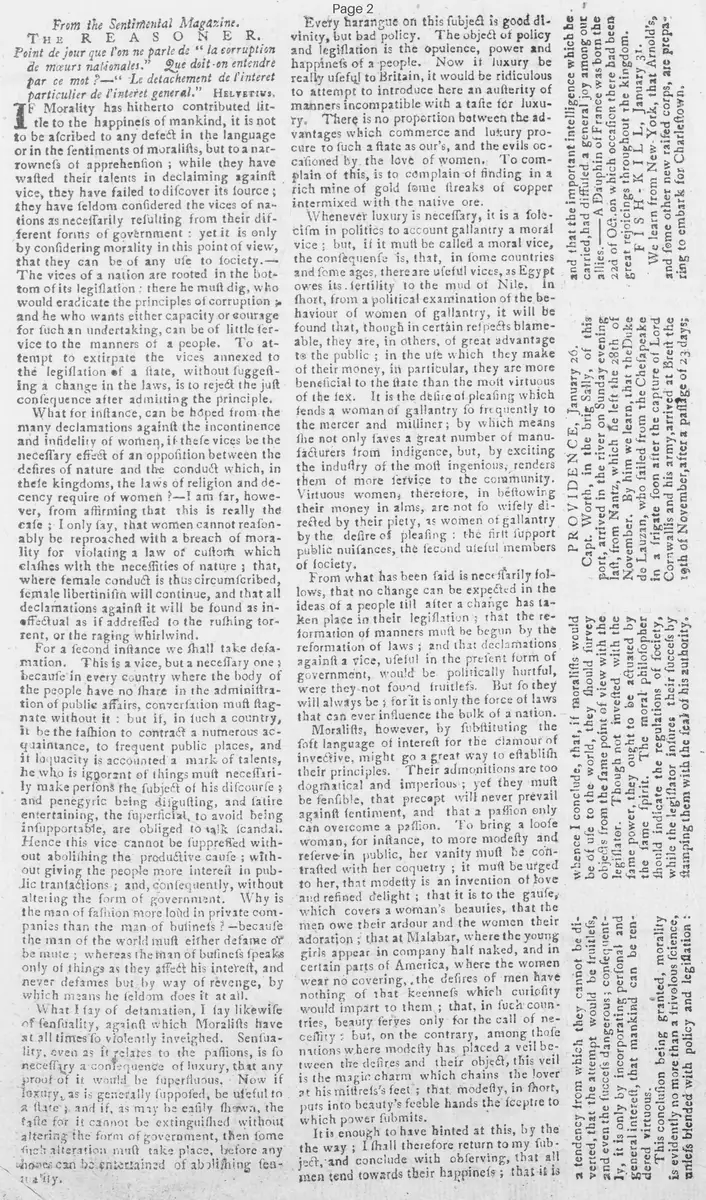
From the Sentimental Magazine.
THE REASONER.
"Point de jour que l'on ne parle de la corruption de mœurs nationales." Que doit-on entendre par ce mot? "Le détachement de l'intérêt particulier de l'intérêt général." Helvetius.
Morality has hitherto contributed little to the happiness of mankind. It is not to be ascribed to any defect in the language or in the sentiments of moralists, but to a narrowness of apprehension; while they have wasted their talents in declaiming against vice, they have failed to discover its source: they have seldom considered the vices of nations as necessarily resulting from their different forms of government: yet it is only by considering morality in this point of view, that they can be of any use to society.
The vices of a nation are rooted in the bottom of its legislation: there he must dig, who would eradicate the principles of corruption; and he who wants either capacity or courage for such an undertaking, can be of little service to the manners of a people. To attempt to extirpate the vices annexed to the legislation of a state, without suggesting a change in the laws, is to reject the just consequence after admitting the principle.
What, for instance, can be hoped from the many declamations against the incontinence and infidelity of women, if these vices be the necessary effect of an opposition between the desires of nature and the conduct which, in these kingdoms, the laws of religion and decency require of women?--I am far, however, from affirming that this is really the case: I only say, that women cannot reasonably be reproached with a breach of morality for violating a law of custom which clashes with the necessities of nature; that, where female conduct is thus circumscribed, female libertinism will continue, and that all declamations against it will be found as ineffectual as if addressed to the rushing torrent, or the raging whirlwind.
For a second instance we shall take defamation. This is a vice, but a necessary one; because in every country where the body of the people have no share in the administration of public affairs, conversation must stagnate without it: but if, in such a country, it be the fashion to contract a numerous acquaintance, to frequent public places, and if loquacity is accounted a mark of talents, he who is ignorant of things must necessarily make persons the subject of his discourse; and panegyric being disgusting, and satire entertaining, the superficial, to avoid being insupportable, are obliged to talk scandal.
Hence this vice cannot be suppressed without abolishing the productive cause: without giving the people more interest in public transactions; and, consequently, without altering the form of government. Why is the man of fashion more loud in private companies than the man of business? --because the man of the world must either defame or be mute: whereas the man of business speaks only of things as they affect his interest, and never defames but by way of revenge, by which means he seldom does it at all.
What I say of defamation, I say likewise of sensuality, against which Moralists have at all times so violently inveighed. Sensuality, even as it relates to the passions, is so necessary a consequence of luxury, that any proof of it would be superfluous. Now if luxury, as is generally supposed, be useful to a state; and if, as may be easily shown, the taste for it cannot be extinguished without altering the form of government, then some such alteration must take place, before any hopes can be entertained of abolishing sensuality.
Every harangue on this subject is good divinity, but bad policy. The object of policy and legislation is the opulence, power and happiness of a people. Now if luxury be really useful to Britain, it would be ridiculous to attempt to introduce here an austerity of manners incompatible with a taste for luxury.
There is no proportion between the advantages which commerce and luxury procure to such a state as ours, and the evils occasioned by the love of women. To complain of this, is to complain of finding in a rich mine of gold some streaks of copper intermixed with the native ore.
Whenever luxury is necessary, it is a solecism in politics to account gallantry a moral vice: but, if it must be called a moral vice, the consequence is, that, in some countries and some ages, there are useful vices, as Egypt owes its fertility to the mud of Nile. In short, from a political examination of the behaviour of women of gallantry, it will be found that, though in certain respects blamable, they are, in others, of great advantage to the public; in the use which they make of their money, in particular, they are more beneficial to the state than the most virtuous of the sex. It is the desire of pleasing which sends a woman of gallantry so frequently to the mercer and milliner: by which means she not only saves a great number of manufacturers from indigence, but, by exciting the industry of the most ingenious, renders them of more service to the community.
Virtuous women, therefore, in bestowing their money in alms, are not so wisely directed by their piety, as women of gallantry by the desire of pleasing: the first support public nuisances, the second useful members of society.
From what has been said it necessarily follows, that no change can be expected in the ideas of a people till after a change has taken place in their legislation; that the reformation of manners must be begun by the reformation of laws: and that declamations against a vice, useful in the present form of government, would be politically hurtful, were they not found fruitless. But so they will always be: for it is only the force of laws that can ever influence the bulk of a nation.
Moralists, however, by substituting the soft language of interest for the clamour of invective, might go a great way to establish their principles. Their admonitions are too dogmatical and imperious: yet they must be sensible, that precept will never prevail against sentiment, and that a passion only can overcome a passion. To bring a loose woman, for instance, to more modesty and reserve in public, her vanity must be contrasted with her coquetry: it must be urged to her, that modesty is an invention of love and refined delight; that it is to the gauze, which covers a woman's beauties, that the men owe their ardour and the women their adoration: that at Malabar, where the young girls appear in company half naked, and in certain parts of America, where the women wear no covering, the desires of men have nothing of that keenness which curiosity would impart to them: that, in such countries, beauty serves only for the call of necessity: but, on the contrary, among those nations where modesty has placed a veil between the desires and their object, this veil is the magic charm which chains the lover at his mistress's feet; that, modesty, in short, puts into beauty's feeble hands the sceptre to which power submits.
It is enough to have hinted at this, by the way; I shall therefore return to my subject, and conclude with observing, that all men tend towards their happiness; that it is a tendency from which they cannot be diverted, that the attempt would be fruitless, and even the success dangerous; consequently, it is only by incorporating personal and general interest, that mankind can be rendered virtuous.
This conclusion, being granted, morality is evidently no more than a trivial science, unless blended with policy and legislation: whence I conclude, that, if moralists would be of use to the world, they should survey objects from the same point of view with the legislator. Though not invested with the same power, they ought to be actuated by the same spirit. The moral philosopher should indicate the regulations of society, while the legislator insures their success by stamping them with the seal of his authority.
THE REASONER.
"Point de jour que l'on ne parle de la corruption de mœurs nationales." Que doit-on entendre par ce mot? "Le détachement de l'intérêt particulier de l'intérêt général." Helvetius.
Morality has hitherto contributed little to the happiness of mankind. It is not to be ascribed to any defect in the language or in the sentiments of moralists, but to a narrowness of apprehension; while they have wasted their talents in declaiming against vice, they have failed to discover its source: they have seldom considered the vices of nations as necessarily resulting from their different forms of government: yet it is only by considering morality in this point of view, that they can be of any use to society.
The vices of a nation are rooted in the bottom of its legislation: there he must dig, who would eradicate the principles of corruption; and he who wants either capacity or courage for such an undertaking, can be of little service to the manners of a people. To attempt to extirpate the vices annexed to the legislation of a state, without suggesting a change in the laws, is to reject the just consequence after admitting the principle.
What, for instance, can be hoped from the many declamations against the incontinence and infidelity of women, if these vices be the necessary effect of an opposition between the desires of nature and the conduct which, in these kingdoms, the laws of religion and decency require of women?--I am far, however, from affirming that this is really the case: I only say, that women cannot reasonably be reproached with a breach of morality for violating a law of custom which clashes with the necessities of nature; that, where female conduct is thus circumscribed, female libertinism will continue, and that all declamations against it will be found as ineffectual as if addressed to the rushing torrent, or the raging whirlwind.
For a second instance we shall take defamation. This is a vice, but a necessary one; because in every country where the body of the people have no share in the administration of public affairs, conversation must stagnate without it: but if, in such a country, it be the fashion to contract a numerous acquaintance, to frequent public places, and if loquacity is accounted a mark of talents, he who is ignorant of things must necessarily make persons the subject of his discourse; and panegyric being disgusting, and satire entertaining, the superficial, to avoid being insupportable, are obliged to talk scandal.
Hence this vice cannot be suppressed without abolishing the productive cause: without giving the people more interest in public transactions; and, consequently, without altering the form of government. Why is the man of fashion more loud in private companies than the man of business? --because the man of the world must either defame or be mute: whereas the man of business speaks only of things as they affect his interest, and never defames but by way of revenge, by which means he seldom does it at all.
What I say of defamation, I say likewise of sensuality, against which Moralists have at all times so violently inveighed. Sensuality, even as it relates to the passions, is so necessary a consequence of luxury, that any proof of it would be superfluous. Now if luxury, as is generally supposed, be useful to a state; and if, as may be easily shown, the taste for it cannot be extinguished without altering the form of government, then some such alteration must take place, before any hopes can be entertained of abolishing sensuality.
Every harangue on this subject is good divinity, but bad policy. The object of policy and legislation is the opulence, power and happiness of a people. Now if luxury be really useful to Britain, it would be ridiculous to attempt to introduce here an austerity of manners incompatible with a taste for luxury.
There is no proportion between the advantages which commerce and luxury procure to such a state as ours, and the evils occasioned by the love of women. To complain of this, is to complain of finding in a rich mine of gold some streaks of copper intermixed with the native ore.
Whenever luxury is necessary, it is a solecism in politics to account gallantry a moral vice: but, if it must be called a moral vice, the consequence is, that, in some countries and some ages, there are useful vices, as Egypt owes its fertility to the mud of Nile. In short, from a political examination of the behaviour of women of gallantry, it will be found that, though in certain respects blamable, they are, in others, of great advantage to the public; in the use which they make of their money, in particular, they are more beneficial to the state than the most virtuous of the sex. It is the desire of pleasing which sends a woman of gallantry so frequently to the mercer and milliner: by which means she not only saves a great number of manufacturers from indigence, but, by exciting the industry of the most ingenious, renders them of more service to the community.
Virtuous women, therefore, in bestowing their money in alms, are not so wisely directed by their piety, as women of gallantry by the desire of pleasing: the first support public nuisances, the second useful members of society.
From what has been said it necessarily follows, that no change can be expected in the ideas of a people till after a change has taken place in their legislation; that the reformation of manners must be begun by the reformation of laws: and that declamations against a vice, useful in the present form of government, would be politically hurtful, were they not found fruitless. But so they will always be: for it is only the force of laws that can ever influence the bulk of a nation.
Moralists, however, by substituting the soft language of interest for the clamour of invective, might go a great way to establish their principles. Their admonitions are too dogmatical and imperious: yet they must be sensible, that precept will never prevail against sentiment, and that a passion only can overcome a passion. To bring a loose woman, for instance, to more modesty and reserve in public, her vanity must be contrasted with her coquetry: it must be urged to her, that modesty is an invention of love and refined delight; that it is to the gauze, which covers a woman's beauties, that the men owe their ardour and the women their adoration: that at Malabar, where the young girls appear in company half naked, and in certain parts of America, where the women wear no covering, the desires of men have nothing of that keenness which curiosity would impart to them: that, in such countries, beauty serves only for the call of necessity: but, on the contrary, among those nations where modesty has placed a veil between the desires and their object, this veil is the magic charm which chains the lover at his mistress's feet; that, modesty, in short, puts into beauty's feeble hands the sceptre to which power submits.
It is enough to have hinted at this, by the way; I shall therefore return to my subject, and conclude with observing, that all men tend towards their happiness; that it is a tendency from which they cannot be diverted, that the attempt would be fruitless, and even the success dangerous; consequently, it is only by incorporating personal and general interest, that mankind can be rendered virtuous.
This conclusion, being granted, morality is evidently no more than a trivial science, unless blended with policy and legislation: whence I conclude, that, if moralists would be of use to the world, they should survey objects from the same point of view with the legislator. Though not invested with the same power, they ought to be actuated by the same spirit. The moral philosopher should indicate the regulations of society, while the legislator insures their success by stamping them with the seal of his authority.
What sub-type of article is it?
Essay
What themes does it cover?
Political
Moral Virtue
Commerce Trade
What keywords are associated?
Morality
Vices
Legislation
Government
Luxury
Sensuality
Defamation
Women Gallantry
Literary Details
Title
The Reasoner.
Subject
On The Corruption Of National Morals And Its Relation To Legislation
Key Lines
The Vices Of A Nation Are Rooted In The Bottom Of Its Legislation: There He Must Dig, Who Would Eradicate The Principles Of Corruption;
Whenever Luxury Is Necessary, It Is A Solecism In Politics To Account Gallantry A Moral Vice:
From What Has Been Said It Necessarily Follows, That No Change Can Be Expected In The Ideas Of A People Till After A Change Has Taken Place In Their Legislation;
Morality Is Evidently No More Than A Trivial Science, Unless Blended With Policy And Legislation