Thank you for visiting SNEWPapers!
Sign up free
Richmond Enquirer
Richmond, Richmond County, Virginia
What is this article about?
1816 House committee report on cotton manufacturing petitions, detailing industry's rapid growth from 1800-1815, economic benefits, employment, and advocating 25% ad valorem tariffs on imported cotton goods to protect nascent U.S. factories from foreign competition.
Merged-components note: These components form a single continuous congressional report on cotton manufacturing, split across pages due to parsing.
Clippings
1 of 2
OCR Quality
Full Text
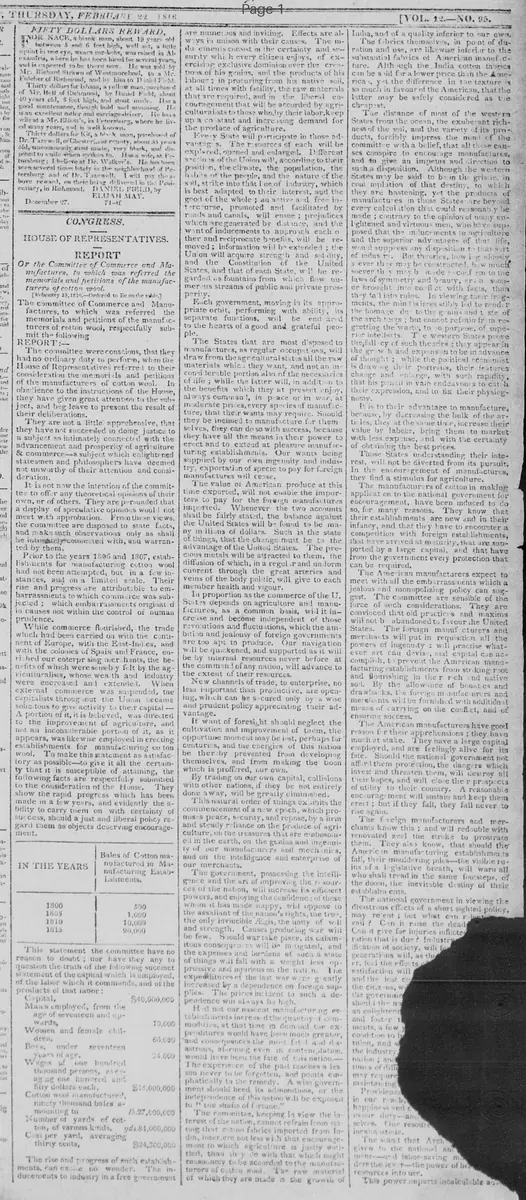
HOUSE OF REPRESENTATIVES.
REPORT
Of the Committee of Commerce and Manufactures, to which was referred the memorials and petitions of the manufacturers of cotton wool.
[February 13, 1816. - Ordered to lie on the table.]
The committee of Commerce and Manufactures, to which was referred the memorials and petitions of the manufacturers of cotton wool, respectfully submit the following
REPORT:-
The committee were conscious, that they had no ordinary duty to perform, when the House of Representatives referred to their consideration the memorials and petitions of the manufacturers of cotton wool. In obedience to the instructions of the House, they have given great attention to the subject, and beg leave to present the result of their deliberations.
They are not a little apprehensive, that they have not succeeded in doing justice to a subject so intimately connected with the advancement and prosperity of agriculture & commerce - a subject which enlightened statesmen and philosophers have deemed not unworthy of their attention and consideration.
It is not now the intention of the committee to offer any theoretical opinions of their own, or of others. They are persuaded that a display of speculative opinions would not meet with approbation. From these views, the committee are disposed to state facts, and make such observations only as shall be intimately connected with, and warranted by them.
Prior to the years 1806 and 1807, establishments for manufacturing cotton wool had not been attempted, but in a few instances, and on a limited scale. Their rise and progress are attributable to embarrassments to which commerce was subjected ; which embarrassments originated in causes not within the control of human prudence.
While commerce flourished, the trade which had been carried on with the continent of Europe. with the East-Indies, and with the colonies of Spain and France, enriched our enterprising merchants, the benefits of which were sensibly felt by the agriculturalists, whose wealth and industry were increased and extended. When external commerce was suspended, the capitalists throughout the Union became solicitous to give activity to their capital -- A portion of it, it is believed, was directed to the improvement of agriculture, and not an inconsiderable portion of it, as it appears, was likewise employed in erecting establishments for manufacturing cotton wool, To make this statement as satisfactory as possible - to give it all the certainty that it is susceptible of attaining, the following facts are respectfully submitted to the consideration of the House. They show the rapid progress which has been made in a few years, and evidently the ability to carry them on with certainty of success, should a just and liberal policy regard them as objects deserving encouragement.
Bales of Cotton manufactured in Manufacturing Establishments.
IN THE YEARS
1800 500
1805 1,000
1810 10,000
1815 90,000
This statement the committee have no reason to doubt ; nor have they any to question the truth of the following succinct statement of the capital which is employed, of the labor which it commands, and of the products of that labor:
Capital, $10,000,000
Males employed, from the age of seventeen and upwards, 19,000
Women and female children, 65,000
Boys, under seventeen years of age, 24,000
Wages of one hundred thousand persons, per annum one hundred and fifty dollars each, $15,000,000
Cotton wool manufactured ninety thousand bales amounting to $27,600,000
Number of yards of cotton, of various kinds, 81,000,000 yds.
Cost per yard, averaging thirty cents, $24,300,000
The rise and progress of such establishments, can excite no wonder. The inducements to industry in a free government are numerous and inviting. Effects are always in unison with their causes. The inducements consist in the certainty and security which every citizen enjoys, of exercising exclusive dominion over the creations of his genius, and the products of his labour; in procuring from his native soil, at all times with facility, the raw materials that are required, and in the liberal encouragement that will be accorded by agricultural states to those who, by their labor, keep up a constant and increasing demand for the produce of agriculture.
Every State will participate in those advantages. The resources of each will be explored, opened and enlarged. Different sections of the Union will, according to their position, the climate, the population, the habits of the people, and the nature of the soil, strike into that line of industry, which is best adapted to their interest, and the good of the whole : an active and free intercourse, promoted and facilitated by roads and canals, will ensue ; prejudices which are generated by distance, and the want of inducements to approach each other and reciprocate benefits, will be removed: information will be extended ; the Union will acquire strength and solidity, and the Constitution of the United States, and that of each State, will be regarded as fountains from which flow numerous streams of public and private prosperity.
Each government, moving in its appropriate orbit, performing with ability, its separate functions, will be endeared to the hearts of a good and grateful people.
The States that are most disposed to manufactures, as regular occupations, will draw from the agricultural states all the raw materials which they want, and not an inconsiderable portion also of the necessaries of life : while the latter will, in addition to the benefits which they at present enjoy, always command, in peace or in war, at moderate prices, every species of manufacture, that their wants may require. Should they be inclined to manufacture for themselves, they can do so with success, because they have all the means in their power to erect and to extend at pleasure manufacturing establishments. Our wants being supplied by our own ingenuity and industry, exportation of specie to pay for foreign manufactures will cease.
The value of American produce at this time exported, will not enable the importers to pay for the foreign manufactures imported. Whenever the two accounts shall be fairly stated. the balance against the United States will be found to be many millions of dollars. Such is the state of things, that the change must be to the advantage of the United States. The precious metals will be attracted to them, the diffusion of which, in a regular and uniform current through the great arteries and veins of the body politic, will give to each member health and vigour.
In proportion as the commerce of the U. States depends on agriculture and manufactures, as a common basis, will it increase and become independent of those revolutions and fluctuations, which the ambition and jealousy of foreign governments are too apt to produce. Our navigation will be quickened, and supported as it will be by internal resources never before at the command of any nation, will advance to the extent of their resources.
New channels of trade, to enterprise, no less important than productive, are opening, which can be secured only by a wise and prudent policy appreciating their advantage.
If want of foresight should neglect the cultivation and improvement of them, the opportune moment may be lost, perhaps for centuries, and the energies of this nation be thereby prevented from developing themselves, and from making the boon which is proffered, our own.
By trading on our own capital, collisions with other nations, if they be not entirely done away, will be greatly diminished.
This natural order of things exhibits the commencement of a new epoch, which promises peace, security, and repose, by a firm and steady reliance on the produce of agriculture, on the treasures that are embosomed in the earth, on the genius and ingenuity of our manufacturers and mechanics, and on the intelligence and enterprise of our merchants.
The government, possessing the intelligence and the art of improving the resources of the nation, will increase its efficient powers, and enjoying the confidence of those whom it has made happy, will oppose to the assailant of the nation's rights, the only invincible Aegis, the unity of will and strength. Causes producing war will be few. Should war take place, its calamitous consequences will be mitigated, and the expenses and burdens of such a state of things will fall with a weight less oppressive and injurious on the nation. The expenditures of the last war were greatly increased by a dependence on foreign supplies. The prices incident to such a dependence will always be high.
Had not our nascent manufacturing establishments increased the quantity of commodities, at that time in demand the expenditures would have been much greater, and consequences the most fatal and disastrous, alarming even in contemplation. would have been the fate of this nation -
The experience of the past teaches a lesson never to be forgotten, and points emphatically to the remedy. A wise government should heed its admonitions, or the independence of this nation will be exposed to 'the shafts of Fortune.'
The committee, keeping in view the interest of the nation, cannot refrain from making that cotton fabrics imported from India, under one name or other, are not less with that encouragement to which agriculture is justly entitled, than they do with that which ought reasonably to be accorded to the manufacturers of cotton wool. The raw material of which they are made is the growth of
India, and of a quality inferior to our own. The fabrics themselves, in point of durability and use, are likewise inferior to the substantial fabrics of American manufacture. Although the. India cotton fabrics can be sold for a lower price than the American, yet the difference in the texture is so much in favour of the American, that the latter may be safely considered as the cheapest.
The distance of most of the western States from the ocean, the exuberant richness of the soil, and the variety of its products, forcibly impress the mind of the committee with a belief, that all these causes conspire to encourage manufactures, and to give an impetus and direction to such a disposition. Although the western States may be said to be in the gristle. in contemplation of that destiny, to which they are hastening, yet the products of manufactures in those States are beyond every calculation that could reasonably be made ; contrary to the opinion of many enlightened and virtuous men, who have supposed that the inducements to agriculture and the superior advantages of that life, would suppress any disposition to that sort of industry. But theories, how ingeniously. soever they may be constructed, how much soever they may be made to conform to the laws of symmetry and beauty, are no sooner brought into conflict with facts, than they fall into ruins. In viewing their fragments. the mind is irresistibly led to render the homage due to the genius and taste of the architects ; but cannot refrain from regretting the waste, to no purpose, of superior intellects The western States prove the fallacy of such theories ; they appear in the growth and expansion to be in advance of thought ; while the political economist is drawing their portraits, their features change and enlarge, with such rapidity, that his pencil in vain endeavours to catch their expression, and to fix their physiognomy.
It is to their advantage to manufacture. because, by decreasing the bulk of the articles, they at the same time, increase their value by labour, bring them to market with less expense, and with the certainty of obtaining the best prices.
Those States understanding their interest, will not be diverted from its pursuit. In the encouragement of manufactures, they find a stimulus for agriculture.
The manufacturers of cotton in making application to the national government for encouragement, have been induced to do so, for many reasons. They know that their establishments are new and in their infancy, and that they have to encounter a competition with foreign establishments, that have arrived at maturity, that are supported by a large capital, and that have from the government every protection that can be required.
The American manufacturers expect to meet with all the embarrassments which a jealous and monopolizing policy can suggest. The committee are sensible of the force of such considerations. They are convinced that old practices and maxims will not be abandoned to favour the United States. The foreign manufacturers and merchants will put in requisition all the powers of ingenuity : will practise whatever art can devise, and capital can accomplish. to prevent the American manufacturing establishments from striking root and flourishing in their rich and native soil. By the allowance of bounties and drawbacks. the foreign manufacturers and merchants will be furnished with additional means of carrying on the conflict, and of ensuring success.
The American manufacturers have good reason for their apprehensions; they have much at stake. They have a large capital employed, and are feelingly alive for its fate. Should the national government not afford them protection, the dangers which invest and threaten them, will destroy all their hopes, and will close their prospects of utility to their country. A reasonable encouragement will sustain and keep them erect; but if they fall, they fall never to rise again.
The foreign manufacturers and merchants know this ; and will redouble with renovated zeal the stroke to prostrate them. They also know, that should the American manufacturing establishments fall, their mouldering piles - the visible ruins of a legislative breath, will ward all who shall tread in the same footsteps, of the doom, the inevitable destiny of their establishments.
The national government in viewing the disastrous effects of a short sighted policy, may repent : but what can repentance avail ? Can it raise the dead Can it give for injuries inflicted satisfaction to society, will feel the effects generations will, as they transmit the story, feel the effects and the lost confidence of the citizens, Will weaken the government
shall then an enlightened nation and fortunate circumstances, permit the infant manufactures, a few more years of competition, and yet protect the industry
maintain; and this of different kinds as circumstances may require maintaining
Providence in our affairs, has placed within our reach, happiness and security - and it is our duty - and we have the means within ourselves, Our resources are inexhaustible.
The hand that has given to the national arm such strength -- and labor-saving machines. direct the lever - the power of bringing our resources into use.
This power imparts incalculable advantages.
Stages to a nation whose population is not full. The United States require the use of this power, because they do not abound in population. The diminution of manual labour by means of machinery, in the cotton manufacture in Great Britain, was in the year 1810, as two hundred to one.
Our manufactures have already availed themselves of this power, and have profited by it. A little more experience in making machines, and in managing them with skill, will enable our manufacturers to supply more fabrics than are necessary for the home demand.
Competition will make the prices of the articles low, and the extension of the cotton manufactories will produce that competition.
One striking and important advantage, which labour-saving machines bestow, is this, that in all their operations they require few men, as a reference to another part of this report will show. No apprehensions can, then, be seriously entertained that agriculture will be in danger of having its efficient laborers withdrawn from its service.
On the contrary, the manufacturing establishments increasing the demand for raw materials, will give to agriculture new life and expansion.
The Committee, after having, with great deference and respect, presented to the House this important subject, in various points of view, feel themselves constrained, before concluding this report, to offer a few more observations, which they consider as being immediately connected with it, and not less so, with the present and future prosperity of this nation.
The prospects of an enlarged commerce are not flattering.
Every nation, in times of peace, will supply its own wants from its own resources, or from those of other nations.
When supplies are drawn from foreign countries, the intercourse which will ensue, will furnish employment to the navigation only of the countries connected, by their reciprocal wants.
Our concern does not arise from, nor can it be increased by, the limitation which our navigation and trade will have prescribed to them, by the peace and apparent repose of Europe.
Our apprehensions arise from causes that cannot animate by their effects. Look wheresoever the eye can glance, and what are the objects that strike the vision? On the continent of Europe, industry, deprived of its motive and incitement, is paralyzed; the accumulated wealth of ages, seized by the hand of military despotism, is appropriated to, and squandered on objects of ambition; the order of things unsettled, and confidence between man & man annihilated.
Every moment is looked for, with tremulous, anxious, and increased solicitude; hope languishes; and commercial enterprise stiffens with fear. The political horizon appears to be calm, but many of no ordinary sagacity, think they behold signs portentous of a change. The indications of a violent tempest, which will again rage, and desolate that devoted region.
Should this prediction fail, no change for the better, under existing circumstances, can take place. Where despotism-military despotism reigns-silence and fearful stillness must prevail.
Such is the prospect which continental Europe exhibits to the enterprise of American merchants.
Can it be possible for them to find in that region, sources which will supply them with more than seventeen millions of dollars, the balance due for British manufactures imported; this balance being over and above the value of all the exports to foreign countries from the U. States.
The view which is given of the dreary prospect of commercial advantages accruing to the U. S. by an intercourse with continental Europe, is believed to be just. The statement made of the great balance in favor of Great Britain, due from the U. States, is founded on matter of fact.
In the hands of G. Britain are gathered together and held many powers, which they have not been accustomed hitherto to feel and to exercise.
No improper motives are intended to be imputed to that government. But does not experience teach a lesson that should never be forgotten, that governments, like individuals, are apt to feel power and forget right? It is not inconsistent with national decorum, to become circumspect & prudent. May not the government of G. Britain be inclined, in analysing the basis of her political power, to consider and regard the United States as her rival, and to indulge an improper jealousy, the enemy of peace and repose?
Can it be politic, in any point of view, to make the United States dependent on any nation for supplies absolutely necessary for defence, for comfort, and for accommodation?
Will not the strength, the political energies of this nation be materially impaired at any time, but fatally so in those of difficulty and distress, by such dependence?
Do not these suggestions of wisdom plainly show, that the security, the peace and the happiness of this nation depend on opening all our resources, and drawing them whatever shall be required for public or private accommodation?
See, from the views which we have taken, and considering the situation of our establishments to be permanent, a liberal encouragement ought to be given to bring them into operation; but should it be otherwise rated. Though we and wretched millions of the greater part of the world, may be deprived of the benefits which evidence may show, the powers of prosperity, will strengthen which improve. It is the use that we make of them. The considerations on this subject, are a conviction that establishments of cotton manufacturing ability to the agricultural interest, will contribute much to the wealth and strength of the Union. Under this conviction the committee respectfully, with this report, submit the following resolution:
Resolved, That from and after the 24th day of June next, in lieu of the duties now authorized by law, there be laid, levied and collected on cotton goods imported into the United States and Territories thereof, from any foreign country whatever, 25 per centum, ad valorem, being not less than 25 cents per square yard.
What sub-type of article is it?
What themes does it cover?
What keywords are associated?
Where did it happen?
Story Details
Location
United States
Event Date
February 13, 1816
Story Details
Committee report details the growth of U.S. cotton manufacturing from limited pre-1807 efforts to 90,000 bales in 1815, employing 100,000 with $10M capital; argues for protective tariffs against foreign competition to ensure economic independence, agricultural benefits, and national security.