Thank you for visiting SNEWPapers!
Sign up free
The Wrangell Sentinel
Wrangell, Alaska
What is this article about?
A fish buyer from Pelican City, Alaska, submits to the Sentinel editor a copy of his letter to the International Fisheries Commission. He discusses halibut fishing challenges, emphasizing the need for regulations promoting short trips to ensure quality fish for competing with foreign suppliers, based on his observations from visiting markets in 33 states.
Clipping
OCR Quality
Full Text
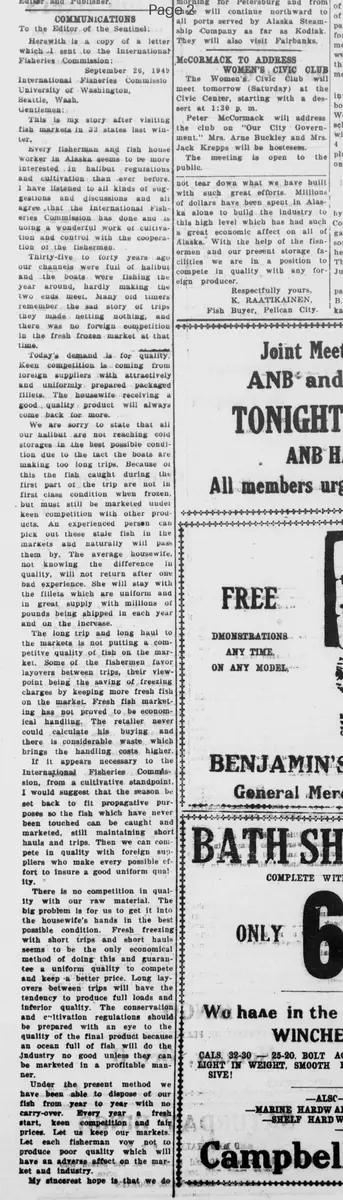
To the Editor of the Sentinel:
Herewith is a copy of a letter which I sent to the International Fisheries Commission:
September 26, 1949
International Fisheries Commission
University of Washington,
Seattle, Wash
Gentlemen:
This is my story after visiting fish markets in 33 states last winter.
Every fisherman and fish house worker in Alaska seems to be more interested in halibut regulations and cultivation than ever before.
I have listened to all kinds of suggestions and discussions and all agree that the International Fisheries Commission has done and is doing a wonderful work of cultivation and control with the cooperation of the fishermen.
Thirty-five to forty years ago our channels were full of halibut and the boats were fishing the year around, hardly making the two ends meet. Many old timers remember the sad story of trips they made netting nothing, and there was no foreign competition in the fresh frozen market at that time.
Today's demand is for quality.
Keen competition is coming from foreign suppliers with attractively and uniformly prepared packaged fillets. The housewife receiving a good quality product will always come back for more.
We are sorry to state that all our halibut are not reaching cold storages in the best possible condition due to the fact the boats are making too long trips. Because of this the fish caught during the first part of the trip are not in first class condition when frozen, but must still be marketed under keen competition with other products. An experienced person can pick out these stale fish in the markets and naturally will pass them by.
The average housewife, not knowing the difference in quality, will not return after one bad experience. She will stay with the fillets which are uniform and in great supply with millions of pounds being shipped in each year and on the increase.
The long trip and long haul to the markets is not putting a competitive quality of fish on the market. Some of the fishermen favor layovers between trips, their view point being the saving of freezing charges by keeping more fresh fish on the market. Fresh fish marketing has not proved to be economical handling. The retailer never could calculate his buying and there is considerable waste which brings the handling costs higher.
If it appears necessary to the International Fisheries Commission, from a cultivative standpoint, I would suggest that the season be set back to fit propagative purposes so the fish which have never been touched can be caught and marketed, still maintaining short hauls and trips. Then we can compete in quality with foreign suppliers who make every possible effort to insure a good uniform quality.
There is no competition in quality with our raw material. The big problem is for us to get it into the housewife's hands in the best possible condition. Fresh freezing with short trips and short hauls seems to be the only economical method of doing this and guarantee a uniform quality to compete and keep a better price. Long layovers between trips will have the tendency to produce full loads and inferior quality. The conservation and cultivation regulations should be prepared with an eye to the quality of the final product because an ocean full of fish will do the industry no good unless they can be marketed in a profitable manner.
Under the present method we have been able to dispose of our fish from year to year with no carry-over.
Every year a fresh start, keen competition and fair prices. Let us keep our markets.
Let each fisherman vow not to produce poor quality which will have an adverse affect on the market and industry.
My sincerest hope is that we do not tear down what we have built with such great efforts.
Millions of dollars have been spent in Alaska alone to build the industry to this high level which has had such a great economic affect on all of Alaska. With the help of the fishermen and our present storage facilities we are in a position to compete in quality with any foreign producer.
Respectfully yours,
K. RAATIKAINEN.
Fish Buyer, Pelican City.
What sub-type of article is it?
What themes does it cover?
What keywords are associated?
What entities or persons were involved?
Letter to Editor Details
Author
K. Raatikainen, Fish Buyer, Pelican City
Recipient
Editor Of The Sentinel
Main Argument
halibut fishing regulations should prioritize short trips and adjusted seasons to ensure high-quality frozen fish, enabling competition with foreign suppliers and maintaining market share, rather than long hauls that degrade quality.
Notable Details