Thank you for visiting SNEWPapers!
Sign up free
Daily National Intelligencer
Washington, District Of Columbia
What is this article about?
John Graham's 1818 report to the U.S. Secretary of State details the political, economic, and social situation in the United Provinces of South America following the 1810 revolution against Spain. It covers internal divisions, wars with royalists, provincial conflicts including with Artigas and Paraguay, provisional government, commerce dominated by British, and prospects for independence and constitution.
Merged-components note: Merged population estimate tables and notes with Graham's report on South American affairs into a single foreign news component.
Clipping
OCR Quality
Full Text
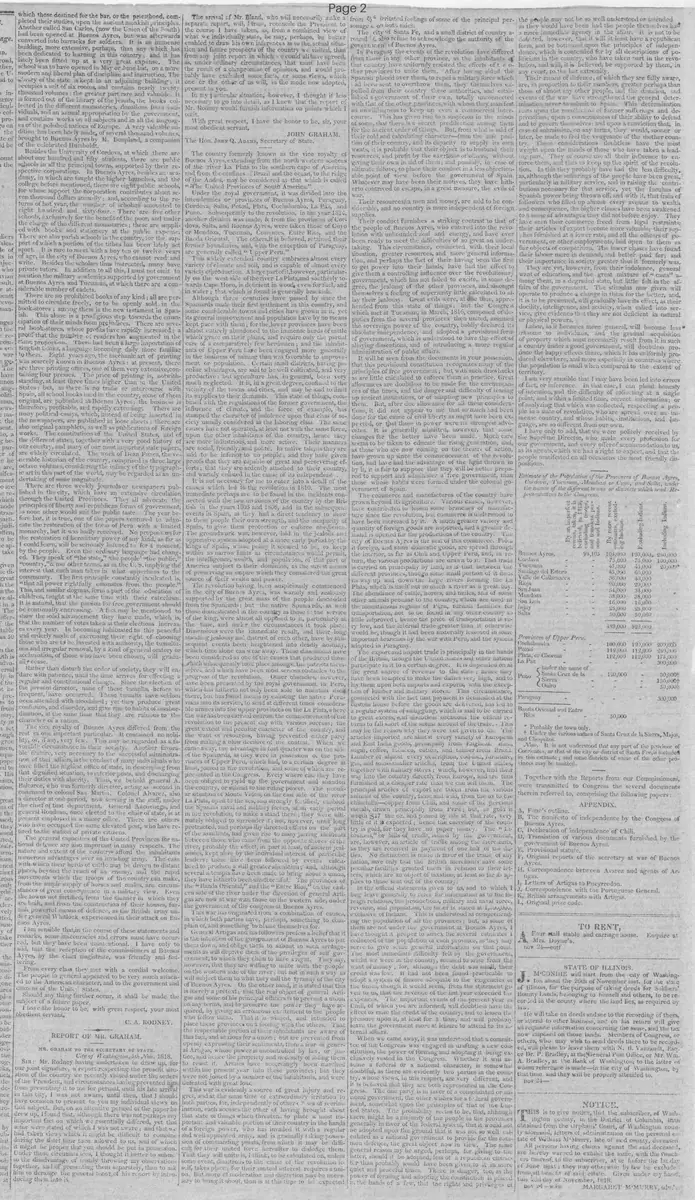
MR. GRAHAM TO THE SECRETARY OF STATE.
City of Washington, 5th Nov. 1818.
Sir: Mr. Rodney having undertaken to draw up, for our joint signature, a report respecting the present situation of the country we recently visited under the orders of the President, and circumstances having prevented him from presenting it to me for perusal, until his late arrival in this city, I was not aware, until then, that I should have occasion to present to you my individual views on that subject. But, on an attentive perusal of the paper he drew up, I found that, although there was not perhaps any important fact on which we essentially differed, yet that some were stated of which I was not aware; and that we had taken views which it might be difficult to combine during the short time taken allowed to us, and of which it might be proper that you should be put in possession.
Under these circumstances, I thought it better to submit to the disadvantage of hastily throwing my observations together, and of presenting them separately, than to ask him to derange the general tenor of his report by introducing them into it.
: The arrival of Mr. Bland, who will necessarily make a separate report, will, I trust, reconcile the President to the course I have taken, as, from a combined view of what we individually state, he may, perhaps, be better enabled to draw his own inferences as to the actual situation and future prospects of the country we visited, than from any joint report in which we could all have agreed as, under ordinary circumstances, that must have been the result of a compromise of opinions, and would probably have excluded some facts, or some views, which one or the other of us will, in the mode now adopted, present to you.
In my particular situation, however, I thought it less necessary to go into detail, as I knew that the report of Mr. Rodney would furnish information on points which I omit.
With great respect, I have the honor to be, sir, your most obedient servant,
JOHN GRAHAM.
The Hon. John Q. Adams, Secretary of State.
The country formerly known as the viceroyalty of Buenos Aires, extending from the north western sources of the river La Plata to the southern cape of America and from the confines of Brazil and the ocean, to the ridge of the Andes, may be considered as that which is called "The United Provinces of South America."
Under the royal government, it was divided into the intendencies or provinces of Buenos Aires, Paraguay, Cordova, Salta, Potosi, Plata, Cochabamba, La Paz, and Puno. Subsequently to the revolution, in the year 1810 another division was made; & from the provinces of Cordova, Salta, and Buenos Aires, were taken those of Cuyo or Mendoza, Tucuman, Corrientes, Entre Rios, and the Banda Oriental. The others, it is believed, retained their former boundaries, and, with the exception of Paraguay, are generally called "Upper Peru."
This widely extended country embraces almost every variety of climate and soil, and is capable of almost every variety of production. A large part of it, however, particularly on the west side of the river La Plata, and southerly towards Cape Horn, is deficient in wood even for fuel, and in water; that which is found is generally brackish.
Although three centuries have passed by since the Spaniards made their first settlement in this country, and some considerable towns and cities have grown in it, yet its general improvement and population have by no means kept pace with them: for the lower provinces have been almost entirely abandoned to the immense herds of cattle which graze on their plains, and require only the partial care of a comparatively few herdsmen: and the inhabitants of Upper Peru have been engaged more generally in the business of mining than was favorable to improvement or population. Certain small districts, having peculiar advantages, are said to be well cultivated, and very productive: but agriculture has, in general, been very much neglected. It is, in a great degree, confined to the vicinity of the towns and cities, and may be said to limit its supplies to their demands. This state of things, combined with the regulations of the former government, the influence of climate, and the force of example, has stamped the character of indolence upon that class of society usually considered as the laboring class. The same causes have not operated, at least not with the same force, upon the other inhabitants of the country, hence they are more industrious, and more active. Their manners are social, friendly, and polite. In native talents they are said to be inferior to no people; and they have given proofs that they are capable of great and persevering efforts; that they are ardently attached to their country, and warmly enlisted in the cause of its independence.
It is not necessary for me to enter into a detail of the causes which led to the revolution in 1810. The most immediate perhaps are to be found in the incidents connected with the two invasions of the country by the British in the years 1805 and 1806, and in the subsequent events in Spain, as they had a direct tendency to show to these people their own strength, and the incapacity of Spain, to give them protection or enforce obedience.
The groundwork was, however, laid in the jealous and oppressive system adopted at a more early period by the kings of Spain, whose policy it seemed to be, to keep within as narrow limits as circumstances would permit, the intelligence, wealth, and population, of that part of America subject to their dominion, as the surest means of preserving an empire which they considered the great source of their wealth and power.
The revolution having been auspiciously commenced in the city of Buenos Aires, was warmly and zealously supported by the great mass of the people descended from the Spaniards; but the native Spaniards, as well those domesticated in the country as those in the service of the king, were almost all opposed to it, particularly at the time, and under the circumstances it took place.
Dissensions were the immediate result, and their long standing jealousy and distrust of each other, have by subsequent events been heightened into deadly hostility, which time alone can wear away. These dissensions have been considered as one of the causes that produced those which subsequently took place amongst the patriots themselves, and which have been most serious obstacles to the progress of the revolution. Other obstacles, however, have been presented by the royal government in Peru, which has hitherto not only been able to maintain itself there, but has found means by enlisting the native Peruvians into its service, to send at different times considerable armies into the upper provinces on the La Plata, where the war has been carried on from the commencement of the revolution to the present day with various success; the great extent and peculiar character of the country, and the want of resources, having prevented either party from making a blow decisive of the contest. When we came away, the advantage in that quarter was on the side of the Spaniards, as they were in possession of the provinces of Upper Peru, which had, to a certain degree at least, joined in the revolution, and some of which are represented in the Congress. Everywhere else they have been obliged to yield up the government and abandon the country, or submit to the ruling power. The peculiar situation of Monte Video, on the east side of the river La Plata, open to the sea, and strongly fortified, enabled the Spanish naval and military forces, at an early period in the revolution, to make a stand there; they were ultimately obliged to surrender it; not, however, until long protracted, and perhaps illy directed efforts on the part of the assailants, had given rise to many jarring incidents between those who came from the opposite shores of the river, probably the effect, in part at least, of ancient jealousies, kept alive by the individual interest of particular leaders; these have been followed by events calculated to produce a still greater alienation; and, although several attempts have been made to bring about a union, they have hitherto been unsuccessful. The provinces of the "Banda Oriental," and the "Entre Rios," on the eastern side of the river under the direction of general Artigas are now at war with those on the western side, under the government of the congress at Buenos Aires.
This war has originated from a combination of causes, in which both parties have, perhaps, something to complain of, and something to blame themselves for.
General Artigas and his followers profess a belief that it is the intention of the government of Buenos Aires to put them down, and oblige them to submit to such arrangements as will deprive them of the privileges of self government, to which they claim to have a right. They say, however, that they are willing to unite with the people on the western side of the river; but not in such a way as will subject them to what they call the tyranny of the city of Buenos Aires. On the other hand, it is stated that this is merely a pretext; that the real object of general Artigas and some of his principal officers is to prevent a union on any terms, and to preserve the power they have acquired, by giving an erroneous excitement to the people who follow them. That it is wished, and intended to place these provinces on a footing with the others. That the respectable portion of their inhabitants are aware of this fact, and anxious for a union; but are prevented from openly expressing their sentiments, from a fear of general Artigas, whose power is uncontrolled by law, or justice, and hence the propriety and necessity of aiding them to resist it. Armies have accordingly been marched within the present year into these provinces; but they were not joined by a number of the inhabitants, and were defeated with great loss.
This war is evidently a source of great injury and regret, and at the same time of extraordinary irritation to both parties, for, independently of other sets of recrimination, each accuses the other of having brought about that state of things which threatens to place a most important and valuable portion of their country in the hands of a foreign power, who has invaded it with a regular and well appointed army, and is gradually taking possession of commanding points, from which it may be difficult for their united force hereafter to dislodge them.
That they will unite is, I think, to be calculated on, unless some event, disastrous to the cause of the revolution itself, takes place; for their mutual interest requires a union. But more of moderation and discretion may be necessary to bring it about, than is at this time to be expected from the irritated feelings of some of the principal personages on both sides.
The city of Santa Fe, and a small district of country around it, also refuse to acknowledge the authority of the government of Buenos Aires.
In Paraguay the events of the revolution have differed from those in any other province, as the inhabitants that country have uniformly resisted the efforts of the other provinces to unite them. After having aided the Spanish placed over them, to repel a military force which had been sent to overthrow them, they themselves expelled from their country these authorities, and established a government of their own, totally unconnected with that of the other provinces, with whom they manifest an unwillingness to keep up even a commercial intercourse. This has given rise to a suspicion in the minds of some, that there is a secret predilection among them for the ancient order of things. But, from what is said of their cold and calculating character—from the safe position of their country, and its capacity to supply its own wants, it is probable that their object is to husband their resources, and profit by the exertions of others, without giving their own in aid of them, and possibly, in case of ultimate failure, to place their conduct in a less objectionable point of view before the government of Spain.
Whatever may have been their motives, they have hitherto contrived to escape, in a great measure, the evils of war.
Their resources, in men and money, are said to be considerable, and no country is more independent of foreign supplies.
Their conduct furnishes a striking contrast to that of the people of Buenos Aires, who entered into the revolution with unbounded zeal and energy, and have ever been ready to meet the difficulties of so great an undertaking. This circumstance, connected with their local situation, greater resources, and more general information, and perhaps the fact of their having been the first to get power into their hands, have had the effect to give them a controlling influence over the revolutionary government, which has not failed to excite, in some degree, the jealousy of the other provinces, and amongst themselves a feeling of superiority little calculated to allay their jealousy. Great evils were, at one time, apprehended from this state of things; but the Congress which met at Tucaman, in March, 1816, composed of deputies from the several provinces then united, assumed the sovereign power of the country, boldly declared its absolute independence, and adopted a provisional form of government, which is understood to have the effect of allaying dissentions, and of introducing a more regular administration of public affairs.
It will be seen from the documents in your possession, that this provisional constitution recognizes many of the principles of free government; but with such drawbacks as are little calculated to enforce them in practice. Great allowances are doubtless to be made for the circumstances of the times, and the danger and difficulty of tearing up ancient institutions, or of adapting new principles to them. But, after due allowance for all these considerations, it did not appear to me that so much had been done for the cause of civil liberty as might have been expected, or that those in power were its strongest advocates. It is generally admitted, however, that some changes for the better have been made. Much care seems to be taken to educate the rising generation, and, as those who are now coming on the theatre of action, have grown up since the commencement of the revolution, and have had the advantage of the light thrown in by it, it is fair to suppose that they will be better prepared to support and administer a free government, than those whose habits were formed under the colonial government of Spain.
The commerce and manufactures of the country have grown beyond its agriculture. Various causes, however, have contributed to lessen some branches of manufacture since the revolution, but commerce is understood to have been increased by it. A much greater variety and quantity of foreign goods are imported, and a greater demand is opened for the productions of the country. The city of Buenos Aires is the seat of this commerce. From it foreign, and some domestic goods, are spread through the interior, as far as Chili and Upper Peru, and, in return, the various productions are drawn to it. This trade is carried on principally by land, as is that between the different provinces, though some small portion of it finds its way up and down the large rivers forming the La Plata, which is itself not so much a river as a great bay.
The abundance of cattle, horses, and mules, and of some other animals peculiar to the country, which are used in the mountainous regions of Peru, furnish facilities for transportation, not to be found in any other country so little improved; hence the price of transportation is very low, and the internal trade greater than it otherwise would be, though it had been materially lessened in some important branches by the war with Peru, and the system adopted in Paraguay.
The export and import trade is principally in the hands of the British, though the United States and other nations participate in it to a certain degree. It is depended on as the great source of revenue to the state; hence they have been tempted to make the duties very high, and to lay them upon both imports and exports, with the exception of lumber and military stores. This circumstance, connected with the fact that payment is demanded at the custom house before the goods are delivered, has led to a regular system of smuggling, which is said to be carried to great excess, and doubtless occasions the official returns to fall short of the actual amount of the trade. This may be the reason why they were not given to us. The articles imported are almost every variety of European and East India goods, principally from England. Rum, sugar, coffee, tobacco, cotton, and timber from Brazil. Lumber of almost every description, cod-fish, furniture, gin, and some similar articles, from the United States, together with military stores; which, however, find their way into the country directly from Europe, and are thus furnished at a cheaper rate than we can sell them. The principal articles of export are taken from the various animals of the country, tame and wild, from the ox to the chinchilla—copper from Chili, and some of the precious metals, drawn principally from Peru; but, as gold is worth $17 the oz. and passed by tale at that rate, very little of it is exported; hence the currency of the country is gold, for they have no paper money. The "Libranzas," or bills of credit, issued by the government, are, however, an article of traffic among the merchants, as they are received in payment of one half of the duties. No distinction is made in favor of the trade of any nation, save only that the British merchants have some peculiar facilities granted them in relation to their letters, which are an object of taxation, at least so far as applies to those sent out of the country.
In the official statements given to us, and to which I beg leave generally to refer for information as to the foreign relations, the productions, military and naval force, revenue, and population, the latter is stated at 1,000,000 exclusive of Indians. This is understood as comprehending the population of all the provinces; but, as some of them are not under the government at Buenos Aires, I have thought it proper to annex the several estimates I collected of the population of each province, as they may serve to give some general information on that point.
The most immediate difficulty felt by the government, whilst we were in the country, seemed to arise from the want of money, for, although the debt was small, their credit was low. It had not been found practicable to adopt a system of finance adequate to the exigencies of the times, though it would seem, from the statement given to us, that the revenue of the last year exceeded the expenses. The important events of the present year in Chili, of which you are informed, will doubtless have the effect to raise the credit of the country, and to lessen the pressure upon it, at least for a time, and will probably leave the government more at leisure to attend to its internal affairs.
When we came away, it was understood that a committee of the Congress was engaged in drafting a new constitution, the power of forming and adopting it being exclusively vested in the Congress. Whether it will assume a federal or a national character, is somewhat doubtful, as there are evidently two parties in the country, whose views, in this respect, are very different, and it is believed that they are both represented in the Congress. The one party is in favor of a consolidated or national government, the other wishes for a federal government, somewhat upon the principles of that of the United States. The probability seems to be, that, although there might be a majority of the people in the provinces generally in favor of the federal system, that it would not be adopted upon the ground that it was not so well calculated as a national government to provide for the common defence, the great object now in view. The same general reason may be urged, perhaps, for giving to the latter, should it be adopted, less of a republican character than probably would have been given to it in more quiet and peaceful times. There is danger, too, as the power of forming and adopting the constitution is placed in the hands of a few, that the rights and privileges of the people may not be so well understood or attended as they would have been had the people themselves had a more immediate agency in the affair. It is not to be doubted, however, that it will at least have a republican form, and be bottomed upon the principles of independence, which is contended for by all descriptions of politicians in the country, who have taken part in the revolution, and will, it is believed, be supported by them, in any event, to the last extremity.
Their means of defence, of which they are fully aware, are, in proportion to their numbers, greater perhaps than those of almost any other people, and the duration, and events of the war have strengthened the general determination never to submit to Spain. This determination rests upon the recollection of former sufferings and deprivations; upon a consciousness of their ability to defend and to govern themselves: and upon a conviction that, in case of submission, on any terms, they would, sooner or later, be made to feel the vengeance of the mother country. These considerations doubtless have the most weight upon the minds of those who have taken a leading part. They of course use all their influence to enforce them, and thus to keep up the spirit of the revolution. In this they probably have had the less difficulty, as, although the sufferings of the people have been great, particularly in military service, and in raising the contributions necessary for that service, yet the Incubus of Spanish power being thrown off, and with it, that train of followers who filled up almost every avenue to wealth and consequence, the higher classes have been awakened to a sense of advantages they did not before enjoy. They have seen their commerce freed from legal restraints; their articles of export become more valuable; their supplies furnished at a lower rate, and all the officers of government, or other employments, laid open to them as fair objects of competition. The lower classes have found their labour more in demand, and better paid for; and their importance in society greater than it formerly was. They are yet, however, from their indolence, general want of education, and the great mixture of "casts" among them, in a degraded state, but little felt in the affairs of the government. The stimulus now given will operate to produce a change in them for the better, and, it is to be presumed, will gradually have its effect, as their docility, intelligence, and activity, when called into service, give evidence that they are not deficient in natural or physical powers.
Labor, as it becomes more general, will become less irksome to individuals, and the gradual acquisition of property which must necessarily result from it in such a country under a good government, will doubtless produce the happy effects there, which it has uniformly produced elsewhere, and more especially in countries where the population is small when compared to the extent of territory.
I am very sensible that I may have been led into errors of fact, or inference. In that case, I can plead honesty of intention, and the difficulty of collecting at a single point, and within a limited time, correct information; or of analyzing that which was collected, respecting a people in a state of revolution, who are spread over an immense country, and whose habits, institutions, and language, are so different from our own.
I have only to add, that we were politely received by the Supreme Director, who made every profession for our government, and every offer of accommodation, to us, as its agents, which we had a right to expect, and that the people manifested on all occasions the most friendly dispositions.
Estimate of the Population of the Provinces of Buenos Aires, Cordova, Tucuman, Mendoza or Cuyo, and Salta, under the names of the different towns or districts which send Representatives to the Congress,
[Table of populations omitted for brevity, but included in merge: e.g., KICS 50,000, etc.]
Note. It is not understood that any part of the province of Corrientes, or that of the city or district of Santa Fe, is included in this estimate; and some districts of some of the other provinces may be omitted.
Together with the Reports from our Commissioners, were transmitted to Congress the several documents therein referred to, comprising the following papers:
APPENDIX.
A. Funes' outline.
B. The manifesto of independence by the Congress of Buenos Aires.
C. Declaration of independence of Chili.
D. Translation of various documents furnished by the government of Buenos Aires,
E. Provisional statute.
F. Original reports of the secretary at war of Buenos Aires.
H. Correspondence between Alvarez and agents of Artigas.
I. Letters of Artigas to Pueyrredon.
J. Correspondence with the Portuguese General.
K. British arrangements with Artigas.
L. Original prize code.
| By more recent estimates, exclud- |
| ing Indians. |
| By an imperfect census, taken, it is believed, in 1815, excluding troops, and transient persons and Indians. |
| Buenos Aires, Cordova | 93,105 | 105,000 | 120,000 | 250,000 |
| Tucman | 75,000 | 75,000 | 100,000 | |
| Santiago del Estero | 45,000 | 45,000 | 20,000 $ ^{*} $ | |
| Valle de Callamarca | 45,000 | 60,000 | ||
| Rioja | 36,000 | 40,000 | ||
| San Juan | 20,000 | 20,000 | ||
| Mendoza | 34,000 | 34,000 | ||
| San Luis | 38,000 | 38,000 | ||
| Injuy | 16,000 | 16,000 | ||
| Salta | 25,000 | 25,000 | ||
| 50,000 | 50,000 |
| Cochabamba | 100,000 | 120,000 | 200,000 |
| Potosi | 112,000 | 112,000 | 250,000 |
| Plata, or Choveas | 112,000 | 112,000 | 175,000 |
| La Paz | - | - | 300,000 |
| Puno | under the name of Santa Cruz de la Sierra Quinoa | 120,000 | 30,000 |
| Paraguay | - | - | 300,000 |
| Banda Oriental and Entre | - | - | - |
What sub-type of article is it?
What keywords are associated?
What entities or persons were involved?
Where did it happen?
Foreign News Details
Primary Location
United Provinces Of South America
Event Date
1818
Key Persons
Outcome
armies marched into eastern provinces defeated with great loss; spaniards hold upper peru; ongoing internal wars and resistance in paraguay and santa fe; provisional government adopted; commerce increased but agriculture neglected; population estimates provided; new constitution in drafting.
Event Details
John Graham's report describes the geography, history, and current state of the United Provinces of South America post-1810 revolution. It details divisions into provinces, economic conditions with neglected agriculture but growing commerce led by British, internal conflicts including war between Buenos Aires government and General Artigas' forces in Banda Oriental and Entre Rios, Paraguay's isolation, Santa Fe's refusal of authority, ongoing war with Spanish in Upper Peru, 1816 Congress declaration of independence and provisional constitution, debates on federal vs. national government, and strong resolve for independence.