Thank you for visiting SNEWPapers!
Sign up free
Gazette Of The United States
New York, New York County, New York
What is this article about?
John Adams' 1776 letter to George Wythe proposes principles for American colonial governments amid independence, advocating annual elections, separation of powers, independent judiciary, militia, education, and frugality to ensure liberty and happiness.
Merged-components note: The second component is the concluding quote from Milton that completes the essay in the first component, so they should be merged into a single literary piece.
Clipping
OCR Quality
Full Text
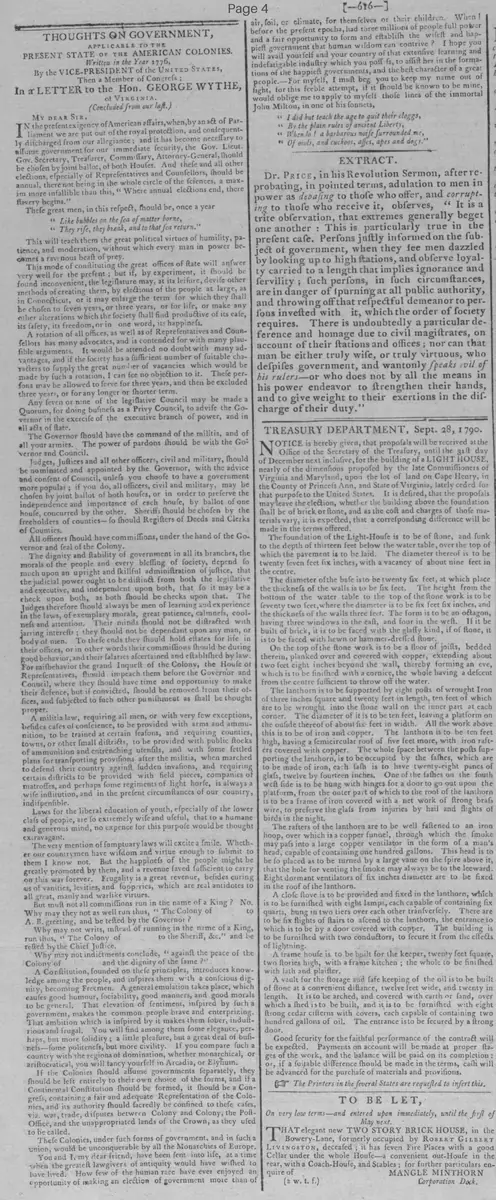
PRESENT STATE OF THE AMERICAN COLONIES.
APPLICABLE TO THE
Written in the Year 1776,
By the VICE-PRESIDENT of the United States,
Then a Member of Congress;
In a LETTER to the Hon. GEORGE WYTHE,
of VIRGINIA.
(Concluded from our last.)
My Dear Sir,
IN the present exigency of American affairs, when, by an act of Parliament we are put out of the royal protection, and consequently discharged from our allegiance; and it has become necessary to assume government for our immediate security, the Gov. Lieut. Gov. Secretary, Treasurer, Commissary, Attorney-General, should be chosen by joint ballot, of both Houses. And these and all other elections, especially of Representatives and Counsellors, should be annual, there not being in the whole circle of the sciences, a maxim more infallible than this, "Where annual elections end, there slavery begins."
These great men, in this respect, should be, once a year
"Like bubbles on the sea of matter borne,
"They rise, they break, and to that sea return."
This will teach them the great political virtues of humility, patience, and moderation, without which every man in power becomes a ravenous beast of prey.
This mode of constituting the great offices of state will answer very well for the present; but if, by experiment, it should be found inconvenient, the legislature may, at its leisure, devise other methods of creating them, by elections of the people at large, as in Connecticut, or it may enlarge the term for which they shall be chosen to seven years, or three years, or for life, or make any other alterations which the society shall find productive of its ease, its safety, its freedom, or in one word, its happiness.
A rotation of all offices, as well as of Representatives and Counsellors has many advocates, and is contended for with many plausible arguments. It would be attended no doubt with many advantages, and if the society has a sufficient number of suitable characters to supply the great number of vacancies which would be made by such a rotation, I can see no objection to it. These persons may be allowed to serve for three years, and then be excluded three years, or for any longer or shorter term.
Any seven or nine of the legislative Council may be made a Quorum, for doing business as a Privy Council, to advise the Governor in the exercise of the executive branch of power, and in all acts of state.
The Governor should have the command of the militia, and of all your armies. The power of pardons should be with the Governor and Council. Judges, Justices and all other officers, civil and military, should be nominated and appointed by the Governor, with the advice and consent of Council, unless you choose to have a government more popular; if you do, all officers, civil and military, may be chosen by joint ballot of both houses, or in order to preserve the independence and importance of each house, by ballot of one house, concurred by the other. Sheriffs should be chosen by the freeholders of counties—so should Registers of Deeds and clerks of Counties.
All officers should have commissions, under the hand of the Governor and seal of the Colony.
The dignity and stability of government in all its branches, the morals of the people and every blessing of society, depend so much upon an upright and skilful administration of justice, that the judicial power ought to be distinct from both the legislative and executive, and independent upon both, that so it may be a check upon both, as both should be checks upon that. The Judges therefore should always be men of learning and experience in the laws, of exemplary morals, great patience, calmness, coolness and attention. Their minds should not be distracted with jarring interests; they should not be dependent upon any man, or body of men. To these ends they should hold estates for life in their offices, or in other words their commissions should be during good behavior, and their salaries ascertained and established by law.
For misbehavior the grand Inquest of the Colony, the House of Representatives, should impeach them before the Governor and Council, where they should have time and opportunity to make their defence, but if convicted, should be removed from their offices, and subjected to such other punishment as shall be thought proper.
A militia law, requiring all men, or with very few exceptions, besides cases of conscience, to be provided with arms and ammunition, to be trained at certain seasons, and requiring counties, towns, or other small districts, to be provided with public stocks of ammunition and entrenching utensils, and with some settled plans for transporting provisions after the militia, when marched to defend their country against sudden invasions, and requiring certain districts to be provided with field pieces, companies of matrosses, and perhaps some regiments of light horse, is always a wise institution, and in the present circumstances of our country, indispensable.
Laws for the liberal education of youth, especially of the lower class of people, are so extremely wise and useful, that to a humane and generous mind, no expense for this purpose would be thought extravagant.
The very mention of sumptuary laws will excite a smile. Whether our countrymen have wisdom and virtue enough to submit to them I know not. But the happiness of the people might be greatly promoted by them, and a revenue saved sufficient to carry on this war forever. Frugality is a great revenue, besides curing us of vanities, levities, and fopperies, which are real antidotes to all great, manly and warlike virtues.
But must not all commissions run in the name of a King? No. Why may they not as well run thus, "The Colony of Massachusetts Bay to A. B. greeting, and be tested by the Governor?"
Why may not writs, instead of running in the name of a King, run thus, "The Colony of Massachusetts," to the Sheriff, &c." and be tested by the Chief Justice.
Why may not indictments conclude, "against the peace of the Colony of Massachusetts Bay and the dignity of the same?"
A Constitution, founded on these principles, introduces knowledge among the people, and inspires them with a conscious dignity, becoming Freemen. A general emulation takes place, which causes good humour, sociability, good manners, and good morals to be general. That elevation of sentiment, inspired by such a government, makes the common people brave and enterprising. That ambition which is inspired by it makes them sober, industrious and frugal. You will find among them some elegance, perhaps, but more solidity; a little pleasure, but a great deal of business—some politeness, but more civility. If you compare such a country with the regions of domination, whether monarchical, or aristocratical, you will fancy yourself in Arcadia, or Elysium.
If the Colonies should assume governments separately, they should be left entirely to their own choice of the forms, and if a Continental Constitution should be formed, it should be a Congress, containing a fair and adequate Representation of the Colonies, and its authority should sacredly be confined to these cases, viz. war, trade, disputes between Colony and Colony, the Post-Office, and the unappropriated lands of the Crown, as they used to be called.
These Colonies, under such forms of government, and in such a union, would be unconquerable by all the Monarchies of Europe.
You and I, my dear friend, have been sent into life, at a time when the greatest lawgivers of antiquity would have wished to live. How few of the human race have ever enjoyed an opportunity of making an election of government, more than of air, soil, or climate, for themselves or their children. When! before the present epocha, had three millions of people full power and a fair opportunity to form and establish the wisest and happiest government that human wisdom can contrive? I hope you will avail yourself and your country of that extensive learning and indefatigable industry which you possess, to assist her in the formation of the happiest governments, and the best character of a great people.—For myself, I must beg you to keep my name out of sight, for this feeble attempt, if it should be known to be mine, would oblige me to apply to myself those lines of the immortal John Milton, in one of his sonnets,
"I did but teach the age to quit their clogs,
"By the plain rules of ancient Liberty,
"When lo! a barbarous noise surrounded me,
Of owls, and cuckoos, asses, apes and dogs."
What sub-type of article is it?
What themes does it cover?
What keywords are associated?
What entities or persons were involved?
Literary Details
Title
Thoughts On Government, Present State Of The American Colonies.
Author
By The Vice President Of The United States, Then A Member Of Congress;
Subject
In A Letter To The Hon. George Wythe, Of Virginia.
Key Lines