Thank you for visiting SNEWPapers!
Sign up free
Daily National Intelligencer
Washington, District Of Columbia
What is this article about?
In this letter, 'Homo' argues against governments issuing unlimited national paper currency, citing revolutionary examples like Continental money and French assignats, and opposes specie as a circulating medium due to its exportability and insufficiency. He praises Britain's prosperity after suspending specie payments in 1797 and calls for facts supporting specie's adequacy.
Clipping
OCR Quality
Full Text
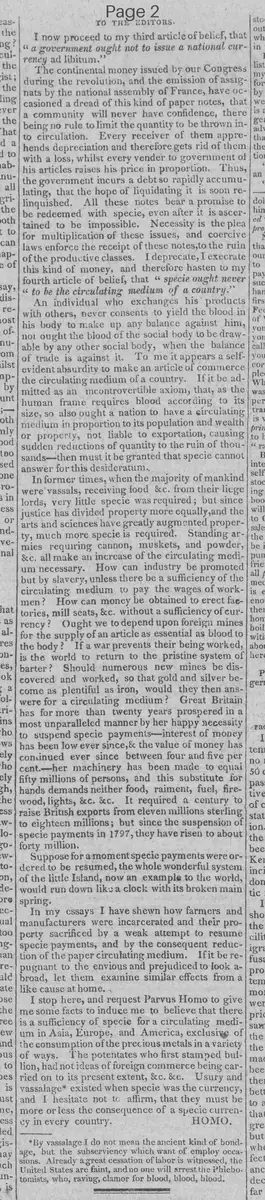
I now proceed to my third article of belief, that "a government ought not to issue a national currency ad libitum."
The continental money issued by our Congress during the revolution, and the emission of assignats by the national assembly of France, have occasioned a dread of this kind of paper notes, that a community will never have confidence, there being no rule to limit the quantity to be thrown into circulation. Every receiver of them apprehends depreciation and therefore gets rid of them with a loss, whilst every vender to government of his articles raises his price in proportion. Thus, the government incurs a debt so rapidly accumulating, that the hope of liquidating it is soon relinquished. All these notes bear a promise to be redeemed with specie, even after it is ascertained to be impossible. Necessity is the plea for multiplication of these issues, and coercive laws enforce the receipt of these notes, to the ruin of the productive classes. I deprecate, I execrate this kind of money, and therefore hasten to my fourth article of belief, that "specie ought never to be the circulating medium of a country."
An individual who exchanges his products with others, never consents to yield the blood in his body to make up any balance against him, nor ought the blood of the social body to be drawable by any other social body, when the balance of trade is against it. To me it appears a self-evident absurdity to make an article of commerce the circulating medium of a country. If it be admitted as an incontrovertible axiom, that, as the human frame requires blood according to its size, so also ought a nation to have a circulating medium in proportion to its population and wealth or property, not liable to exportation, causing sudden reductions of quantity to the ruin of thousands—then must it be granted that specie cannot answer for this desideratum.
In former times, when the majority of mankind were vassals, receiving food &c. from their liege lords, very little specie was required; but since justice has divided property more equally, and the arts and sciences have greatly augmented property, much more specie is required. Standing armies requiring cannon, muskets, and powder, &c. all make an increase of the circulating medium necessary. How can industry be promoted but by slavery, unless there be a sufficiency of the circulating medium to pay the wages of workmen? How can money be obtained to erect factories, mill seats, &c. without a sufficiency of currency? Ought we to depend upon foreign mines for the supply of an article as essential as blood to the body? If a war prevents their being worked, is the world to return to the pristine system of barter? Should numerous new mines be discovered and worked, so that gold and silver become as plentiful as iron, would they then answer for a circulating medium? Great Britain has for more than twenty years prospered in a most unparalleled manner by her happy necessity to suspend specie payments—interest of money has been low ever since, & the value of money has continued ever since between four and five per cent.—her machinery has been made to equal fifty millions of persons, and this substitute for hands demands neither food, raiment, fuel, firewood, lights, &c. &c. It required a century to raise British exports from eleven millions sterling to eighteen millions; but since the suspension of specie payments in 1797, they have risen to about forty million.
Suppose for a moment specie payments were ordered to be resumed, the whole wonderful system of the little Island, now an example to the world, would run down like a clock with its broken main spring.
In my essays I have shewn how farmers and manufacturers were incarcerated and their property sacrificed by a weak attempt to resume specie payments, and by the consequent reduction of the paper circulating medium. If it be repugnant to the envious and prejudiced to look abroad, let them examine similar effects from a like cause at home.
I stop here, and request Parvus Homo to give me some facts to induce me to believe that there is a sufficiency of specie for a circulating medium in Asia, Europe, and America, exclusive of the consumption of the precious metals in a variety of ways. The potentates who first stamped bullion, had not ideas of foreign commerce being carried on to its present extent, &c. &c. Usury and vassalage* existed when specie was the currency, and I hesitate not to affirm, that they must be more or less the consequence of a specie currency in every country.
HOMO.
*By vassalage I do not mean the ancient kind of bondage, but the subserviency which want of employment occasions. Already a great cessation of labor is witnessed, the United States are faint, and no one will arrest the Phlebotomists, who, raving, clamor for blood, blood, blood.
What sub-type of article is it?
What themes does it cover?
What keywords are associated?
What entities or persons were involved?
Letter to Editor Details
Author
Homo.
Recipient
To The Editors
Main Argument
governments should not issue unlimited national currency due to inevitable depreciation and ruin, as seen in historical examples; specie is unsuitable as a circulating medium because it is exportable and insufficient for modern economies, advocating instead for a stable, proportional currency like paper.
Notable Details