Thank you for visiting SNEWPapers!
Sign up free
Literary
August 28, 1790
Gazette Of The United States
New York, New York County, New York
What is this article about?
In this conclusion to Discourse XVIII on Davila, Admiral Coligni advises the Prince of Condé against open war, suggesting instead to incite Calvinist unrest against the Guises to advance Bourbon interests covertly, framing it as religious conflict. The narrator, noting Davila's Catholicism, defends Coligni's sincerity and loyalty.
Clipping
OCR Quality
92%
Excellent
Full Text
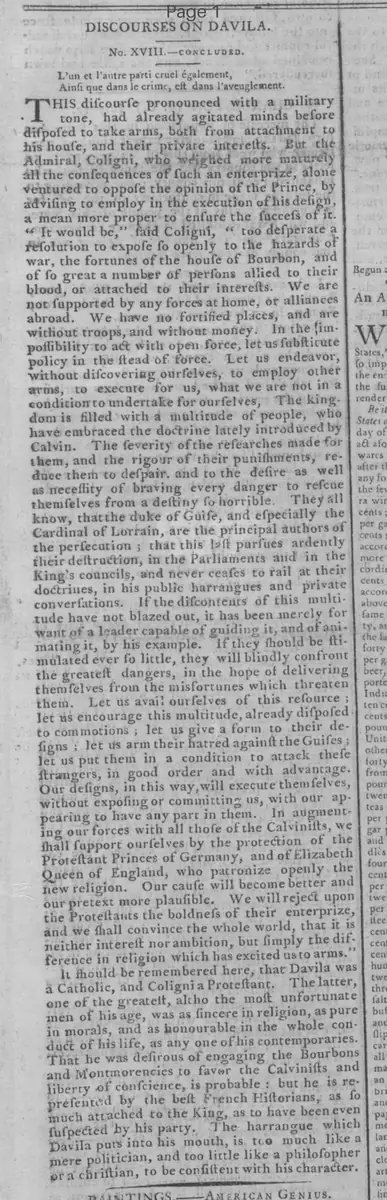
DISCOURSES ON DAVILA.
No. XVIII.-CONCLUDED.
L'un et l'autre parti cruel également,
Ainsi que dans le crime, est dans l'aveuglement.
It is only disposed to take arms, both from attachment to
his house, and their private interests. But the
Admiral, Coligni, who weighed more maturely
all the consequences of such an enterprize, alone
ventured to oppose the opinion of the Prince, by
advising to employ in the execution of his design,
a mean more proper to ensure the success of it.
"It would be," said Coligni, "too desperate a
resolution to expose so openly to the hazards of
war, the fortunes of the house of Bourbon, and
of so great a number of persons allied to their
blood, or attached to their interests. We are
not supported by any forces at home, or alliances
abroad. We have no fortified places, and are
without troops, and without money. In the impossibility to act with open force, let us substitute
policy in the stead of force. Let us endeavor,
without discovering ourselves, to employ other
arms, to execute for us, what we are not in a
condition to undertake for ourselves. The king-
dom is filled with a multitude of people, who
have embraced the doctrine lately introduced by
Calvin. The severity of the researches made for
them, and the rigour of their punishments, re-
duce them to despair, and to the desire as well
as necessity of braving every danger to rescue
themselves from a destiny so horrible. They all
know, that the duke of Guise, and especially the
Cardinal of Lorrain, are the principal authors of
the persecution; that this last pursues ardently
their destruction, in the Parliaments and in the
King's councils, and never ceases to rail at their
conversations. If the discontents of this multi-
tude have not blazed out, it has been merely for
want of a leader capable of guiding it, and of ani-
mating it, by his example. If they should be sti-
mulated ever so little, they will blindly confront
the greatest dangers, in the hope of delivering
themselves from the misfortunes which threaten
them. Let us avail ourselves of this resource;
let us encourage this multitude, already disposed
to commotions; let us give a form to their de-
signs; let us arm their hatred against the Guises;
let us put them in a condition to attack these
strangers, in good order and with advantage.
Our designs, in this way, will execute themselves,
without exposing or committing us, with our ap-
pearing to have any part in them. In augment-
ing our forces with all those of the Calvinists, we
shall support ourselves by the protection of the
Protestant Princes of Germany, and of Elizabeth
Queen of England, who patronize openly the
new religion. Our cause will become better and
our pretext more plausible. We will reject upon
the Protestants the boldness of their enterprize,
and we shall convince the whole world, that it is
neither interest nor ambition, but simply the dif-
ference in religion which has excited us to arms."
It should be remembered here, that Davila was
a Catholic, and Coligni a Protestant. The latter,
one of the greatest, altho the most unfortunate
in morals, and as honourable in the whole con-
duct of his age, was as sincere in religion, as pure
in the conduct of his life, as any one of his contemporaries.
That he was desirous of engaging the Bourbons
and Montmorencies to favor the Calvinists and
liberty of conscience, is probable: but he is re-
presented by the best French Historians, as so
much attached to the King, as to have been even
suspected by his party. The harangue which
Davila puts into his mouth, is too much like a
mere politician, and too little like a philosopher
or a christian, to be consistent with his character.
No. XVIII.-CONCLUDED.
L'un et l'autre parti cruel également,
Ainsi que dans le crime, est dans l'aveuglement.
It is only disposed to take arms, both from attachment to
his house, and their private interests. But the
Admiral, Coligni, who weighed more maturely
all the consequences of such an enterprize, alone
ventured to oppose the opinion of the Prince, by
advising to employ in the execution of his design,
a mean more proper to ensure the success of it.
"It would be," said Coligni, "too desperate a
resolution to expose so openly to the hazards of
war, the fortunes of the house of Bourbon, and
of so great a number of persons allied to their
blood, or attached to their interests. We are
not supported by any forces at home, or alliances
abroad. We have no fortified places, and are
without troops, and without money. In the impossibility to act with open force, let us substitute
policy in the stead of force. Let us endeavor,
without discovering ourselves, to employ other
arms, to execute for us, what we are not in a
condition to undertake for ourselves. The king-
dom is filled with a multitude of people, who
have embraced the doctrine lately introduced by
Calvin. The severity of the researches made for
them, and the rigour of their punishments, re-
duce them to despair, and to the desire as well
as necessity of braving every danger to rescue
themselves from a destiny so horrible. They all
know, that the duke of Guise, and especially the
Cardinal of Lorrain, are the principal authors of
the persecution; that this last pursues ardently
their destruction, in the Parliaments and in the
King's councils, and never ceases to rail at their
conversations. If the discontents of this multi-
tude have not blazed out, it has been merely for
want of a leader capable of guiding it, and of ani-
mating it, by his example. If they should be sti-
mulated ever so little, they will blindly confront
the greatest dangers, in the hope of delivering
themselves from the misfortunes which threaten
them. Let us avail ourselves of this resource;
let us encourage this multitude, already disposed
to commotions; let us give a form to their de-
signs; let us arm their hatred against the Guises;
let us put them in a condition to attack these
strangers, in good order and with advantage.
Our designs, in this way, will execute themselves,
without exposing or committing us, with our ap-
pearing to have any part in them. In augment-
ing our forces with all those of the Calvinists, we
shall support ourselves by the protection of the
Protestant Princes of Germany, and of Elizabeth
Queen of England, who patronize openly the
new religion. Our cause will become better and
our pretext more plausible. We will reject upon
the Protestants the boldness of their enterprize,
and we shall convince the whole world, that it is
neither interest nor ambition, but simply the dif-
ference in religion which has excited us to arms."
It should be remembered here, that Davila was
a Catholic, and Coligni a Protestant. The latter,
one of the greatest, altho the most unfortunate
in morals, and as honourable in the whole con-
duct of his age, was as sincere in religion, as pure
in the conduct of his life, as any one of his contemporaries.
That he was desirous of engaging the Bourbons
and Montmorencies to favor the Calvinists and
liberty of conscience, is probable: but he is re-
presented by the best French Historians, as so
much attached to the King, as to have been even
suspected by his party. The harangue which
Davila puts into his mouth, is too much like a
mere politician, and too little like a philosopher
or a christian, to be consistent with his character.
What sub-type of article is it?
Essay
Dialogue
What themes does it cover?
Political
Religious
Liberty Freedom
What keywords are associated?
Coligni
Guises
Calvinists
Bourbon
Religious Persecution
Political Intrigue
Liberty Of Conscience
Literary Details
Title
Discourses On Davila. No. Xviii. Concluded.
Subject
Advice Of Admiral Coligni Against Open War, Using Calvinist Discontent
Key Lines
"It Would Be," Said Coligni, "Too Desperate A Resolution To Expose So Openly To The Hazards Of War, The Fortunes Of The House Of Bourbon..."
"Let Us Endeavor, Without Discovering Ourselves, To Employ Other Arms, To Execute For Us, What We Are Not In A Condition To Undertake For Ourselves."
The Harangue Which Davila Puts Into His Mouth, Is Too Much Like A Mere Politician, And Too Little Like A Philosopher Or A Christian, To Be Consistent With His Character.