Thank you for visiting SNEWPapers!
Sign up free
Jenks's Portland Gazette
Portland, Cumberland County, Maine
What is this article about?
Commentary from the 'Mercury of Europe' (Nov. 30) on the 18th Brumaire revolution in France, portraying it as a bloodless coup by Buonaparte and the Council of Ancients against the Jacobins, comparing him to Caesar, Cromwell, and Washington, and debating its implications for French governance and liberty.
Clipping
OCR Quality
Full Text
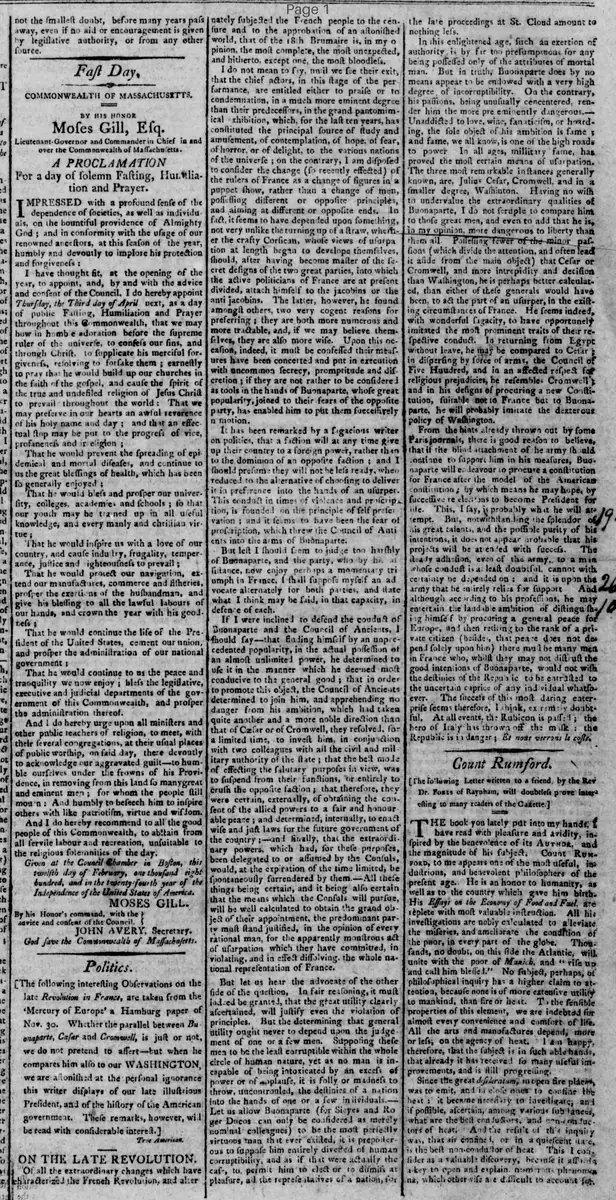
The following interesting Observations on the
late Revolution in France, are taken from the
'Mercury of Europe' a Hamburg paper of
Nov. 30. Whether the parallel between Bu-
onaparte, Caesar and Cromwell, is just or not.
we do not pretend to assert-but when he
compares him also to our WASHINGTON.
we are astonished at the personal ignorance
this writer displays of our late illustrious
President, and of the history of the American
government. These remarks, however, will
be read with considerable interest.]
True American.
ON THE LATE REVOLUTION.
Of all the extraordinary changes which have
characterized the French Revolution, and alter-
nately subjected the French people to the cen-
sure and to the approbation of an astonished
world, that of the 18th Brumaire is, in my o-
pinion, the most complete, the most unexpected,
and hitherto, except one, the most bloodless.
I do not mean to say, until we see their exit;
that the chief actors, in this stage of the per-
formance, are entitled either to praise or to
condemnation, in a much more eminent degree
than their predecessors, in the grand pantomim-
ical exhibition, which, for the last ten years, has
constituted the principal source of study and
amusement, of contemplation, of hope, of fear,
of horror, or of delight, to the various nations
of the universe ; on the contrary, I am disposed
to consider the change (so recently effected) of
the rulers of France as a change of figures in a
puppet show, rather than a change of men,
possessing different or opposite principles,
and aiming at different or opposite ends. In
fact, it seems to have depended upon something,
not very unlike the turning up of a straw, wherh-
er the crafty Corsican, whose views of usurpa-
tion at length began to develope themselves,
should, after having become master of the e-
nsecret designs of the two great parties, into which
the active politicians of France are at present
divided, attach himself to the jacobins or the
anti jacobins. The latter, however, he found
amongst others, two very cogent reasons for
preferring ; they are both more numerous and
more tractable, and, if we may believe them-
themselves, they are also more wise. Upon this oc-
caion, indeed, it must be confessed their mea-
sures have been concerted and put in execution
with uncommon secrecy, promptitude and dis-
cretion ; if they are not rather to be considered
as tools in the hands of Buonaparte, whose great
popularity, joined to their fears of the opposite
party, has enabled him to put them successfully
in motion.
It has been remarked by a sagacious writer
on politics, that a faction will at any time give
up their country to a foreign power, rather than
to the dominion of an opposite faction : and I
should presume they will not be less ready, when
reduced to the alternative of choosing to deliver
it in preference into the hands of an usurper.
This conduct in times of violence and precipita-
tion, is founded on the principle of self preser-
vation : and it seems to have been the fear of
proscription, which threw the Council of Anti-
ents into the arms of Buonaparte.
But lest I should seem to judge too harshly
of Buonaparte, and the party, who by his. ai-
littance, now enjoy perhaps a momentary tri-
uph in France, I shall suppose myself an ad-
vocate alternately for both parties, and state
what I think may be said, in that capacity, in
defence of each.
If I were inclined to defend the conduct of
Buonaparte and the Council of Ancients. I
should say--that finding himself by an unpre-
cedented popularity. in the actual possession of
an almost unlimited power, he determined to
use it in the manner which he deemed most
conducive to the general good ; that in order
to promote this object, the Council of Ancients
determined to join him, and apprehending no
danger from his ambition, which had taken
quite another and a more noble direction than
that of Caesar or of Cromwell, they resolved, for
a limited time, to invest him, in conjunction
with two colleagues with all the civil and mil-
itary authority of the state ; that the best mole
of effecting the salutary purposes in view, was
to suspend from their functions, or entirely to
crush the opposite faction ; that therefore, they
were certain, externally, of obtaining the con-
sent of the allied powers to a fair and honour-
able peace ; and determined, internally, to enact
wise and just laws for the future government of
the country ;-and finally, that the extraordi-
nary powers, which had, for these purposes,
been delegated to or assumed by the Consuls,
would, at the expiration of the time limited, be
spontaneously surrendered by them.- All these
things being certain, and it being also certain
that the means which the Consuls will pursue,
will be well calculated to obtain the grand ob-
ject of their appointment. the predominant par-
tv must stand justified, in the opinion of every
rational man, for the apparently monstrous act
of usurpation which they have committed, in
violating, and in effect dissolving. the whole na-
tional representation of France.
But let us hear the advocate of the other
side of the question, In fair reasoning, it must
indeed be granted, that the great utility clearly
ascertained, will justify even the violation of
principles. But the determining that general
utility ought never to depend upon the judge-
inent of one or a few men. Supposing these
men to be the least corruptible within the whole
circle of human nature, yet as no man is in-
capable of being intoxicated by an excess of
power or of applause, it is folly or madness to
throw, uncontrolled, the destinies of a nation
into the hands of one or a few individuals.--
Let us allow Buonaparte (for Sieyes and Ro-
ger Ducos can only be considered as merely
nominal colleagues) to be the most perseve-
ring virtuous man that ever existed, it is preposter-
ous to suppose him entirely divested of human
corruptibility, and as if that were actually the
case, to permit him to elect or to dismiss at
pleasure, all the representatives of a nation, for
the late proceedings at St. Cloud amount to
nothing less.
In this enlightened age, such an exertion of
authority. is by far too presumptuous for any
being possessed only of the attributes of mortal
man. But in truth, Buonaparte does by no
means appear to be endowed with a very high
degree, of incorruptibility. On the contrary,
his passions. being unusually concentrated, ren-
der him the more pre eminently dangerous.-
Unaddicted to love, wine, fanaticism, or hoard-
ing. the sole object of his ambition is fame z
and fame, we all know, is one of the high roads
to power In all ages, military fame, has
proved the most certain means of usurpation.
The three most remarkable instances generally
known, are, Julius Caesar, Cromwell, and in a
smaller degree, Washington. Having no wish
to undervalue the extraordinary qualities of
Buonaparte, I do not scruple to compare him
to those great men, and even to add that he is,
in my opinion, more dangerous to liberty than
them all. Possessing fewer of the minor pa-
sions (which divide the attention, and often lead
it aside from the main object) than Caesar or
Cromwell, and more intrepidity and decision
than Washington, he is perhaps better calculat-
ed, than either of these generals would have
been, to act the part of an usurper. in the existing circumstances of France. He seems indeed,
with wonderful sagacity, to have opportunely
imitated the most prominent traits of their re-
pective conduct. In returning from Egypt
without leave, he may be compared to Caesar
in dispersing by force of arms, the Council of
Five Hundred, and in an affected respect for
religious prejudices, he resembles Cromwell
and in his designs of procuring a new Consti-
tution, suitable not to France but to Buona-
parte, he will probably imitate the dexterous.
policy of Washington.
From the hints already thrown out by some
Paris journals, there is good reason to believe,
that if the blind attachment of the army should
continue to support him in his measures, Buo.
naparte will endeavour to procure a constitution
for France after the model of the American
constitution; by which means he may hope. by
successive re elections to become President for
life. This, I say, is probably what he will at-
tempt. But, notwithstanding the splendor o
his great talents, and the possible purity of his
intentions, it does not appear probable that his
projets will be attended with success. The
steady adhesion, even of the army.. to a man
whose conduct is at least doubtful. cannot with
certainty be depended on : and it is upon the
army that he entirely relies for support And
although according to his professions, he may
entertain the laudable ambition of distinguisha
ing himself by procuring a general peace for
Europe, and then retiring to the rank of a pri-
vate citizen (besides, that peace does not des
pend solely upon him) there must be many men
in France who, whilst they may not distrust the
good intentions of Buonaparte, would not wish
the destinies of the Republic to be entrusted to
the uncertain caprice of any individual whato-
ever. The success of this not daring enter-
prise seems therefore, I think, extremely doubt-
ful. At all events. the Rubicon is passed'; the
hero of Italy has thrown off the mask : the
Republic is in danger ; Et nous verrons l cole.
What sub-type of article is it?
What keywords are associated?
What entities or persons were involved?
Where did it happen?
Foreign News Details
Primary Location
France
Event Date
18th Brumaire
Key Persons
Outcome
most bloodless, except one; change of rulers with buonaparte and two colleagues invested with civil and military authority for a limited time; dissolution of national representation; potential for new constitution modeled on american one
Event Details
The 18th Brumaire revolution involved Buonaparte, backed by the more numerous and tractable anti-Jacobins in the Council of Ancients, executing a secret and prompt coup against the Jacobins, dispersing the Council of Five Hundred by force, suspending or crushing the opposite faction, to pursue peace externally and just laws internally, with powers to be surrendered after a limited time.