Thank you for visiting SNEWPapers!
Sign up free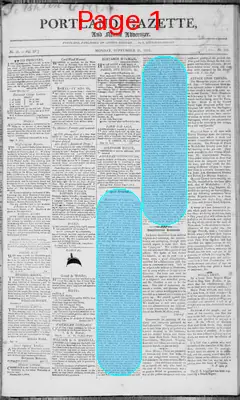
Literary
September 21, 1812
Portland Gazette, And Maine Advertiser
Portland, Cumberland County, Maine
What is this article about?
This essay argues that the primary goal of education is to mature the mind through developing a habit of independent thinking and reasoning in children. It critiques rote memorization, praises mental exercises like mathematics and chess, and emphasizes clear, gradual explanations to foster curiosity and understanding.
Clipping
OCR Quality
95%
Excellent
Full Text
Original Miscellany.
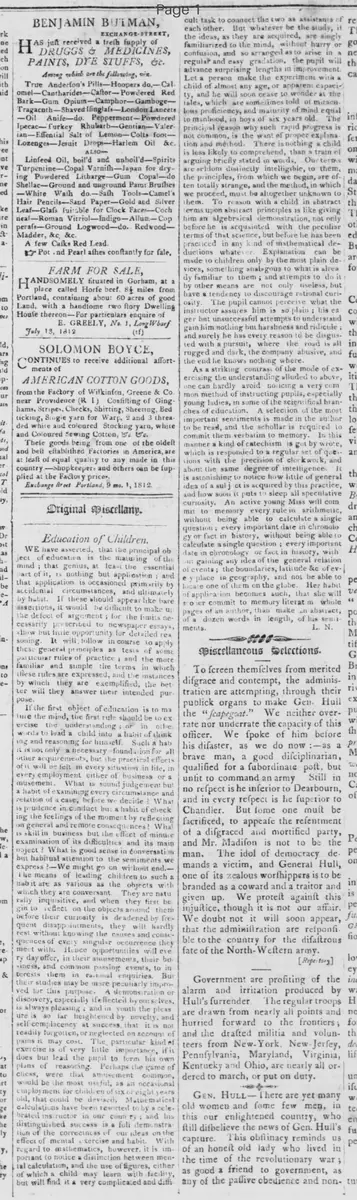
Education of Children.
WE have asserted, that the principal object of education is the maturing of the mind; that genius, at least the essential part of it, is nothing but application; and that application is occasioned primarily by accidental circumstances, and ultimately by habit. If these should appear like bare assertions, it would be difficult to make up the defect of argument; for the limits necessarily prescribed to newspaper essays, allow but little opportunity for detailed reasoning. It will, follow in course to apply these general principles as tests of some particular rules of practice and the more familiar and simple the terms in which these rules are expressed, and the instances by which they are exemplified, the better will they answer their intended purpose.
If the first object of education is to mature the mind, the first rule should be to exercise the understanding: or in other words to lead a child into a habit of thinking and reasoning for himself. Such a habit is not only a necessary foundation for all other acquirements, but the practical effects of it will be felt in every situation in life, in every employment either of business or amusement. What is sound judgement but a habit of examining every circumstance and relation of a case, before we decide? What is prudence in conduct but a habit of checking the feelings of the moment by reflecting on general and remote consequences? What is skill in business but the effect of minute examination of its difficulties and its main object? What is good sense in conversation but habitual attention to the sentiments we express?--We might go on without end.--
The means of leading children to such a habit are as various as the objects with which they are conversant They are naturally inquisitive, and when they first begin to reflect on the objects around them before their curiosity is deadened by frequent disappointments, they will hardly rest without knowing the causes and consequences of every singular occurrence they meet with. Hence opportunities will every day offer, in their amusements, their business, and common passing events, to interest them in rational enquiries. But their studies may be more peculiarly improved for thus purpose. A demonstration or discovery, especially if effected by ourselves, is always pleasing; and in youth the pleasure is so far heightened by novelty, and self complacency at success, that it is not readily forgotten, or neglected on account of pains it may cost. The particular kind of exercise is of very little importance, if it does but lead the pupil to form his own plans of reasoning. Perhaps the game of chess, were that amusement common, would be the most useful, as an occasional employment for children of six or eight years old, that could be devised. Mathematical calculations have been resorted to by a celebrated instructor in our country; and his distinguished success is a full demonstration of the correctness of our ideas on the effect of mental exercise and habit. With regard to mathematics, however, it is important to notice a distinction between mental calculation, and the use of figures, either of which a child may learn with facility, but will find it a very complicated and difficult task to connect the two as assistants of each other. But whatever be the study, it the ideas, as they are acquired, are singly familiarized to the mind, without hurry or confusion, and so arranged as to arise in a regular and easy gradation, the pupil will advance surprising lengths in improvement. Let a person make the experiment with a child of almost any age, or apparent capacity, and he will soon cease to wonder at the tales, which are sometimes told of miraculous proficiency, and maturity of mind equal to manhood, in boys of six years old. The principal reason why such rapid progress is not common, is the want of proper explanation and method. There is nothing a child is less likely to comprehend, than a train of arguing briefly stated in words, Our terms are seldom distinctly intelligible, to them, the principles, from which we begin, are often totally strange, and the method, in which we proceed, must be altogether unknown to them. To reason with a child in abstract terms upon abstract principles is like giving him an algebraical demonstration, not only before he is acquainted with the peculiar terms of that science, but before he has been practiced in any kind of mathematical deductions whatever. Explanation can be made to children only by the most plain devices, something analogous to what is already familiar to them; and attempts to do it by other means are not only useless, but have a tendency to discourage rational curiosity. The pupil cannot perceive what the instructor assures him is so plain; his eager but unsuccessful attempts to understand gain him nothing but harshness and ridicule; and surely he has every reason to be disgusted with a pursuit, where the road is all rugged and dark, the company abusive, and the end he knows nothing where.
As a striking contrast of the mode of exercising the understanding alluded to above, one can hardly avoid noticing a very common method of instructing pupils, especially young ladies, in some of the scientifical branches of education. A selection of the most important sentiments is made in the author to be read, and the scholar is required to commit them verbatim to memory. In this manner a kind of catechism is got by rote, which is responded to a regular set of questions with the precision of clockwork, and about the same degree of intelligence. It is astonishing to notice how little of general idea of a subject is acquired by this practice, and how soon it puts to sleep all speculative curiosity. An active young Miss will commit to memory every rule in arithmetic without being able to calculate a single question; every important date in chronology or fact in history, without gaining any idea of the general relation of events; the boundaries, latitude &c of every place in geography, and not be able to locate one of them on the globe. Her habit of application becomes such, that she will sooner commit to memory literal whole pages of an author, than make an abstract, of a dozen words in length, of his sentiments.
L. N.
Education of Children.
WE have asserted, that the principal object of education is the maturing of the mind; that genius, at least the essential part of it, is nothing but application; and that application is occasioned primarily by accidental circumstances, and ultimately by habit. If these should appear like bare assertions, it would be difficult to make up the defect of argument; for the limits necessarily prescribed to newspaper essays, allow but little opportunity for detailed reasoning. It will, follow in course to apply these general principles as tests of some particular rules of practice and the more familiar and simple the terms in which these rules are expressed, and the instances by which they are exemplified, the better will they answer their intended purpose.
If the first object of education is to mature the mind, the first rule should be to exercise the understanding: or in other words to lead a child into a habit of thinking and reasoning for himself. Such a habit is not only a necessary foundation for all other acquirements, but the practical effects of it will be felt in every situation in life, in every employment either of business or amusement. What is sound judgement but a habit of examining every circumstance and relation of a case, before we decide? What is prudence in conduct but a habit of checking the feelings of the moment by reflecting on general and remote consequences? What is skill in business but the effect of minute examination of its difficulties and its main object? What is good sense in conversation but habitual attention to the sentiments we express?--We might go on without end.--
The means of leading children to such a habit are as various as the objects with which they are conversant They are naturally inquisitive, and when they first begin to reflect on the objects around them before their curiosity is deadened by frequent disappointments, they will hardly rest without knowing the causes and consequences of every singular occurrence they meet with. Hence opportunities will every day offer, in their amusements, their business, and common passing events, to interest them in rational enquiries. But their studies may be more peculiarly improved for thus purpose. A demonstration or discovery, especially if effected by ourselves, is always pleasing; and in youth the pleasure is so far heightened by novelty, and self complacency at success, that it is not readily forgotten, or neglected on account of pains it may cost. The particular kind of exercise is of very little importance, if it does but lead the pupil to form his own plans of reasoning. Perhaps the game of chess, were that amusement common, would be the most useful, as an occasional employment for children of six or eight years old, that could be devised. Mathematical calculations have been resorted to by a celebrated instructor in our country; and his distinguished success is a full demonstration of the correctness of our ideas on the effect of mental exercise and habit. With regard to mathematics, however, it is important to notice a distinction between mental calculation, and the use of figures, either of which a child may learn with facility, but will find it a very complicated and difficult task to connect the two as assistants of each other. But whatever be the study, it the ideas, as they are acquired, are singly familiarized to the mind, without hurry or confusion, and so arranged as to arise in a regular and easy gradation, the pupil will advance surprising lengths in improvement. Let a person make the experiment with a child of almost any age, or apparent capacity, and he will soon cease to wonder at the tales, which are sometimes told of miraculous proficiency, and maturity of mind equal to manhood, in boys of six years old. The principal reason why such rapid progress is not common, is the want of proper explanation and method. There is nothing a child is less likely to comprehend, than a train of arguing briefly stated in words, Our terms are seldom distinctly intelligible, to them, the principles, from which we begin, are often totally strange, and the method, in which we proceed, must be altogether unknown to them. To reason with a child in abstract terms upon abstract principles is like giving him an algebraical demonstration, not only before he is acquainted with the peculiar terms of that science, but before he has been practiced in any kind of mathematical deductions whatever. Explanation can be made to children only by the most plain devices, something analogous to what is already familiar to them; and attempts to do it by other means are not only useless, but have a tendency to discourage rational curiosity. The pupil cannot perceive what the instructor assures him is so plain; his eager but unsuccessful attempts to understand gain him nothing but harshness and ridicule; and surely he has every reason to be disgusted with a pursuit, where the road is all rugged and dark, the company abusive, and the end he knows nothing where.
As a striking contrast of the mode of exercising the understanding alluded to above, one can hardly avoid noticing a very common method of instructing pupils, especially young ladies, in some of the scientifical branches of education. A selection of the most important sentiments is made in the author to be read, and the scholar is required to commit them verbatim to memory. In this manner a kind of catechism is got by rote, which is responded to a regular set of questions with the precision of clockwork, and about the same degree of intelligence. It is astonishing to notice how little of general idea of a subject is acquired by this practice, and how soon it puts to sleep all speculative curiosity. An active young Miss will commit to memory every rule in arithmetic without being able to calculate a single question; every important date in chronology or fact in history, without gaining any idea of the general relation of events; the boundaries, latitude &c of every place in geography, and not be able to locate one of them on the globe. Her habit of application becomes such, that she will sooner commit to memory literal whole pages of an author, than make an abstract, of a dozen words in length, of his sentiments.
L. N.
What sub-type of article is it?
Essay
What themes does it cover?
Moral Virtue
What keywords are associated?
Education
Children
Reasoning
Habit
Mind
Rote Memorization
Mental Exercise
What entities or persons were involved?
L. N.
Literary Details
Title
Education Of Children
Author
L. N.
Key Lines
If The First Object Of Education Is To Mature The Mind, The First Rule Should Be To Exercise The Understanding: Or In Other Words To Lead A Child Into A Habit Of Thinking And Reasoning For Himself.
What Is Sound Judgement But A Habit Of Examining Every Circumstance And Relation Of A Case, Before We Decide?
Explanation Can Be Made To Children Only By The Most Plain Devices, Something Analogous To What Is Already Familiar To Them;
An Active Young Miss Will Commit To Memory Every Rule In Arithmetic Without Being Able To Calculate A Single Question;