Thank you for visiting SNEWPapers!
Sign up free
Story
April 11, 1955
Trainman News
Indianapolis, Marion County, Indiana
What is this article about?
United action by three unions representing 4,450 Colgate-Palmolive workers at plants in Jersey City, Jeffersonville, and Kansas City led to a successful two-week strike, securing an 8.5-cent hourly wage increase and company recognition of collective bargaining rights.
Clipping
OCR Quality
98%
Excellent
Full Text
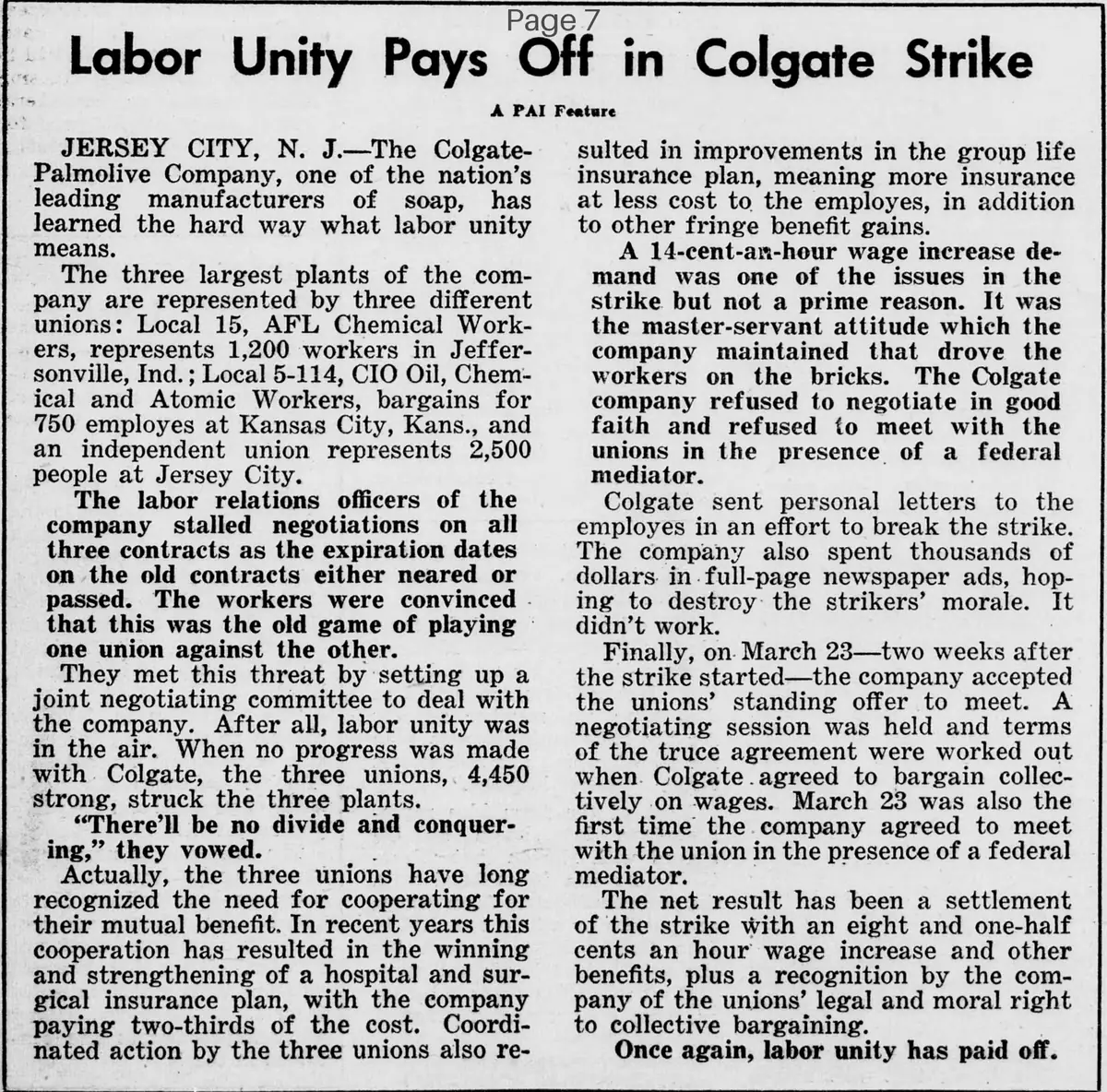
Labor Unity Pays Off in Colgate Strike
JERSEY CITY, N. J.--The Colgate-Palmolive Company, one of the nation's leading manufacturers of soap, has learned the hard way what labor unity means.
The three largest plants of the company are represented by three different unions: Local 15. AFL Chemical Workers, represents 1,200 workers in Jeffersonville, Ind. ; Local 5-114, C10 Oil, Chemical and Atomic Workers, bargains for 750 employes at Kansas City, Kans., and an independent union represents 2,500 people at Jersey City.
The labor relations officers of the company stalled negotiations on all three contracts as the expiration dates on the old contracts either neared or passed. The workers were convinced that this was the old game of playing one union against the other.
They met this threat by setting up a joint negotiating committee to deal with the company. After all, labor unity was in the air. When no progress was made with Colgate, the three unions, 4,450 strong, struck the three plants.
"There'll be no divide and conquering," they vowed.
Actually, the three unions have long recognized the need for cooperating for their mutual benefit. In recent years this cooperation has resulted in the winning and strengthening of a hospital and surgical insurance plan, with the company paying two-thirds of the cost. Coordinated action by the three unions also resulted in improvements in the group life insurance plan, meaning more insurance at less cost to the employes, in addition to other fringe benefit gains.
A 14-cent-an-hour wage increase demand was one of the issues in the strike but not a prime reason. It was the master-servant attitude which the company maintained that drove the workers on the bricks. The Colgate company refused to negotiate in good faith and refused to meet with the unions in the presence of a federal mediator.
Colgate sent personal letters to the employes in an effort to break the strike. The company also spent thousands of dollars. in full-page newspaper ads, hoping to destroy the strikers' morale. It didn't work.
Finally, on March 23--two weeks after the strike started --the company accepted the unions' standing offer to meet. A negotiating session was held and terms of the truce agreement were worked out when Colgate agreed to bargain collectively .on wages. March 23 was also the first time the company agreed to meet with the union in the presence of a federal mediator.
The net result has been a settlement of the strike with an eight and one-half cents an hour wage increase and other benefits, plus a recognition by the com- pany of the unions' legal and moral right to collective bargaining.
Once again, labor unity has paid off.
JERSEY CITY, N. J.--The Colgate-Palmolive Company, one of the nation's leading manufacturers of soap, has learned the hard way what labor unity means.
The three largest plants of the company are represented by three different unions: Local 15. AFL Chemical Workers, represents 1,200 workers in Jeffersonville, Ind. ; Local 5-114, C10 Oil, Chemical and Atomic Workers, bargains for 750 employes at Kansas City, Kans., and an independent union represents 2,500 people at Jersey City.
The labor relations officers of the company stalled negotiations on all three contracts as the expiration dates on the old contracts either neared or passed. The workers were convinced that this was the old game of playing one union against the other.
They met this threat by setting up a joint negotiating committee to deal with the company. After all, labor unity was in the air. When no progress was made with Colgate, the three unions, 4,450 strong, struck the three plants.
"There'll be no divide and conquering," they vowed.
Actually, the three unions have long recognized the need for cooperating for their mutual benefit. In recent years this cooperation has resulted in the winning and strengthening of a hospital and surgical insurance plan, with the company paying two-thirds of the cost. Coordinated action by the three unions also resulted in improvements in the group life insurance plan, meaning more insurance at less cost to the employes, in addition to other fringe benefit gains.
A 14-cent-an-hour wage increase demand was one of the issues in the strike but not a prime reason. It was the master-servant attitude which the company maintained that drove the workers on the bricks. The Colgate company refused to negotiate in good faith and refused to meet with the unions in the presence of a federal mediator.
Colgate sent personal letters to the employes in an effort to break the strike. The company also spent thousands of dollars. in full-page newspaper ads, hoping to destroy the strikers' morale. It didn't work.
Finally, on March 23--two weeks after the strike started --the company accepted the unions' standing offer to meet. A negotiating session was held and terms of the truce agreement were worked out when Colgate agreed to bargain collectively .on wages. March 23 was also the first time the company agreed to meet with the union in the presence of a federal mediator.
The net result has been a settlement of the strike with an eight and one-half cents an hour wage increase and other benefits, plus a recognition by the com- pany of the unions' legal and moral right to collective bargaining.
Once again, labor unity has paid off.
What sub-type of article is it?
Historical Event
Personal Triumph
What themes does it cover?
Triumph
Justice
Moral Virtue
What keywords are associated?
Labor Unity
Colgate Strike
Union Cooperation
Wage Increase
Collective Bargaining
Labor Dispute
Where did it happen?
Jersey City, N. J.; Jeffersonville, Ind.; Kansas City, Kans.
Story Details
Location
Jersey City, N. J.; Jeffersonville, Ind.; Kansas City, Kans.
Event Date
March 23
Story Details
Three unions representing workers at Colgate-Palmolive plants united against the company's stalling tactics, striking for two weeks and securing an 8.5-cent hourly wage increase, improved benefits, and recognition of collective bargaining rights.