Thank you for visiting SNEWPapers!
Sign up free
Editorial
December 7, 1811
The Enquirer
Richmond, Henrico County, Virginia
What is this article about?
An editorial defending Thomas Paine's crucial contributions to American independence via 'Common Sense' and 'Crisis' against Rep. John Randolph's dismissal, citing endorsements from historians Ramsay, Gordon, and patriots like Samuel Adams, Jefferson, and Monroe. It rebukes class-based sneers at Paine's humble origins.
Clipping
OCR Quality
98%
Excellent
Full Text
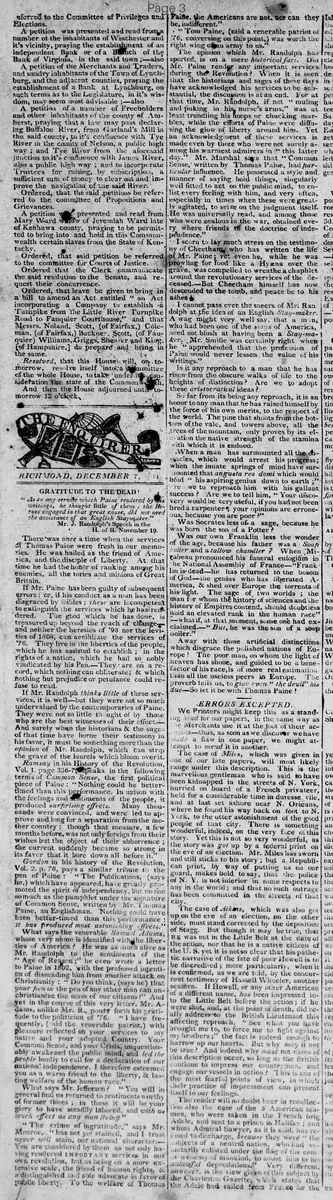
RICHMOND, DECEMBER 7, 1811
GRATITUDE TO THE DEAD!
"As to any service which Paine rendered by his writings, he thought little of them; the Heroes engaged in that great cause, did not need the assistance of an English Staymaker."
Mr. J. Randolph's Speech in the H. of R. November 19.
There was once a time when the services of Thomas Paine were fresh in our memories. He was hailed as the friend of America, and the disciple of Liberty. At that time he had the honor of ranking among his enemies, all the tories and minions of Great Britain.
If Mr. Paine has been guilty of subsequent errors: or, if his conduct as a man has been disgraced by foibles; these are incompetent to extinguish the services which he has rendered. The good which he has done, is treasured up beyond the reach of change and neither the heresies of '98 nor the levities of 1808, can annihilate the services of 76. They live in the liberties of the people, which he has assisted to establish; in the rights of a nation, which he had so nobly vindicated by his Pen.—They are on a record, which nothing can obliterate; & which nothing but prejudice or petulance could refuse to read.
If Mr. Randolph thinks little of these services, it is well—but they were not so much undervalued by the contemporaries of Paine. They were not so little thought of by those who are the best witnesses of their effect. And surely when the historians & the sages of that time have borne their testimony in his favor, it must be something more than the opinion of Mr. Randolph, which can strip the grave of the laurels which bloom over it.
Ramsay in his History of the Revolution, Vol. 1. page 336-7, speaks in the following terms of Common Sense, the first political piece of Paine: "Nothing could be better-timed than this performance. In unison with the feelings and sentiments of the people, it produced surprising effects. Many thousands were convinced, and were led to approve and long for a separation from the mother country: though that measure, a few months before, was not only foreign from their wishes but the object of their abhorrence; the current suddenly became so strong in its favor that it bore down all before it."
Gordon in his history of the Revolution, Vol. 2. p. 78, pays a similar tribute to the pen of Paine: "The Publications, (says he,) which have appeared, have greatly promoted the spirit of independency, but none so much as the pamphlet under the signature of Common Sense, written by Mr. Thomas Paine, an Englishman. Nothing could have been better-timed than this performance: it has produced most astonishing effects."
What says the venerable Samuel Adams, whose very name is identified with the liberties of America? He was as much alive as Mr. Randolph to the sentiments of the "Age of Reason;" he even wrote a letter to Paine in 1802, with the professed intention of dissuading him from another attack on Christianity: Do you think, (says he) that your pen or the pen of any other man can un-christianize the mass of our citizens? And yet in the course of this very letter, Mr. Adams, unlike Mr. R., pours forth his gratitude to the politician of '76. "I have frequently, (said the venerable patriot,) with pleasure reflected on your services to my native and your adopted Country. Your Common Sense, and your Crisis, unquestionably awakened the public mind, and led the people loudly to call for a declaration of our national independence. I therefore esteemed you as a warm friend to the liberty, & lasting welfare of the human race."
What says Mr. Jefferson? "You will in general find us returned to sentiments worthy of former times; in these it will be your glory to have steadily labored, and with as much effect as any man living"
"The crime of ingratitude," says Mr. Monroe, "has not yet stained, and I trust never will stain, our national character. You are considered by them as not only having rendered IMPORTANT services in our own revolution, but as being on a more extensive scale, the friend of human rights, & a distinguished and able advocate in favor of public liberty. To the welfare of Thomas Paine, the Americans are not, nor can they be, indifferent."
"Tom Paine, (said a venerable patriot of '76, conversing on this point,) was worth the right wing of an army to us.'"
The opinion which Mr. Randolph has sported, is on a mere historical fact. Did Mr. Paine render any important services during the Revolution? When it is seen that the historians and sages of those days have acknowledged his services to be substantial, the discussion is at an end. For at that time, Mr. Randolph, if not "mewling and puking in his nurse's arms," was at least trundling his hoops or chucking marbles, while the efforts of Paine were diffusing the glow of liberty around him. Yet an acknowledgement of these services is made even by those who were not surely among his warmest admirers in "this latter day."
Mr. Marshall says that "Common Sense, written by Thomas Paine, had particular influence. He possessed a style and manner of saying bold things, singularly well fitted to act on the public mind, to enlist every feeling with him, and very often, especially in times when these were greatly agitated, to seize on the judgment itself. He was universally read, and among those who were zealous in the war, obtained everywhere friends to the doctrine of independence."
I do not deem it to lay much stress on the testimony of Cheetham who has written the life of Mr. Paine; yet even he, while he was prowling for food like a Hyæna over the grave, was compelled to wreathe a chaplet around the revolutionary services of the deceased.—But Cheetham himself has now descended to the tomb, and peace be to his ashes
I cannot pass over the sneers of Mr. Randolph at the idea of an English Stay-maker. A wag might very well say, that a man, who had been one of the stays of America, need not blush at having been a Stay-maker. Mr. Smilie was certainly right when he "apprehended that the profession of Paine would never lessen the value of his writings."
Is it any reproach to a man that he has risen from the obscure walks of life to the heights of distinction? Are we to adopt these aristocratical ideas?
So far from its being any reproach, it is an honor to any man that he has raised himself by the force of his own merits, to the respect of the world. The pine that shoots from the bottom of the vale, and towers above, all the trees of the mountain, only proves by its elevation the native strength of the stamina with which it is endued.
When a man has surmounted all the obstacles, which would arrest his progress; when the innate springs of mind have surmounted that angusta res domi which would bind "his aspiring genius down to earth;" are we to reproach him with his gallant success? Are we to tell him, "Your discovery would be very useful, if you had not been bred a carpenter; your opinions are erroneous, because you are poor?"
Was Socrates less of a sage, because he was born the son of a Potter?
Was our own Franklin less the wonder of the age, because his father was a Soap boiler and tallow chandler? When Mirabeau pronounced his funeral eulogium in the National Assembly of France "Franklin is dead—he has returned to the bosom of God—the genius who has liberated America, & shed over Europe the torrents of his light. The sage of two worlds; the man for whom the history of sciences and the history of Empires contend, should doubtless hold an elevated rank in the human race"
:—what if, at that moment, some one had exclaimed."But, he was the son of a soap boiler."
Away with those artificial distinctions which disgrace the polished nations of Europe! The poor man, on whom the light of heaven has shone, and guided to be a benefactor of his race, is of more real estimation than all the useless peers in Europe. The proverb tells us, to give even "the devil" his due—So let it be with Thomas Paine?
GRATITUDE TO THE DEAD!
"As to any service which Paine rendered by his writings, he thought little of them; the Heroes engaged in that great cause, did not need the assistance of an English Staymaker."
Mr. J. Randolph's Speech in the H. of R. November 19.
There was once a time when the services of Thomas Paine were fresh in our memories. He was hailed as the friend of America, and the disciple of Liberty. At that time he had the honor of ranking among his enemies, all the tories and minions of Great Britain.
If Mr. Paine has been guilty of subsequent errors: or, if his conduct as a man has been disgraced by foibles; these are incompetent to extinguish the services which he has rendered. The good which he has done, is treasured up beyond the reach of change and neither the heresies of '98 nor the levities of 1808, can annihilate the services of 76. They live in the liberties of the people, which he has assisted to establish; in the rights of a nation, which he had so nobly vindicated by his Pen.—They are on a record, which nothing can obliterate; & which nothing but prejudice or petulance could refuse to read.
If Mr. Randolph thinks little of these services, it is well—but they were not so much undervalued by the contemporaries of Paine. They were not so little thought of by those who are the best witnesses of their effect. And surely when the historians & the sages of that time have borne their testimony in his favor, it must be something more than the opinion of Mr. Randolph, which can strip the grave of the laurels which bloom over it.
Ramsay in his History of the Revolution, Vol. 1. page 336-7, speaks in the following terms of Common Sense, the first political piece of Paine: "Nothing could be better-timed than this performance. In unison with the feelings and sentiments of the people, it produced surprising effects. Many thousands were convinced, and were led to approve and long for a separation from the mother country: though that measure, a few months before, was not only foreign from their wishes but the object of their abhorrence; the current suddenly became so strong in its favor that it bore down all before it."
Gordon in his history of the Revolution, Vol. 2. p. 78, pays a similar tribute to the pen of Paine: "The Publications, (says he,) which have appeared, have greatly promoted the spirit of independency, but none so much as the pamphlet under the signature of Common Sense, written by Mr. Thomas Paine, an Englishman. Nothing could have been better-timed than this performance: it has produced most astonishing effects."
What says the venerable Samuel Adams, whose very name is identified with the liberties of America? He was as much alive as Mr. Randolph to the sentiments of the "Age of Reason;" he even wrote a letter to Paine in 1802, with the professed intention of dissuading him from another attack on Christianity: Do you think, (says he) that your pen or the pen of any other man can un-christianize the mass of our citizens? And yet in the course of this very letter, Mr. Adams, unlike Mr. R., pours forth his gratitude to the politician of '76. "I have frequently, (said the venerable patriot,) with pleasure reflected on your services to my native and your adopted Country. Your Common Sense, and your Crisis, unquestionably awakened the public mind, and led the people loudly to call for a declaration of our national independence. I therefore esteemed you as a warm friend to the liberty, & lasting welfare of the human race."
What says Mr. Jefferson? "You will in general find us returned to sentiments worthy of former times; in these it will be your glory to have steadily labored, and with as much effect as any man living"
"The crime of ingratitude," says Mr. Monroe, "has not yet stained, and I trust never will stain, our national character. You are considered by them as not only having rendered IMPORTANT services in our own revolution, but as being on a more extensive scale, the friend of human rights, & a distinguished and able advocate in favor of public liberty. To the welfare of Thomas Paine, the Americans are not, nor can they be, indifferent."
"Tom Paine, (said a venerable patriot of '76, conversing on this point,) was worth the right wing of an army to us.'"
The opinion which Mr. Randolph has sported, is on a mere historical fact. Did Mr. Paine render any important services during the Revolution? When it is seen that the historians and sages of those days have acknowledged his services to be substantial, the discussion is at an end. For at that time, Mr. Randolph, if not "mewling and puking in his nurse's arms," was at least trundling his hoops or chucking marbles, while the efforts of Paine were diffusing the glow of liberty around him. Yet an acknowledgement of these services is made even by those who were not surely among his warmest admirers in "this latter day."
Mr. Marshall says that "Common Sense, written by Thomas Paine, had particular influence. He possessed a style and manner of saying bold things, singularly well fitted to act on the public mind, to enlist every feeling with him, and very often, especially in times when these were greatly agitated, to seize on the judgment itself. He was universally read, and among those who were zealous in the war, obtained everywhere friends to the doctrine of independence."
I do not deem it to lay much stress on the testimony of Cheetham who has written the life of Mr. Paine; yet even he, while he was prowling for food like a Hyæna over the grave, was compelled to wreathe a chaplet around the revolutionary services of the deceased.—But Cheetham himself has now descended to the tomb, and peace be to his ashes
I cannot pass over the sneers of Mr. Randolph at the idea of an English Stay-maker. A wag might very well say, that a man, who had been one of the stays of America, need not blush at having been a Stay-maker. Mr. Smilie was certainly right when he "apprehended that the profession of Paine would never lessen the value of his writings."
Is it any reproach to a man that he has risen from the obscure walks of life to the heights of distinction? Are we to adopt these aristocratical ideas?
So far from its being any reproach, it is an honor to any man that he has raised himself by the force of his own merits, to the respect of the world. The pine that shoots from the bottom of the vale, and towers above, all the trees of the mountain, only proves by its elevation the native strength of the stamina with which it is endued.
When a man has surmounted all the obstacles, which would arrest his progress; when the innate springs of mind have surmounted that angusta res domi which would bind "his aspiring genius down to earth;" are we to reproach him with his gallant success? Are we to tell him, "Your discovery would be very useful, if you had not been bred a carpenter; your opinions are erroneous, because you are poor?"
Was Socrates less of a sage, because he was born the son of a Potter?
Was our own Franklin less the wonder of the age, because his father was a Soap boiler and tallow chandler? When Mirabeau pronounced his funeral eulogium in the National Assembly of France "Franklin is dead—he has returned to the bosom of God—the genius who has liberated America, & shed over Europe the torrents of his light. The sage of two worlds; the man for whom the history of sciences and the history of Empires contend, should doubtless hold an elevated rank in the human race"
:—what if, at that moment, some one had exclaimed."But, he was the son of a soap boiler."
Away with those artificial distinctions which disgrace the polished nations of Europe! The poor man, on whom the light of heaven has shone, and guided to be a benefactor of his race, is of more real estimation than all the useless peers in Europe. The proverb tells us, to give even "the devil" his due—So let it be with Thomas Paine?
What sub-type of article is it?
Partisan Politics
Moral Or Religious
What keywords are associated?
Thomas Paine
Common Sense
American Revolution
John Randolph
Historical Services
Gratitude
Class Distinctions
Age Of Reason
What entities or persons were involved?
Thomas Paine
John Randolph
Samuel Adams
Thomas Jefferson
James Monroe
David Ramsay
William Gordon
John Marshall
Benjamin Franklin
Socrates
Mirabeau
Cheetham
Smilie
Editorial Details
Primary Topic
Defense Of Thomas Paine's Revolutionary Services Against John Randolph's Criticism
Stance / Tone
Strongly Pro Paine, Anti Aristocratic, Emphasizing Historical Gratitude
Key Figures
Thomas Paine
John Randolph
Samuel Adams
Thomas Jefferson
James Monroe
David Ramsay
William Gordon
John Marshall
Benjamin Franklin
Socrates
Mirabeau
Cheetham
Smilie
Key Arguments
Paine's 'Common Sense' And 'Crisis' Were Pivotal In Awakening Public Support For Independence
Historians Ramsay And Gordon Praised The Timely And Astonishing Effects Of Paine's Writings
Samuel Adams Expressed Gratitude For Paine's Services Despite Disagreeing With His Religious Views
Jefferson And Monroe Affirmed Paine's Important Role In The Revolution And Human Rights
Randolph's Dismissal Ignores Contemporary Testimonies From Revolution Era Figures
Paine's Humble Origins As A Staymaker Do Not Diminish His Merits, Akin To Franklin And Socrates
Aristocratic Sneers At Social Class Are Rejected In Favor Of Merit Based Honor