Thank you for visiting SNEWPapers!
Sign up free
Indiana State Sentinel
Indianapolis, Marion County, Indiana
What is this article about?
Editorial analyzes Robert Toombs' election to U.S. Senate by Georgia's Union party of Whigs and Democrats, their refusal to join national conventions, and demand for Northern adherence to Compromise measures protecting Southern slavery institutions. Warns of Union dissolution if North panders to abolitionists; calls for mutual respect of compromises to restore confidence and focus on traditional issues.
Merged-components note: These two components form a continuous editorial discussing Southern political movements, the Compromise measures, and the need for Northern support; the second begins directly with 'On the other hand,' indicating continuation. Relabeled from 'story' for the first to 'editorial' as it fits opinionated political commentary.
Clipping
OCR Quality
Full Text
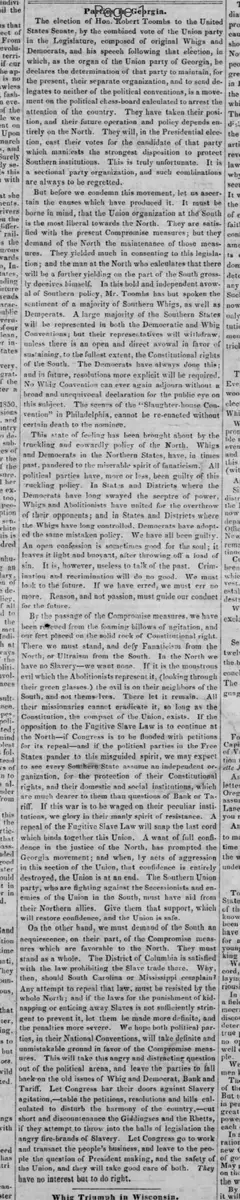
But before we condemn this movement, let us ascertain the causes which have produced it. It must be borne in mind, that the Union organization at the South is the most liberal towards the North. They are satisfied with the present Compromise measures; but they demand of the North the maintenance of those measures. They yielded much in consenting to this legislation; and the man at the North who calculates that there will be a further yielding on the part of the South grossly deceives himself. In this bold and independent avowal of Southern policy, Mr. Toombs has but spoken the sentiment of a majority of Southern Whigs, as well as Democrats. A large majority of the Southern States will be represented in both the Democratic and Whig Conventions; but their representatives will withdraw, unless there is an open and direct avowal in favor of sustaining, to the fullest extent, the Constitutional rights of the South. The Democrats have always done this; and in future, resolutions more explicit will be required. No Whig Convention can ever again adjourn without a broad and unequivocal declaration for the public eye on this subject. The scenes of the "Slaughter-house Convention" in Philadelphia, cannot be re-enacted without certain death to the nominee.
This state of feeling has been brought about by the truckling and cowardly policy of the North. Whigs and Democrats in the Northern States, have, in times past, pandered to the miserable spirit of fanaticism. All political parties have, more or less, been guilty of this truckling policy. In States and Districts where the Democrats have long swayed the sceptre of power, Whigs and Abolitionists have united for the overthrow of their opponents; and in States and Districts where the Whigs have long controlled, Democrats have adopted the same mistaken policy. We have all been guilty. An open confession is sometimes good for the soul; it leaves it light and buoyant, after throwing off a load of sin. It is, however, useless to talk of the past. Crimination and recrimination will do no good. We must look to the future. If we have erred, we must err no more. Reason, and not passion, must guide our conduct for the future.
By the passage of the Compromise measures, we have been rescued from the foaming billows of agitation, and our feet placed on the solid rock of Constitutional right. There we must stand, and defy Fanaticism from the North, or Ultraism from the South. In the North we have no Slavery—we want none. If it is the monstrous evil which the Abolitionists represent it, (looking through their green glasses,) the evil is on their neighbors of the South, and not themselves. There let it remain. All their missionaries cannot eradicate it, so long as the Constitution, the compact of the Union, exists. If the opposition to the Fugitive Slave Law is to continue at the North—if Congress is to be flooded with petitions for its repeal—and if the political parties in the Free States pander to this misguided spirit, we may expect to see every Southern State assume an independent organization, for the protection of their Constitutional rights, and their domestic and social institutions, which are much dearer to them than questions of Bank or Tariff. If this war is to be waged on their peculiar institutions, we glory in their manly spirit of resistance. A repeal of the Fugitive Slave Law will snap the last cord which binds together this Union. A want of full confidence in the justice of the North, has prompted the Georgia movement; and when, by acts of aggression in this section of the Union, that confidence is entirely destroyed, the Union is at an end. The Southern Union party, who are fighting against the Secessionists and enemies of the Union in the South, must have aid from their Northern allies. Give them that support, which will restore confidence, and the Union is safe.
On the other hand, we must demand of the South an acquiescence, on their part, of the Compromise measures which are favorable to the North. They must stand as a whole. The District of Columbia is satisfied with the law prohibiting the Slave trade there. Why, then, should South Carolina or Mississippi complain? Any attempt to repeal that law, must be resisted by the whole North; and if the laws for the punishment of kidnapping or enticing away Slaves is not sufficiently stringent to prevent it, let them be made more definite, and the penalties more severe. We hope both political parties, in their National Conventions, will take definite and unmistakable ground in favor of the Compromise measures. This will take this angry and distracting question out of the political arena, and leave the parties to fall back—on the old issues of Whig and Democrat, Bank and Tariff. Let Congress bar their doors against Slavery agitation,—table the petitions, resolutions and bills calculated to disturb the harmony of the country, cut short and discountenance the Giddingses and the Rhetts, if they attempt to throw into the halls of legislation the angry fire-brands of Slavery. Let Congress go to work and transact the people's business, and leave to the people the question of President making, and the safety of the Union, and they will take good care of both. They have no interest but to do right.
What sub-type of article is it?
What keywords are associated?
What entities or persons were involved?
Editorial Details
Primary Topic
Georgia Union Party's Stance On Protecting Southern Institutions And Demanding Northern Adherence To Compromise Measures
Stance / Tone
Supportive Of Union Preservation Through Mutual Compromise Adherence, Critical Of Northern Abolitionist Pandering
Key Figures
Key Arguments