Thank you for visiting SNEWPapers!
Sign up free
Editorial
July 3, 1799
Gazette Of The United States, & Philadelphia Daily Advertiser
Philadelphia, Philadelphia County, Pennsylvania
What is this article about?
This editorial criticizes pro-French 'patriots' in the US for opposing Federalist measures like the army, navy, alien, and sedition acts, arguing that weakening military preparedness invites foreign conquest, especially from France. It defends taxes and loans as necessary for national defense and independence.
Clipping
OCR Quality
95%
Excellent
Full Text
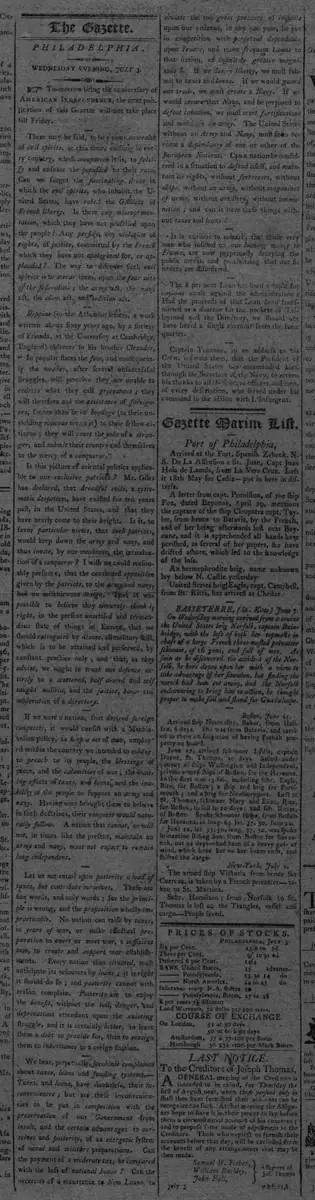
There may be said, to be a commonwealth of evil spirits, at this time, existing in every country, whose occupation it is, to falsify and ensnare the populace to their ruin.
Can we forget the fascinating, dress in which the evil spirits, who inhabit the United States, have robed the Goddess of French liberty. Is there any misrepresentation, which they have not practiced upon the people? Any perfidy, any violation of rights, of justice, committed by the French which they have not apologized for, or applauded?. The way to dispel such evil spirits is to swear them, upon the four acts of the federalists; the army act, the navy act, the alien act, and sedition act.
Hippias (in the Athenian letters, a work written about sixty years ago, by a society of Friends, at the University at Cambridge, England) observes to his brother Cleander,
"In popular states the servile, and consequently the weaker, after several unsuccessful struggles, will perceive they are unable to redress what they call grievances; they will therefore ask the assistance of foreigners, sooner than be in bondage (as their unyielding rancour terms it) to their fellow-citizens; they will court the yoke of a stranger, and submit their country and themselves to the mercy of a conqueror."
Is this picture of oriental politics applicable to our exclusive patriots? Mr. Giles has declared, that dreadful evils, a systematic despotism, have existed for ten years past, in the United States, and that they have nearly come to their height. Is it, to favor particular views, that such patriots, would keep down the army and navy, and thus invite, by our weakness, the introduction of a conqueror? I wish we could reasonably presume, that the continued opposition given by the patriots, to the army and navy, had no mischievous design. I yet it was possible to believe they sincerely think it right, in the present unsettled and tremendous state of things in Europe, that we should extinguish by disuse, all military skill, which is to be attained and preserved, by constant practice only; and that, as they advise, we ought to trust our defence entirely to a scattered, half armed and self taught militia, and the justice, honor and moderation of a directory.
If we were a nation, that desired foreign conquests, it would consist with a Machiavellian policy, to keep a set of men, employed within the country we intended to subdue, to preach to its people, the blessings of peace, and the calamities of war; the wasting effects of taxes, and loans, and the inability of the people to support an army and navy. Having once brought them to believe in such doctrines, their conquest would naturally follow. A nation that cannot, or will not, in times like the present, maintain an army and navy, must not expect to remain long independent.
Let us not entail upon posterity a load of taxes, but contribute ourselves. These are fine words, and only words; for the principle is wrong, and the proposition wholly impracticable. No nation can raise by taxes, in years of war, or make effectual preparation to avert or meet war, a sufficient sum, to create and support war establishments. Every nation thus situated, must anticipate its resources by loans; it is right it should do so; and posterity cannot with reason complain. Posterity are to enjoy the benefit, without the toil, danger, and deprivations attendant upon the existing struggle, and it is certainly better, to leave them a debt to provide for, than to consign them an inheritance to a foreign nation.
We hear, perpetually, jacobinic complaints about taxes, loans and funding systems.—Taxes, and loans, have doubtless, their inconveniences; but are these inconveniences to be put in competition with the preservation of our Government from insult, and the certain advantages to ourselves and posterity, of an energetic system of naval and military preparations. Can the payment of a moderate tax, be compared with the loss of national honor? Can the necessity of a recurrence to New Loans, to obviate the too great pressure of impositions upon our citizens, in any one year, be put in competition with perpetual dependence upon France, and more frequent Loans to that nation, of infinitely greater magnitude?. If we desire liberty, we must submit to taxes and loans. If we would guard our trade, we must create a Navy. If we would secure that Navy, and be prepared to defeat invasion, we must erect fortifications and maintain an army. The United States without an Army and Navy, must soon become a dependency of one or other of the European Nations. Can a nation be considered in a situation to defend itself, and maintain its rights, without fortresses, without ships without an army, without magazines of arms, without artillery, without ammunition; and can it have these things without taxes and loans?
It is curious to remark, that those very men who insisted on our loaning money to France, are now perpetually decrying the public credit, and proclaiming that our finances are disordered.
The 8 per cent Loan has been a topic for copious abuse against the administration:
Had the proceeds of that Loan been transmitted as a douceur for the pockets of Talleyrand and the Directory, we should not have heard a single murmur from the same quarter.
Can we forget the fascinating, dress in which the evil spirits, who inhabit the United States, have robed the Goddess of French liberty. Is there any misrepresentation, which they have not practiced upon the people? Any perfidy, any violation of rights, of justice, committed by the French which they have not apologized for, or applauded?. The way to dispel such evil spirits is to swear them, upon the four acts of the federalists; the army act, the navy act, the alien act, and sedition act.
Hippias (in the Athenian letters, a work written about sixty years ago, by a society of Friends, at the University at Cambridge, England) observes to his brother Cleander,
"In popular states the servile, and consequently the weaker, after several unsuccessful struggles, will perceive they are unable to redress what they call grievances; they will therefore ask the assistance of foreigners, sooner than be in bondage (as their unyielding rancour terms it) to their fellow-citizens; they will court the yoke of a stranger, and submit their country and themselves to the mercy of a conqueror."
Is this picture of oriental politics applicable to our exclusive patriots? Mr. Giles has declared, that dreadful evils, a systematic despotism, have existed for ten years past, in the United States, and that they have nearly come to their height. Is it, to favor particular views, that such patriots, would keep down the army and navy, and thus invite, by our weakness, the introduction of a conqueror? I wish we could reasonably presume, that the continued opposition given by the patriots, to the army and navy, had no mischievous design. I yet it was possible to believe they sincerely think it right, in the present unsettled and tremendous state of things in Europe, that we should extinguish by disuse, all military skill, which is to be attained and preserved, by constant practice only; and that, as they advise, we ought to trust our defence entirely to a scattered, half armed and self taught militia, and the justice, honor and moderation of a directory.
If we were a nation, that desired foreign conquests, it would consist with a Machiavellian policy, to keep a set of men, employed within the country we intended to subdue, to preach to its people, the blessings of peace, and the calamities of war; the wasting effects of taxes, and loans, and the inability of the people to support an army and navy. Having once brought them to believe in such doctrines, their conquest would naturally follow. A nation that cannot, or will not, in times like the present, maintain an army and navy, must not expect to remain long independent.
Let us not entail upon posterity a load of taxes, but contribute ourselves. These are fine words, and only words; for the principle is wrong, and the proposition wholly impracticable. No nation can raise by taxes, in years of war, or make effectual preparation to avert or meet war, a sufficient sum, to create and support war establishments. Every nation thus situated, must anticipate its resources by loans; it is right it should do so; and posterity cannot with reason complain. Posterity are to enjoy the benefit, without the toil, danger, and deprivations attendant upon the existing struggle, and it is certainly better, to leave them a debt to provide for, than to consign them an inheritance to a foreign nation.
We hear, perpetually, jacobinic complaints about taxes, loans and funding systems.—Taxes, and loans, have doubtless, their inconveniences; but are these inconveniences to be put in competition with the preservation of our Government from insult, and the certain advantages to ourselves and posterity, of an energetic system of naval and military preparations. Can the payment of a moderate tax, be compared with the loss of national honor? Can the necessity of a recurrence to New Loans, to obviate the too great pressure of impositions upon our citizens, in any one year, be put in competition with perpetual dependence upon France, and more frequent Loans to that nation, of infinitely greater magnitude?. If we desire liberty, we must submit to taxes and loans. If we would guard our trade, we must create a Navy. If we would secure that Navy, and be prepared to defeat invasion, we must erect fortifications and maintain an army. The United States without an Army and Navy, must soon become a dependency of one or other of the European Nations. Can a nation be considered in a situation to defend itself, and maintain its rights, without fortresses, without ships without an army, without magazines of arms, without artillery, without ammunition; and can it have these things without taxes and loans?
It is curious to remark, that those very men who insisted on our loaning money to France, are now perpetually decrying the public credit, and proclaiming that our finances are disordered.
The 8 per cent Loan has been a topic for copious abuse against the administration:
Had the proceeds of that Loan been transmitted as a douceur for the pockets of Talleyrand and the Directory, we should not have heard a single murmur from the same quarter.
What sub-type of article is it?
Military Affairs
Foreign Affairs
Partisan Politics
What keywords are associated?
Army Act
Navy Act
Alien Act
Sedition Act
French Directory
Military Preparedness
Taxes And Loans
National Defense
Partisan Opposition
What entities or persons were involved?
Federalists
Patriots
Mr. Giles
French Directory
Talleyrand
Hippias
Cleander
Editorial Details
Primary Topic
Support For Federalist Military And Naval Acts Against French Influence
Stance / Tone
Strongly Pro Federalist And Anti French Sympathizers
Key Figures
Federalists
Patriots
Mr. Giles
French Directory
Talleyrand
Hippias
Cleander
Key Arguments
Evil Spirits Promote French Liberty Misrepresentations
Federalist Acts Dispel Pro French Influences
Opposition To Army And Navy Invites Conquerors
Trusting Militia Over Professional Forces Is Unwise
Machiavellian Policy Weakens Nations For Conquest
Taxes And Loans Necessary For Defense
Better To Leave Debt Than Foreign Dependency
Inconveniences Of Taxes Pale Against Loss Of Independence
Without Army Navy And Fortifications Us Vulnerable
Critics Of Loans Hypocritical If For France