Thank you for visiting SNEWPapers!
Sign up free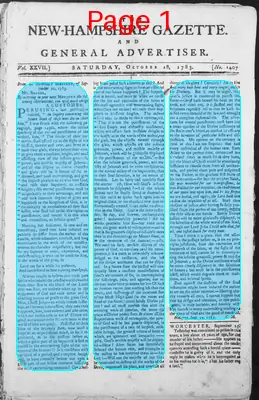
The New Hampshire Gazette And General Advertiser
Portsmouth, Exeter, Rockingham County, New Hampshire
What is this article about?
A letter critiques a theological publication's view that the blessed will derive pleasure from witnessing the eternal torments of the damned, arguing instead that God's greatness is more gloriously displayed in the universal salvation of humanity through Christ's redemption. Written in Newport, RI, on September 15, 1783, by C. M.
Clipping
OCR Quality
Full Text
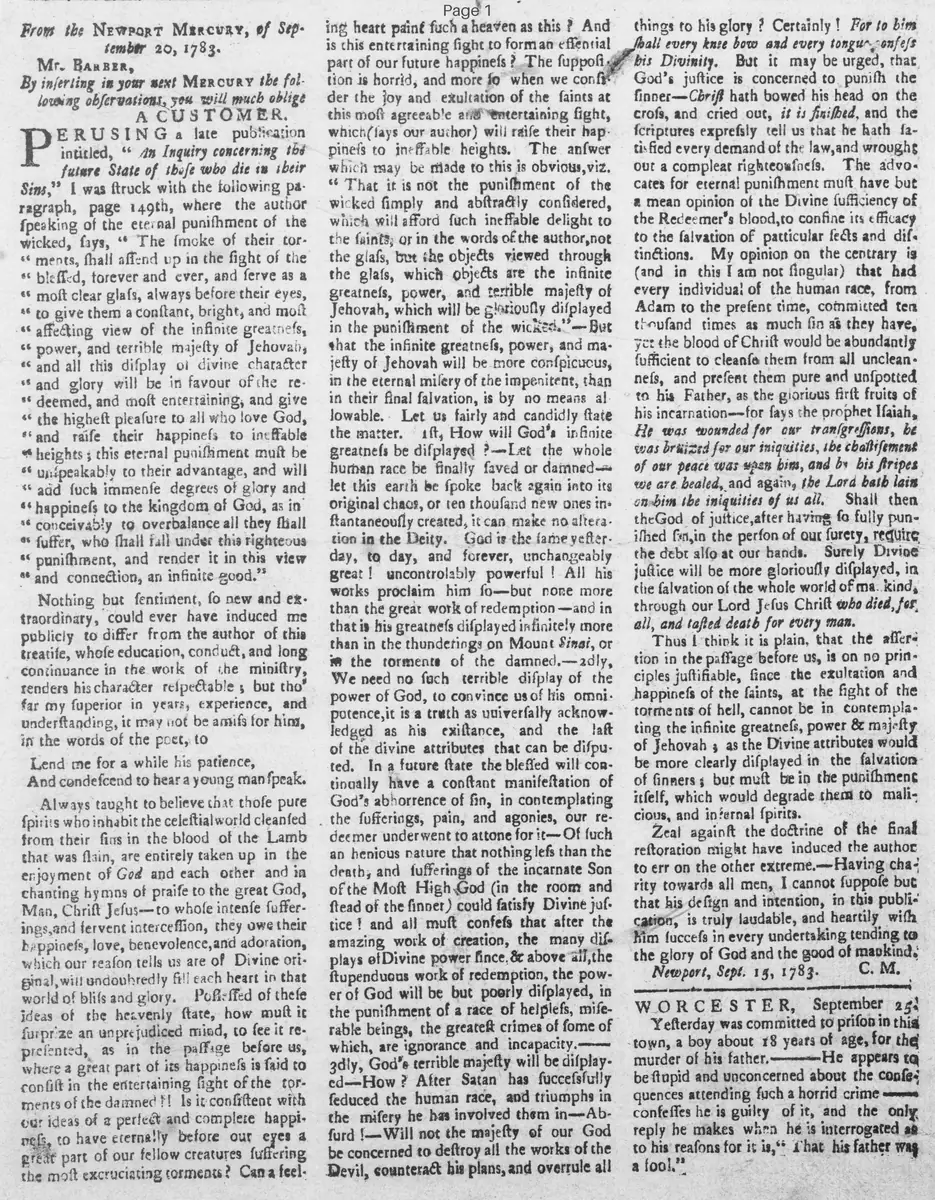
Mr. Barber,
By inserting in your next Mercury the following observations, you will much oblige
A CUSTOMER.
Perusing a late publication intitled, "An Inquiry concerning the future State of those who die in their Sins," I was struck with the following paragraph, page 149th, where the author speaking of the eternal punishment of the wicked, says, "The smoke of their torments, shall ascend up in the sight of the blessed, forever and ever, and serve as a most clear glass, always before their eyes, to give them a constant, bright, and most affecting view of the infinite greatness, power, and terrible majesty of Jehovah; and all this display of divine character and glory will be in favour of the redeemed, and most entertaining, and give the highest pleasure to all who love God, and raise their happiness to ineffable heights; this eternal punishment must be unspeakably to their advantage, and will add such immense degrees of glory and happiness to the kingdom of God, as inconceivably to overbalance all they shall suffer, who shall fall under this righteous punishment, and render it in this view and connection, an infinite good."
Nothing but sentiment so new and extraordinary, could ever have induced me publicly to differ from the author of this treatise, whose education, conduct, and long continuance in the work of the ministry, renders his character respectable; but though far my superior in years, experience, and understanding, it may not be amiss for him, in the words of the poet, to
Lend me for a while his patience,
And condescend to hear a young man speak.
Always taught to believe that those pure spirits who inhabit the celestial world cleansed from their sins in the blood of the Lamb that was slain, are entirely taken up in the enjoyment of God and each other and in chanting hymns of praise to the great God, Man. Christ Jesus--to whose intense sufferings, and fervent intercession, they owe their happiness, love, benevolence, and adoration, which our reason tells us are of Divine original, will undoubtedly fill each heart in that world of bliss and glory. Possessed of these ideas of the heavenly state, how must it surprise an unprejudiced mind, to see it represented, as in the passage before us, where a great part of its happiness is said to consist in the entertaining sight of the torments of the damned !! Is it consistent with our ideas of a perfect and complete happiness, to have eternally before our eyes a great part of our fellow creatures suffering the most excruciating torments? Can a feeling heart paint such a heaven as this? And is this entertaining sight to form an essential part of our future happiness? The supposition is horrid, and more so when we consider the joy and exultation of the saints at this most agreeable and entertaining sight, which (says our author) will raise their happiness to ineffable heights. The answer which may be made to this is obvious, viz. "That it is not the punishment of the wicked simply and abstractly considered, which will afford such ineffable delight to the saints: or in the words of the author not the glass, but the objects viewed through the glass, which objects are the infinite greatness, power, and terrible majesty of Jehovah, which will be gloriously displayed in the punishment of the wicked."--But that the infinite greatness, power, and majesty of Jehovah will be more conspicuous in the eternal misery of the impenitent, than in their final salvation, is by no means allowable. Let us fairly and candidly state the matter. 1st, How will God's infinite greatness be displayed? Let the whole human race be finally saved or damned--let this earth be broke back again into its original chaos, or ten thousand new ones instantaneously created, it can make no alteration in the Deity. God is the same yesterday, to day, and forever, unchangeably great! uncontrolably powerful! All his works proclaim him so--but none more than the great work of redemption -and in that is his greatness displayed infinitely more than in the thunderings on Mount Sinai, or in the torments of the damned. 2dly. We need no such terrible display of the power of God, to convince us of his omnipotence, it is a truth as universally acknowledged as his existence, and the last of the divine attributes that can be disputed. In a future state the blessed will continually have a constant manifestation of God's abhorrence of sin, in contemplating the sufferings, pain, and agonies, our redeemer underwent to atone for it-- Of such an heinous nature that nothing less than the death and sufferings of the incarnate Son of the Most High God (in the room and stead of the sinner) could satisfy Divine justice! and all must confess that after the amazing work of creation, the many displays of Divine power since, &c. above all, the stupendous work of redemption, the power of God will be but poorly displayed, in the punishment of a race of helpless, miserable beings, the greatest crimes of some of which, are ignorance and incapacity. 3dly, God's terrible majesty will be displayed--How? After Satan has successfully seduced the human race, and triumphs in the misery he has involved them in--Absurd! Will not the majesty of our God be concerned to destroy all the works of the Devil, counteract his plans, and overrule all things to his glory? Certainly! For to him shall every knee bow and every tongue confess his Divinity. But it may be urged, that God's justice is concerned to punish the sinner--Christ hath bowed his head on the cross, and cried out, it is finished, and the scriptures expressly tell us that he hath satisfied every demand of the law, and wrought out a complete righteousness. The advocates for eternal punishment must have but a mean opinion of the Divine sufficiency of the Redeemer's blood, to confine its efficacy to the salvation of particular sects and distinctions. My opinion on the contrary is (and in this I am not singular) that had every individual of the human race, from Adam to the present time, committed ten thousand times as much sin as they have, yet the blood of Christ would be abundantly sufficient to cleanse them from all uncleanness, and present them pure and unspotted to his Father, as the glorious first fruits of his incarnation--for says the prophet Isaiah, He was wounded for our transgressions, he was bruised for our iniquities, the chastisement of our peace was upon him, and by his stripes we are healed, and again, the Lord hath lain on him the iniquities of us all. Shall then the God of justice, after having so fully punished sin, in the person of our surety, require the debt also at our hands. Surely Divine justice will be more gloriously displayed, in the salvation of the whole world of mankind, through our Lord Jesus Christ who died, for all, and tasted death for every man. Thus I think it is plain, that the assertion in the passage before us, is on no principles justifiable, since the exultation and happiness of the saints, at the sight of the torments of hell, cannot be in contemplating the infinite greatness, power & majesty of Jehovah; as the Divine attributes would be more clearly displayed in the salvation of sinners; but must be in the punishment itself, which would degrade them to malicious, and infernal spirits. Zeal against the doctrine of the final restoration might have induced the author to err on the other extreme. Having charity towards all men, I cannot suppose but that his design and intention, in this publication, is truly laudable, and heartily wish him success in every undertaking tending to the glory of God and the good of mankind.
Newport, Sept. 15, 1783.
C. M.
What sub-type of article is it?
What themes does it cover?
What keywords are associated?
What entities or persons were involved?
Letter to Editor Details
Author
C. M.
Recipient
Mr. Barber
Main Argument
the letter argues against the notion that the blessed in heaven will find pleasure in viewing the eternal torments of the damned, asserting that god's infinite greatness, power, and majesty are more gloriously displayed in the universal salvation of humanity through christ's atonement than in punishment.
Notable Details