Thank you for visiting SNEWPapers!
Sign up free
Editorial
May 16, 1872
Wyandot County Republican
Upper Sandusky, Wyandot County, Ohio
What is this article about?
Editorial praises President Grant's inaugural address for defining the constitutional role of the executive as faithfully executing laws, contrasting with predecessors like Johnson who focused on legislative policy. Quotes extensively from Grant's address emphasizing strict law enforcement and limited veto use.
Clipping
OCR Quality
98%
Excellent
Full Text
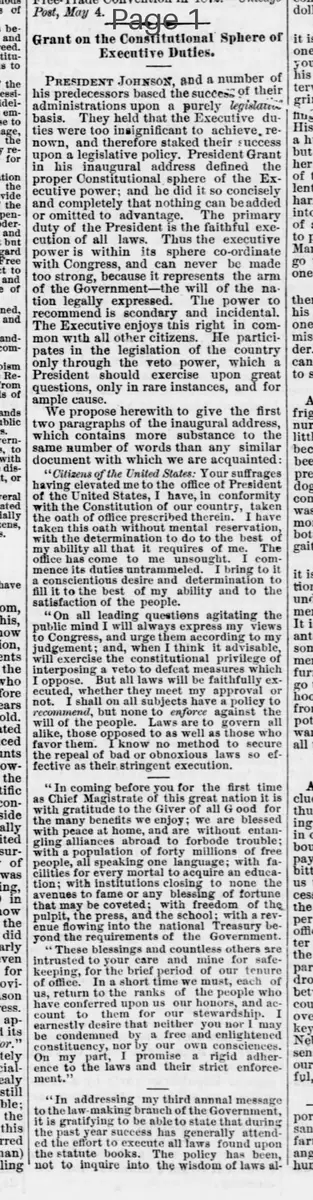
Grant on the Constitutional Sphere of Executive Duties.
President Johnson, and a number of his predecessors based the success of their administrations upon a purely legislative basis. They held that the Executive duties were too insignificant to achieve renown, and therefore staked their success upon a legislative policy. President Grant in his inaugural address defined the proper Constitutional sphere of the Executive power; and he did it so concisely and completely that nothing can be added or omitted to advantage. The primary duty of the President is the faithful execution of all laws. Thus the executive power is within its sphere co-ordinate with Congress, and can never be made too strong, because it represents the arm of the Government—the will of the nation legally expressed.
The power to recommend is secondary and incidental. The Executive enjoys this right in common with all other citizens. He participates in the legislation of the country only through the veto power, which a President should exercise upon great questions, only in rare instances, and for ample cause.
We propose herewith to give the first two paragraphs of the inaugural address, which contains more substance to the same number of words than any similar document with which we are acquainted:
"Citizens of the United States: Your suffrages having elevated me to the office of President of the United States, I have, in conformity with the Constitution of our country, taken the oath of office prescribed therein. I have taken this oath without mental reservation, with the determination to do to the best of my ability all that it requires of me. The office has come to me unsought. I commence its duties untrammeled. I bring to it a conscientious desire and determination to fill it to the best of my ability and to the satisfaction of the people.
"On all leading questions agitating the public mind I will always express my views to Congress, and urge them according to my judgment; and, when I think it advisable, will exercise the constitutional privilege of interposing a veto to defeat measures which I oppose. But all laws will be faithfully executed, whether they meet my approval or not. I shall on all subjects have a policy to recommend, but none to enforce against the will of the people. Laws are to govern all alike, those opposed to as well as those who favor them. I know no method to secure the repeal of bad or obnoxious laws so effective as their stringent execution.
"In coming before you for the first time as Chief Magistrate of this great nation it is with gratitude to the Giver of all Good for the many benefits we enjoy; we are blessed with peace at home, and are without entangling alliances abroad to forebode trouble: with a population of forty millions of free people, all speaking one language; with facilities for every mortal to acquire an education; with institutions closing to none the avenues to fame or any blessing of fortune that may be coveted; with freedom of the pulpit, the press, and the school; with a revenue flowing into the national Treasury beyond the requirements of the Government.
"These blessings and countless others are intrusted to your care and mine for safe-keeping, for the brief period of our tenure of office. In a short time we must, each of us, return to the ranks of the people who have conferred upon us our honors, and account to them for our stewardship. I earnestly desire that neither you nor I may be condemned by a free and enlightened constituency, nor by our own consciences.
On my part, I promise a rigid adherence to the laws and their strict enforcement."
"In addressing my third annual message to the law-making branch of the Government, it is gratifying to be able to state that during the past year success has generally attended the effort to execute all laws found upon the statute books. The policy has been, not to inquire into the wisdom of laws already enacted, but to learn their spirit and intent, and to enforce them accordingly. I submit these suggestions with a confidence that your combined action will be wise, statesmanlike, and in the best interests of the whole country."
President Johnson, and a number of his predecessors based the success of their administrations upon a purely legislative basis. They held that the Executive duties were too insignificant to achieve renown, and therefore staked their success upon a legislative policy. President Grant in his inaugural address defined the proper Constitutional sphere of the Executive power; and he did it so concisely and completely that nothing can be added or omitted to advantage. The primary duty of the President is the faithful execution of all laws. Thus the executive power is within its sphere co-ordinate with Congress, and can never be made too strong, because it represents the arm of the Government—the will of the nation legally expressed.
The power to recommend is secondary and incidental. The Executive enjoys this right in common with all other citizens. He participates in the legislation of the country only through the veto power, which a President should exercise upon great questions, only in rare instances, and for ample cause.
We propose herewith to give the first two paragraphs of the inaugural address, which contains more substance to the same number of words than any similar document with which we are acquainted:
"Citizens of the United States: Your suffrages having elevated me to the office of President of the United States, I have, in conformity with the Constitution of our country, taken the oath of office prescribed therein. I have taken this oath without mental reservation, with the determination to do to the best of my ability all that it requires of me. The office has come to me unsought. I commence its duties untrammeled. I bring to it a conscientious desire and determination to fill it to the best of my ability and to the satisfaction of the people.
"On all leading questions agitating the public mind I will always express my views to Congress, and urge them according to my judgment; and, when I think it advisable, will exercise the constitutional privilege of interposing a veto to defeat measures which I oppose. But all laws will be faithfully executed, whether they meet my approval or not. I shall on all subjects have a policy to recommend, but none to enforce against the will of the people. Laws are to govern all alike, those opposed to as well as those who favor them. I know no method to secure the repeal of bad or obnoxious laws so effective as their stringent execution.
"In coming before you for the first time as Chief Magistrate of this great nation it is with gratitude to the Giver of all Good for the many benefits we enjoy; we are blessed with peace at home, and are without entangling alliances abroad to forebode trouble: with a population of forty millions of free people, all speaking one language; with facilities for every mortal to acquire an education; with institutions closing to none the avenues to fame or any blessing of fortune that may be coveted; with freedom of the pulpit, the press, and the school; with a revenue flowing into the national Treasury beyond the requirements of the Government.
"These blessings and countless others are intrusted to your care and mine for safe-keeping, for the brief period of our tenure of office. In a short time we must, each of us, return to the ranks of the people who have conferred upon us our honors, and account to them for our stewardship. I earnestly desire that neither you nor I may be condemned by a free and enlightened constituency, nor by our own consciences.
On my part, I promise a rigid adherence to the laws and their strict enforcement."
"In addressing my third annual message to the law-making branch of the Government, it is gratifying to be able to state that during the past year success has generally attended the effort to execute all laws found upon the statute books. The policy has been, not to inquire into the wisdom of laws already enacted, but to learn their spirit and intent, and to enforce them accordingly. I submit these suggestions with a confidence that your combined action will be wise, statesmanlike, and in the best interests of the whole country."
What sub-type of article is it?
Constitutional
What keywords are associated?
Executive Power
Inaugural Address
Faithful Execution
Veto Power
Constitutional Duties
Law Enforcement
What entities or persons were involved?
President Grant
President Johnson
Congress
Editorial Details
Primary Topic
Constitutional Sphere Of Executive Duties
Stance / Tone
Supportive Of Grant's Emphasis On Faithful Execution Of Laws
Key Figures
President Grant
President Johnson
Congress
Key Arguments
Executive Duties Are Primary In Faithful Execution Of Laws
Executive Power Is Co Ordinate With Congress
Power To Recommend Is Secondary And Shared With Citizens
Veto Should Be Used Rarely And For Ample Cause
All Laws Must Be Faithfully Executed Regardless Of Approval
Stringent Execution Is Best Way To Repeal Bad Laws
President Promises Rigid Adherence To Laws