Thank you for visiting SNEWPapers!
Sign up free
The Patowmac Guardian, And Berkeley Advertiser
Martinsburg, Shepherdstown, Berkeley County, Jefferson County, West Virginia
What is this article about?
Philadelphia report details US government's humane policies toward Indian tribes, highlighting 1790 Creek treaty, assurances to Choctaws/Chickasaws, planned Cherokee treaty, and failed peace efforts with hostile Wabash Indians amid past hostilities and a 1790 campaign.
Clipping
OCR Quality
Full Text
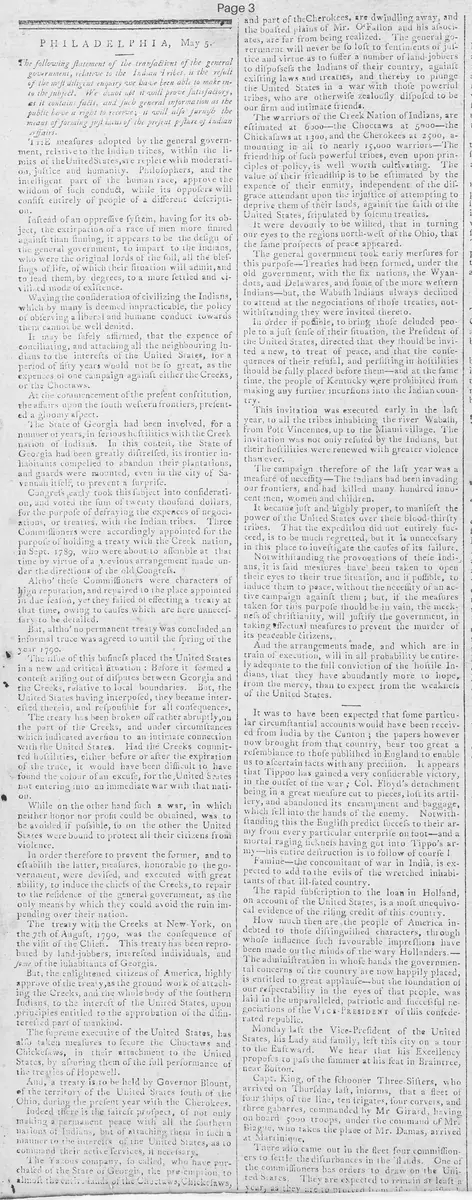
The following statement of the transactions of the general government, relative to the Indian Tribes, is the result of the most diligent enquiry we have been able to make into the subject. We doubt not it will prove satisfactory, as it contains facts, and such general information as the public have a right to receive; it will also furnish the means of forming just ideas of the present posture of Indian affairs.
The measures adopted by the general government, relative to the Indian tribes, within the limits of the United States, are replete with moderation, justice and humanity. Philosophers, and the intelligent part of the human race, approve the wisdom of such conduct, while its opposers will consist entirely of people of a different description.
Instead of an oppressive system, having for its object, the extirpation of a race of men more sinned against than sinning, it appears to be the design of the general government, to impart to the Indians, who were the original lords of the soil, all the blessings of life, of which their situation will admit, and to lead them, by degrees, to a more settled and civilized mode of existence.
Waving the consideration of civilizing the Indians, which by many is deemed impracticable, the policy of observing a liberal and humane conduct towards them cannot be well denied.
It may be safely affirmed, that the expense of conciliating, and attaching all the neighbouring Indians to the interests of the United States, for a period of fifty years would not be so great, as the expenses of one campaign against either the Creeks, or the Choctaws.
At the commencement of the present constitution, the affairs upon the south western frontiers, presented a gloomy aspect.
The State of Georgia had been involved, for a number of years, in serious hostilities with the Creek nation of Indians. In this contest, the State of Georgia had been greatly distressed, its frontier inhabitants compelled to abandon their plantations, and guards were mounted, even in the city of Savannah itself, to prevent a surprise.
Congress early took this subject into consideration, and voted the sum of twenty thousand dollars, for the purpose of defraying the expenses of negotiations, or treaties, with the Indian tribes. Three Commissioners were accordingly appointed for the purpose of holding a treaty with the Creek nation, in Sept. 1789, who were about to assemble at that time by virtue of a previous arrangement made under the directions of the old Congress.
Altho' these Commissioners were characters of high reputation, and repaired to the place appointed in due season, yet they failed of effecting a treaty at that time, owing to causes which are here unnecessary to be detailed.
But, altho' no permanent treaty was concluded an informal truce was agreed to until the spring of the year 1790.
The issue of this business placed the United States in a new and critical situation: Before it seemed a contest arising out of disputes between Georgia and the Creeks, relative to local boundaries. But, the United States having interposed, they became interested therein, and responsible for all consequences.
The treaty has been broken off rather abruptly, on the part of the Creeks, and under circumstances which indicated aversion to an intimate connection with the United States. Had the Creeks committed hostilities, either before or after the expiration of the truce, it would have been difficult to have found the colour of an excuse, for the United States not entering into an immediate war with that nation.
While on the other hand such a war, in which neither honor nor profit could be obtained, was to be avoided if possible, so on the other the United States were bound to protect all their citizens from violence.
In order therefore to prevent the former, and to establish the latter, measures, honorable to the government, were devised, and executed with great ability, to induce the chiefs of the Creeks, to repair to the residence of the general government, as the only means by which they could avoid the ruin impending over their nation.
The treaty with the Creeks at New-York, on the 7th of August, 1790, was the consequence of the visit of the Chiefs. This treaty has been reprobated by land-jobbers, interested individuals, and some of the inhabitants of Georgia.
But, the enlightened citizens of America, highly approve of the treaty, as the ground work of attaching the Creeks, and the whole body of the southern Indians, to the interest of the United States, upon principles entitled to the approbation of the disinterested part of mankind.
The supreme executive of the United States, has also taken measures to secure the Choctaws and Chickasaws, in their attachment to the United States, by assuring them of the full performance of the treaties of Hopewell.
And, a treaty is to be held by Governor Blount, of the territory of the United States south of the Ohio, during the present year with the Cherokees.
Indeed there is the fairest prospect, of not only making a permanent peace with all the southern nations of Indians, but of attaching them in such a manner to the interests of the United States, as to command their active services, if necessary.
The Yazoo company, so called, who have purchased of the State of Georgia, the pre-emption, to almost the entire lands of the Choctaws, Chickasaws, and part of the Cherokees, are dwindling away, and the boasted plans of Mr. O'Fallon and his associates, are far from being realized. The general government will never be so lost to sentiments of justice and virtue as to suffer a number of land-jobbers to dispossess the Indians of their country, against existing laws and treaties, and thereby to plunge the United States in a war with those powerful tribes, who are otherwise zealously disposed to be our firm and intimate friends.
The warriors of the Creek Nation of Indians, are estimated at 6000—the Choctaws at 5000—the Chickasaws at 1300, and the Cherokees at 2500, amounting in all to nearly 15,000 warriors—The friendship of such powerful tribes, even upon principles of policy, is well worth cultivating. The value of their friendship is to be estimated by the expense of their enmity, independent of the disgrace attendant upon the injustice of attempting to deprive them of their lands, against the faith of the United States, stipulated by solemn treaties.
It were devoutly to be wished, that in turning our eyes to the regions north-west of the Ohio, that the same prospects of peace appeared.
The general government took early measures for this purpose -Treaties had been formed, under the old government, with the Six Nations, the Wyandots, and Delawares, and some of the more western Indians—but, the Wabash Indians always declined to attend at the negotiations of those treaties, notwithstanding they were invited thereto.
In order if possible, to bring those deluded people to a just sense of their situation, the President of the United States, directed that they should be invited a new, to treat of peace, and that the consequences of their refusal, and persisting in hostilities should be fully placed before them—and at the same time, the people of Kentucky were prohibited from making any further incursions into the Indian country.
This invitation was executed early in the last year, to all the tribes inhabiting the river Wabash, from Post Vincennes, up to the Miami village. The invitation was not only refused by the Indians, but their hostilities were renewed with greater violence than ever.
The campaign therefore of the last year was a measure of necessity—The Indians had been invading our frontiers, and had killed many hundred innocent men, women and children.
It became just and highly proper, to manifest the power of the United States over these blood-thirsty tribes. That the expedition did not entirely succeed, is to be much regretted, but it is unnecessary in this place to investigate the causes of its failure.
Notwithstanding the provocations of these Indians, it is said measures have been taken to open their eyes to their true situation, and if possible, to induce them to peace, without the necessity of an active campaign against them; but, if the measures taken for this purpose should be in vain, the meekness of christianity, will justify the government, in taking effectual measures to prevent the murder of its peaceable citizens.
And the arrangements made, and which are in train of execution, will in all probability be entirely adequate to the full conviction of the hostile Indians, that they have abundantly more to hope, from the mercy, than to expect from the weakness of the United States.
What sub-type of article is it?
What keywords are associated?
What entities or persons were involved?
Where did it happen?
Domestic News Details
Primary Location
United States
Event Date
May 5
Key Persons
Outcome
past hostilities with creeks distressed georgia; wabash indians killed many hundred innocent men, women and children; failed expedition against northern indians; treaties aimed at peace and attachment to us interests
Event Details
Overview of US government's moderate, just, and humane policies towards Indian tribes, including failed 1789 treaty with Creeks leading to 1790 New York treaty; assurances to Choctaws and Chickasaws; planned treaty with Cherokees; opposition to Yazoo company land schemes; northern efforts with Wabash Indians including invitation to peace talks refused, leading to 1790 campaign; estimates of warriors in southern tribes totaling nearly 15,000