Thank you for visiting SNEWPapers!
Sign up free
Lynchburg Virginian
Lynchburg, Virginia
What is this article about?
On September 13 in Richmond, Virginia, a grand procession involving military units, a boys' company, and the public celebrated the restoration of French liberty with an oration at the Capitol, national salute, and evening illuminations, marked by widespread enthusiasm and no disorder.
Clipping
OCR Quality
Full Text
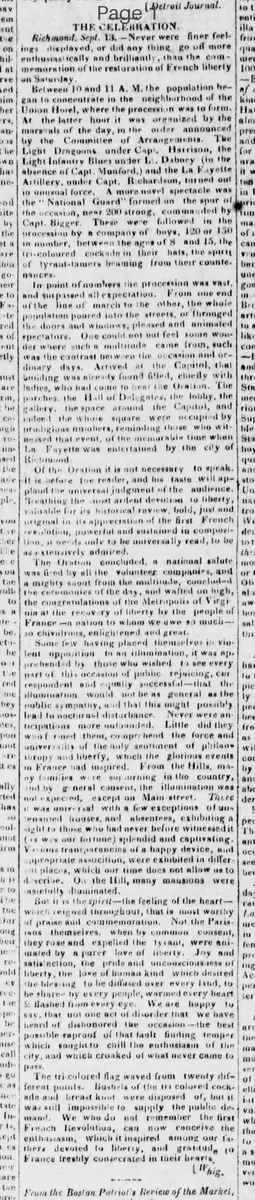
Richmond, Sept. 13.—Never were finer feelings displayed, or did any thing go off more enthusiastically and brilliantly, than the commemoration of the restoration of French liberty on Saturday.
Between 10 and 11 A. M. the population began to concentrate in the neighborhood of the Union Hotel, where the procession was to form.
At the latter hour it was organized by the marshals of the day, in the order announced by the Committee of Arrangements. The Light Dragoons under Capt. Harrison, the Light Infantry Blues under L. Dabney (in the absence of Capt. Munford.) and the La Fayette Artillery, under Capt. Richardson, turned out in unusual force. A more novel spectacle was the "National Guard" formed on the spur of the occasion, near 200 strong, commanded by Capt. Bigger. These were followed in the procession by a company of boys, 120 or 150 in number, between the ages of 8 and 15, the tri-coloured cockade in their hats, the spirit of tyrant-tamers beaming from their countenances.
In point of numbers the procession was vast. and surpassed all expectation. From one end of the line of march to the other, the whole population poured into the streets, or thronged the doors and windows, pleased and animated spectators. One could not but feel some wonder where such a multitude came from, such was the contrast between the occasion and ordinary days. Arrived at the Capitol, that building was already found filled, chiefly with ladies, who had come to hear the Oration. The porches, the Hall of Delegates, the lobby, the gallery, the space around the Capitol, and indeed the whole square were occupied by prodigious numbers, reminding those who witnessed that event, of the memorable time when La Fayette was entertained by the city of Richmond
Of the Oration it is not necessary to speak. it is before the reader, and his taste will applaud the universal judgment of the audience. Breathing the most ardent devotion to liberty, valuable for its historical review, bold, just and original in its appreciation of the first French revolution, powerful and sustained in composition, it needs only to be universally read, to be as extensively admired.
The Oration concluded, a national salute was fired by all the volunteer companies, and a mighty shout from the multitude, concluded the ceremonies of the day, and wafted on high, the congratulations of the Metropolis of Virginia at the recovery of liberty by the people of France—a nation to whom we owe so much— so chivalrous, enlightened and great.
Some few having placed themselves in violent opposition to an illumination, it was apprehended by those who wished to see every part of this occasion of public rejoicing, correspondent and equally successful—that the illumination would not be as general as the public sympathy, and that this might possibly lead to nocturnal disturbance. Never were anticipations more unfounded. Little did they who formed them, comprehend the force and universality of the holy sentiment of philanthropy and liberty, which the glorious events in France had inspired. From the Hills, many families were sojourning in the country. and by general consent, the illumination was not expected, except on Main street. There it was universal with a few exceptions of unoccupied houses, and absentees, exhibiting a sight to those who had never before witnessed it (as was our fortune) splendid and captivating Vistas transparencies of a happy device, and appropriate association, were exhibited in different places, which our time does not allow us to describe. On the Hill, many mansions were beautifully illuminated,
But it is the spirit—the feeling of the heart— which reigned throughout, that is most worthy of praise and commemoration. Not the Parisians themselves, when by common consent. they rose and expelled the tyrant, were animated by a purer love of liberty. Joy and satisfaction, the pride and unconsciousness of liberty, the love of human kind which desired the blessing to be diffused over every land, to be shared by every people, warmed every heart & flashed from every eye. We are happy to say, that not one act of disorder that we have heard of dishonored the occasion—the best possible reproof of that fault finding. temper which sought to chill the enthusiasm of the city, and which croaked of what never came to pass.
The tri-colored flag waved from twenty different points. Bushels of the tri colored cockade and breast knot were disposed of, but it was still impossible to supply the public demand. We who do not remember the first French Revolution, can now conceive the enthusiasm which it inspired among our fathers devoted to liberty, and gratitude to France freshly consecrated in their hearts (Whig.
What sub-type of article is it?
What keywords are associated?
What entities or persons were involved?
Where did it happen?
Domestic News Details
Primary Location
Richmond
Event Date
Sept. 13
Key Persons
Outcome
the event concluded successfully with no acts of disorder, widespread illumination, and enthusiastic public participation.
Event Details
A large procession formed near the Union Hotel, including Light Dragoons, Light Infantry Blues, La Fayette Artillery, a newly formed National Guard of nearly 200, and a company of 120-150 boys aged 8-15 wearing tri-colored cockades. The procession marched to the Capitol for an oration praising French liberty and the first French Revolution, followed by a national salute and shouts of congratulations. Evening illuminations lit Main Street and some mansions on the Hill, with tri-colored flags and cockades in high demand.