Thank you for visiting SNEWPapers!
Sign up free
Literary
March 24, 1878
Daily Globe
Saint Paul, Ramsey County, Minnesota
What is this article about?
In London's Grosvenor Square, poor orphan Polly Marker and her brothers receive a sovereign by mistake from a lady rider, mistaking it for sixpence. They resist temptation, endure hardships and Polly's illness with neighbors' and a doctor's aid, and return the change nine months later, highlighting themes of honesty and compassion amid poverty.
Clipping
OCR Quality
98%
Excellent
Full Text
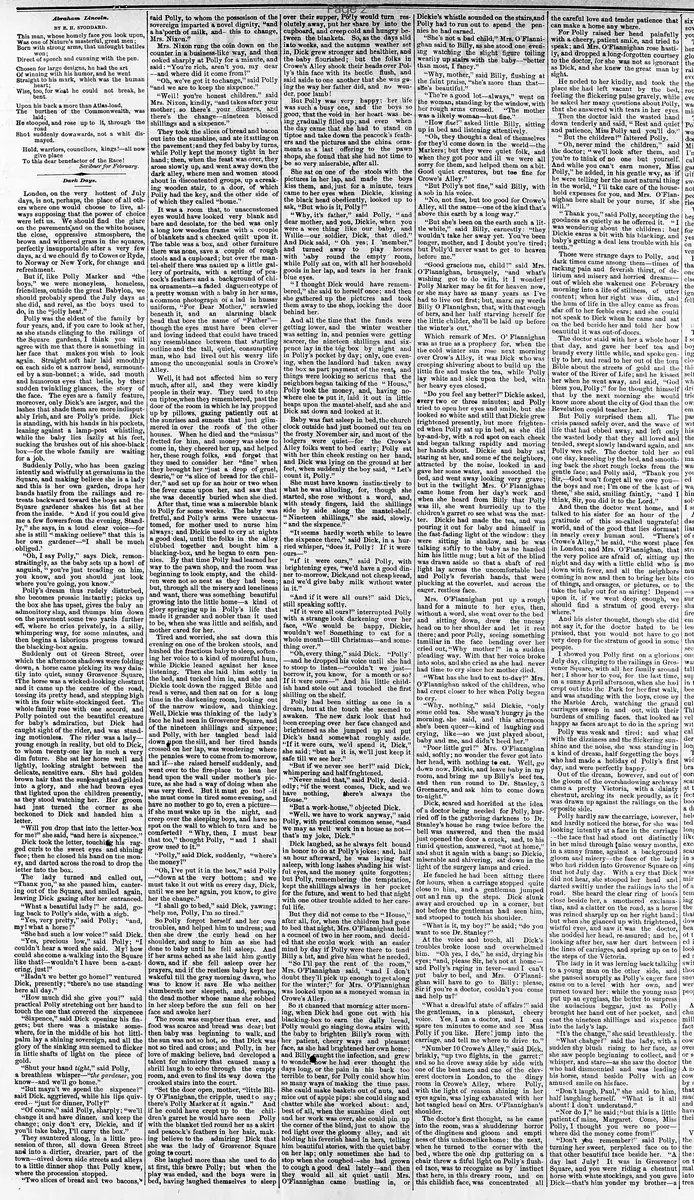
Dark Days.
London, on the very hottest of July days, is not, perhaps, the place of all others where one would choose to live, always supposing that the power of choice were left us. We should find the glare on the pavements and on the white houses, the close, oppressive atmosphere, the brown and withered grass in the squares, perfectly insupportable after a very few days, and we should fly to Cowes or Ryde, to Norway or New York, for change and refreshment.
But if, like Polly Marker and "the boys," we were moneyless, homeless, friendless, outside the great Babylon, we should probably spend the July days as she did, and revel, as the boys used to do, in the "jolly heat."
Polly was the eldest of the family by four years, and, if you care to look at her, as she stands clinging to the railings of the Square gardens, I think you will agree with me that there is something in her face that makes you wish to look again. Straight soft hair laid smoothly on each side of a narrow head, surmounted by a sun-bonnet; a wide, sad mouth and humorous eyes that belie, by their sudden twinkling glances, the story of the face. The eyes are a family feature, moreover, only Dick's are larger, and the lashes that shade them are more indisputably Irish, and are Polly's pride. Dick is standing, with his hands in his pockets, leaning against a lamp-post whistling, while the baby lies lazily at his feet, sucking the brushes out of his shoe-black box—for the whole family are waiting for a job.
Suddenly Polly, who has been gazing intently and wistfully at geraniums in the Square, and making believe she is a lady and this is her own garden, drops her hands hastily from the railings and retreats backward toward the boys and the Square gardener shakes his fist at her from the inside. And if you could give me a few flowers from the evening, Stand-ly," she says, in a loud clear voice—for she is still making believe that this is her own gardener—"I shall be much obliged."
"Oh, I say Polly," says Dick, remonstratingly, as the baby sets up a howl of anguish, "you're just treading on him, you know, and you should just look where you're going, you know."
Polly's dream thus rudely disturbed, she becomes prosaic instantly; picks up the box she has upset, gives the baby an admonitory slap, and thumps him down on the pavement some two yards further off, where he cries privately, in a silly, whimpering way, for some minutes, and then begins a laborious progress toward the blacking-box again.
Suddenly out of Green Street, over which the afternoon shadows were folding down, a horse came picking its way daintily into quiet, sunny Grosvenor Square. The horse was a wicked-looking chestnut and it came up the centre of the road, tossing its pretty head, and stepping high with its four white-stockinged feet. The whole family rose with one accord, and Polly pointed out the beautiful creature for baby's admiration, but Dick had caught sight of the rider, and was standing motionless. The rider was a lady—young enough in reality, but old to Dick, to whom twenty-one lay in such a very dim future. She sat her horse well and lightly, looking straight between the delicate, sensitive ears. She had golden brown hair that the sun caught and gilded into a glory, and she had brown eyes that lighted upon the children presently, as they stood watching her. Her groom had just turned the corner as she beckoned to Dick and handed him a letter.
"Will you drop that into the letter-box for me?" she said, "and here is sixpence."
Dick took the letter, touching his ragged curls to the sweet eyes and shining face; then he closed his hand on the money, and darted across the road to drop the letter into the box.
The lady turned and called out, "Thank you," as she passed him, cantering out of the Square, and smiled again, leaving Dick gazing after her entranced.
"What a beautiful lady!" he said, going back to Polly's side, with a sigh.
"Yes, very pretty," said Polly; "and my! what a horse!"
"She had such a low voice!" said Dick.
"Yes, precious low," said Polly; "I couldn't hear a word she said. My! how could she come a-walking into the Square like that?—wouldn't I have been a-cantering, just!"
"Hadn't we better go home?" ventured Dick, presently; "there's no use standing here all day."
"How much did she give you?" said practical Polly stretching out her hand to touch the one that covered the 'sixpence.'
"Sixpence," said Dick opening his fingers; but there was a mistake somewhere, for in the middle of his hot little palm lay a shining sovereign, and all the glory of the sinking sun seemed to flicker in little shafts of light on the piece of gold.
"Shut your hand tight," said Polly, in a breathless whisper—"the gardener, you know—and we'll go home."
But mayn't we spend the sixpence?" said Dick, aggrieved, while his lips quivered—"just for dinner, Polly?"
"Of course," said Polly, sharply; "we'll change it and have dinner, and keep the change; only don't cry, Dickie, and if you'll take baby, I'll carry the box."
They sauntered along, in a little procession of three, all down Green Street and into a dirtier, drearier, part of the town—dived down side streets and alleys to a little dinner shop that Polly knew, where the procession stopped.
"Two slices of bread and two bacons, said Polly, to whom the possession of the sovereign imparted a novel dignity, "and a ha'porth of milk, and—this to change, Mrs. Nixon."
Mrs. Nixon rung the coin down on the counter in a business-like way, and then looked sharply at Polly for a minute, and said: "You're rich, aren't you, my dear—and where did it come from?"
"Oh, we've got it to change," said Polly "and we are to keep the sixpence."
"Well! you're honest children," said Mrs. Nixon, kindly. "and takes after you mother; so there's your dinners, and there's the change—nineteen blessed shillings and a sixpence."
They took the slices of bread and bacon out into the sunshine, and ate it sitting on the pavement; and they fed baby by turns, while Polly kept the money tight in her hand; then, when the feast was over, they arose slowly up, and went away down the dark alley, where men and women stood about in discontented groups, up a creaking wooden stair, to a door, of which Polly had the key, and the other side of which they called "home."
It was a room that, to unaccustomed eyes would have looked very blank and bare and desolate, for the bed was only a long low wooden frame with a couple of blankets and a checked quilt upon it. The table was a box, and other furniture there was none, save a couple of rough stools and a cupboard; but over the mantel-shelf there was nailed up a little gallery of portraits, with a setting of peacock's feathers and a background of china ornaments—a faded daguerreotype of a pretty woman with a baby in her arms, a common photograph of a lad in hussar uniform, "For Dear Mother," scrawled beneath it, and an alarming black head that bore the name of "Father" though the eyes must have been clever and loving indeed that could have traced any resemblance between that startling outline and the tall, quiet, consumptive man, who had lived out his weary life among the uncongenial souls in Crowe's Alley.
Well, it had not affected him so very much, after all, and they were kindly people in their way. They used to step on tiptoe, when they remembered, past the door of the room in which he lay propped up by pillows, gazing patiently out at the sunrises and sunsets that just glimmered in over the roofs of the other houses. When he died and the "missus" fretted for him, and money was slow to come in, they cheered her up, and helped her, these rough folks, and forgot that they used to consider her "fine" when they brought her "just a drop of gruel, dearie," or "a slice of bread for the children," and set up for an hour or two when the fever came upon her, and saw that she was decently buried when she died.
After that, time was a miserable blank to Polly for some weeks. The baby was fretful, and Polly's arms were unaccustomed, for mother used to nurse him always; and Dickie used to cry at nights a good deal, until the folks in the alley clubbed together and bought him a blacking-box, and he began to earn pennies. By that time Polly had learned her way to the pawn shop, and the room was beginning to look empty, and the children were not so neat as they had been but, through all the misery and loneliness and want, there was something beautiful growing into the little home—a kind of glory springing up in Polly's life that made it grander and nobler than it used to be, when she was little and selfish, and mother cared for her.
Tired and worried, she sat down this evening on one of the broken stools, and hushed the fractious baby to sleep, softening her voice to a kind of mournful hum, while Dickie leaned against her knee listening. Then she laid him softly in the bed, and tucked him in, and she and Dickie took down the ragged Bible and read a verse, and then sat on for a long time in the darkening room, looking out of the narrow window, and thinking.
Well, Dickie was thinking of the lady's face he had seen in Grosvenor Square, and of the nineteen shillings and sixpence: and Polly, with her tangled head laid down upon the sill, and her tired hands crossed on her lap, was wondering where the pennies were to come from to-morrow, and if—she raised herself suddenly, and went over to the fire-place to lean her head upon the wall under mother's picture, as she had a way of doing when she was very tired. But it must go too?—if she must come in tired some evening, and have no mother to go to, even a picture—if she must wake up in the night, and creep over the sleeping boys, and have no spot on the wall to which to turn and be comforted? "Why, then, I must bear that too," thought Polly, "and I shall grow used to it."
"Polly," said Dick, suddenly, "where's the money?"
"Oh, I've put it in the box," said Polly "down at the very bottom; and we must take it out with us every day, Dick, until we see her again, you know, to give her the change."
"I shall go to bed," said Dick, yawning; "help me, Polly, I'm so tired."
So Polly forgot herself and her own troubles, and helped him to undress; and then she drew the curly head on her shoulder, and sang to him as she had done to baby until he fell asleep. And if her arms ached as she laid him gently down, and if she fell asleep over her prayers, and if the restless baby kept her wakeful till the gray morning dawn, who was to know it save He who neither slumbereth nor sleepeth, and, perhaps, the dead mother whose name she sobbed in her sleep before the sun fell on her face and awoke her?
The room was emptier than ever, and food was scarce and bread was dear; but then baby was beginning to walk, and the sun was not so hot, so that Dick was not so tired and cross; and Polly, in her love of making believe, had developed a talent for mimicry that caused many a shrill laugh to echo through the empty room, and even to find its way down the crooked stairs into the court.
"Set the door open, mother," little Billy O'Flanighan, the cripple, used to say; "there's Polly Marker at it again."
And if he could have crept up to the children's garret he would have seen Polly with the blanket tied round her as a skirt and peacock's feathers in her hair, making believe to the admiring Dick that she was the lady of Grosvenor Square going to court.
She laughed more than she used to do at first, this brave Polly; but when the play was ended, and the boys were in bed, having laughed themselves to sleep over their supper, Polly would turn resolutely away, put her share by into the cupboard, and creep cold and hungry between the blankets. So, as the days slid into weeks, and the autumn weather set in, Dick grew stronger and healthier, and the baby flourished; but the folks in Crowe's Alley shook their heads over Polly's thin face with its hectic flush, and said aside to one another that she was going the way her father did, and no wonder, poor lamb!
But Polly was very happy; her life was such a busy one, and the boys so good, that the void in her heart was being gradually filled up: and even when the day came that she had to stand on tiptoe and take down the peacock's feathers and the pictures and the china ornaments as a last offering to the pawn shops, she found that she had not time to be so very miserable, after all.
She sat on one of the stools with the pictures in her lap, and made the boys kiss them, and, just for a minute, tears came to her eyes when Dickie, kissing the black head obediently, looked up to ask, "But who is it, Polly?"
"Why, it's father," said Polly, "and dear mother, and you, Dickie, when you were a wee thing like our baby, and Willie our soldier, Dick, that died."
And Dick said, "Oh yes; I 'member," and turned away to play horses with baby round the empty room, while Polly sat on, with all her household goods in her lap, and tears in her frank blue eyes.
"I thought Dick would have remembered," she said to herself once; and then she gathered up the pictures and took them away to the shop, locking the door behind her.
And all the time that the funds were getting lower, and the winter weather was setting in, and pennies were getting scarcer, the nineteen shillings and sixpence lay in the big box by night and in Polly's pocket by day; only, one evening, when the landlord had taken away the box as part payment of the rent, and things were looking so serious that the neighbors began talking of the "House," Polly took the money, and, having nowhere else to put it, laid it out in little heaps upon the mantel-shelf, and she and Dick sat down and looked at it.
Baby was fast asleep in bed, the church clock outside had just boomed out ten on the frosty November air, and most of the lodgers were quiet—for the Crowe's Alley folks went to bed early; Polly sat with her thin cheek resting on her hand, and Dick was lying on the ground at her feet, when suddenly the boy said, "Let's count it, Polly."
She must have known instinctively to what he was alluding, for, though she started, she rose without a word, and, with steady fingers, laid the shillings side by side along the mantel-shelf.
"Nineteen shillings," she said, slowly, "and the sixpence."
"It seems hardly worth while to leave the sixpence there," said Dick, in a hurried whisper, "does it, Polly? If it were ours—"
"If it were ours," said Polly, with brightening eyes, "we'd have a good dinner to-morrow, Dick, and not cheap bread and we'd give baby milk without water in it."
"And if it were all ours?" said Dick, still speaking softly.
"If it were all ours?" interrupted Polly with a strange look darkening over her face, "We would be happy, Dickie, wouldn't we? Something to eat for a whole month—till Christmas—and something over."
"Oh, everything," said Dick. "Polly—and he dropped his voice until she had to stoop to listen—"couldn't we just—borrow it, you know, for a month or so? If it were ours—" And his little childish hand stole out and touched the first shilling on the shelf.
Polly had been sitting as one in a dream, but at the touch she seemed to awaken. The new dark look that had been creeping over her face changed and brightened as she jumped up and put Dick's hand somewhat roughly aside.
"If it were ours, we'd spend it, Dick," she said; "but as it is, we'll just keep it safe till we see her."
"But if we never see her?" said Dick, whimpering and half frightened.
"Never mind that," said Polly, decidedly; "if the worst comes, Dick, and we have nothing, there's always the House."
"But a work-house," objected Dick.
"Well, we have to work anyway," said Polly, with practical common sense, "and we may as well work in a house as not—that's my joke, Dick."
Dick laughed, as he always felt bound in honor to do at Polly's jokes; and, half an hour afterward, he was laying fast asleep, with long lashes shading his wistful eyes, and the money quite forgotten; but Polly, remembering the temptation, kept the shillings always in her pocket for the future, and went to bed that night with one other trouble added to her careful life.
But they did not come to the "House," after all, for, when the children had gone to bed that night, Mrs. O'Flannighan held a council of two in her room, and decided that she could work with an easier mind by day if Polly were there to tend Billy a bit, and give him what he needed.
"So I'll pay the rent of the room," Mrs. O'Flannighan said, "and I don't doubt they'll pick up enough to get along for the winter;" for Mrs. O'Flannighan was looked upon as a moneyed woman in Crowe's Alley
So it chanced that morning after morning, when Dick had gone out with his blacking-box to earn the daily bread, Polly would go singing down stairs with the baby to brighten Billy's room with her patient, cheery ways and pleasant face, as she had brightened her own home; and Billy caught the infection, and grew to wonder how he had ever thought the days long, or the pain in his back too terrible to bear, for Polly could show him so many ways of making the time pass.
She could make baskets out of nuts, and mice out of apple pips: she could sing and chatter while she worked about: and, best of all, when the sunshine died out and her work was over, she could pin up the corner of the blind, just to show the red light over the gloomy alley, and sit holding his feverish hand in hers, telling him beautiful stories, with the quiet baby on her lap; only sometimes she had to stop when she coughed—she had grown to cough a good deal lately—and then they would all sit quiet until Mrs. O'Flannighan came bustling in, or Dickie's whistle sounded on the stairs, and Polly had to run out to spend the pennies he had earned.
"She's not a bad child," Mrs. O'Flannighan said to Billy, as she stood one evening watching the slight figure toiling wearily up stairs with the baby—"better than most, I fancy."
"Why, mother," said Billy, flushing at the faint praise, "she's more than that—she's beautiful."
"They're a good lot—always," went on the woman, standing by the window, with her rough arms crossed. "The mother was a likely woman—but fine."
"How fine?" asked little Billy, sitting up in bed and listening attentively.
"Oh, they thought a deal of themselves for they'd come down in the world—the Markers; but they were quiet folk, and when they got poor and ill we were all sorry for them, and helped them on a bit. Good quiet creatures, but too fine for Crowe's Alley."
"But Polly's not fine," said Billy, with a sob in his voice.
"No, not fine, but too good for Crowe's Alley, all the same—one of the kind that's above this earth by a long way."
"But she's been on the earth such a little while," said Billy, earnestly: "they wouldn't take her away yet. You've been longer, mother, and I doubt you're tired: but Polly'd never want to get to heaven before me."
"Good gracious me, child!" said Mrs. O'Flannighan, brusquely, "and what's wishing got to do with it I wonder Polly Marker may be fit for heaven now, or she may have as many years as I've had to live out first; but, mark my words Billy O'Flannighan, that, with that cough of hers, and her half starving herself for the little childer, she'll be laid up before the winter's out."
Which remark of Mrs. O'Flannighan was as true as a prophecy for, when the cold winter sun rose next morning over Crowe's Alley, it was Dick who was creeping shivering about to build up the little fire and make the tea, while Polly lay white and sick upon the bed, with her heavy eyes closed.
"Do you feel any better?" Dickie asked, very two or three minutes; and Polly tried to open her eyes and smile, but she looked so white and still that Dickie grew frightened presently, but more frightened when Polly sat up in bed, as she did by-and-by, with a red spot on each cheek and began talking rapidly and moving her hands about. Dickie and baby sat staring at her, and some of the neighbors, attracted by the noise, looked in and gave her some water, and smoothed the bed, and went away looking very grave; but in the twilight Mrs. O'Flannighan came home from her day's work and when she heard from Billy that Polly was ill, she went hurriedly up to the children's garret to see what was the matter. Dickie had made the tea, and was pouring it out for baby and himself in the fast-fading light of the window: they were sitting in shadow, and he was talking softly to the baby as he handed him his little mug; but a bit of the blind was drawn aside so that a shaft of red light lay across the uncomfortable bed and Polly's feverish hands, that were plucking at the coverlet, and across the eager, restless face.
Mrs. O'Flannighan put up a rough hand for a minute to her eyes, then, without a word, she went over to the bed and sitting down, drew the uneasy head on to her shoulder and let it rest there; and poor Polly, seeing something familiar in the face bending over her cried out, "Why mother!" in a sudden pleading way. With that her voice broke into sobs, and she cried as she had never had time to cry since her mother died.
"What has she had to eat to-day?" Mrs. O'Flannighan asked of the children, who had crept closer to her when Polly began to cry.
"Why, nothing," said Dickie, "only some cold tea. She wasn't hungry in the morning, she said, and this afternoon she's been queer—kind of laughing and crying, like—so we just played about, baby and me, and didn't heed her."
"Poor little girl!" Mrs. O'Flannighan said, softly; no wonder the fever got into her head, with nothing to eat. Well, go down now, Dickie, and leave baby in my room, and bring me up Billy's beef tea, and then run round to Dr. Stanley, 5 Greenacre, and ask him to come down to-night."
Dick, scared and horrified at the idea of a doctor being needed for Polly, hurried off in the gathering darkness to Dr. Stanley's house he rang twice before the bell was answered, and then the maid just opened the door a crack, and, to his timid question, answered, "not at home," and shut it again with a bang; so Dickie, miserable and shivering, sat down in the light of the surgery lamps and cried.
He fancied he had been sitting there for hours, when a carriage stopped quite close to him, and a gentleman jumped out and ran up the steps. Dick slunk away and crouched up in a corner, but not before the gentleman had seen him, and stooped to touch his shoulder.
"What is it, my boy?" he said; "do you want to see Dr. Stanley?"
At the voice and touch, all Dick's troubles broke loose and overwhelmed him. "Oh yes, I do," he said, drying his eyes; "and, please Sir, he's not at home—and Polly's raging in fever—and I can't put baby to bed, and Mrs. O'Flannighan will have to go to Billy: please, Sir if you're a doctor, couldn't you come and help us?"
"What a dreadful state of affairs!" said the gentleman, in a pleasant, cheery voice. Yes, I am a doctor, and I can spare ten minutes to come and see Miss Polly if you like. Here! jump into the carriage, and tell me where to drive to."
"Number 10 Crowe's Alley," said Dick, briskly, "up two flights, in the garret;" and so he drove away side by side with one of the best men and one of the cleverest doctors in London, to the dingy room in Crowe's Alley, where Polly, with the light of reason shining in her eyes again, was lying exhausted with her hot tangled head on Mrs. O'Flannighan's shoulder.
The doctor's first thought, as he came into the room, was a shuddering horror of the dinginess and gloom and emptiness of this unhomelike home; the next, when he turned to the corner with the bed, where the one dip guttering on a chair threw a fitful light on Polly's flushed face, was to recognize as by instinct that here, in this dreary room, and on this childish face, was concentrated all the careful love and tender patience that can make a home anywhere.
For Polly raised her head painfully with a cheery, patient smile, and tried to speak; and Mrs. O'Flannighan rose hastily, and dropped a long-forgotten courtesy to the doctor, for she was not as ignorant as Dick, and she knew the great man by sight.
He nodded to her kindly, and took the place she had left vacant by the bed, feeling the flickering pulse gravely, while he asked her many questions about Polly, that she answered with tears in her eyes.
Then the doctor laid the wasted hand down tenderly and said, "Rest and quiet and patience, Miss Polly and you'll do."
"But the children?" faltered Polly.
"Oh, never mind the children," said the doctor; "we'll look after them, and you're to think of no one but yourself. And while you can't earn money, Miss Polly," he added, in his gentle way, as if he were telling her the most natural thing in the world, "I'll take care of the household expenses for you, and Mrs. O'Flannighan here shall be your nurse, if she will."
"Thank you," said Polly, accepting the goodness as quietly as he offered it. "I was wondering about the children; but Dickie earns a bit with his blacking, and baby's getting a deal less trouble with his teeth."
Those were strange days to Polly, and dark times came among them—times of racking pain and feverish thirst, of delirium and misery and horrid dreams—out of which she wakened one February morning into a life of stillness, of utter content; when her sight was dim, and the hum of life in the alley came as from afar off to her feeble ears; and she could not speak to Dick when he came and sat on the bed beside her and told her how beautiful it was out-of-doors.
The doctor stayed with her a whole hour that day, and gave her beef tea and brandy every little while, and spoke gently to her, and read to her out of the old Bible about the streets of gold and the water of the River of Life; and he kissed her when he went away, and said, "God bless you, Polly;" for he thought himself that by the next morning she would know more about the city of God than the Revelation could teach her.
But Polly surprised them all. The crisis passed safely over, and the wave of life that had ebbed away, and left only the wasted body that they all loved and tended, swept slowly landward again, and Polly was safe. The doctor told her so one day, kneeling by the bed, and smoothing back the short rough locks from the gentle face; and Polly said, "Thank you Sir,—God won't forget all we owe you the boys and me; I'm one of the least of these," she said, smiling faintly, "and I think, Sir, you did it to the Lord."
And then the doctor went home, and talked to his sister for an hour of the gratitude of this so-called ungrateful! world, and of the good that lies dormant in nearly every human soul. "There's Crowe's Alley," he said, "the worst place in London; and Mrs. O'Flannighan, that the very police are afraid of, sitting up night and day with a little child who is down with fever, and all the neighbors coming in now and then to bring her bits of things, and oranges, or pictures, or to take the baby out for an airing! Depend upon it, if we went deep enough, we should find a stratum of good everywhere."
And his sister thought, though she did not say it, for the doctor hated to be praised, that you would not have to go very deep for the stratum of good in some people.
I showed you Polly first on a glorious July day, clinging to the railings in Grosvenor Square, with all her family around her; I show her to you, for the last time, on a sunny April afternoon, when she had crept out into the Park for her first walk, and was standing with the boys, closely by the Marble Arch, watching the grand carriages sweep in and out, with their burdens of smiling faces, that looked as happy as faces are apt to do in the spring
Polly was weak and tired; and what with the dizziness and the flickering sunshine and the noise, she was standing in a kind of dream, half forgetting the boys who had made a holiday of Polly's first day, and were perfectly happy.
Out of the dream, however, and out of the gloom of the overshadowing archway came a pretty Victoria, with a dainty chestnut, arching its neck proudly, as it was drawn up against the railings on the opposite side.
Polly hardly saw the carriage, however, and hardly noticed the horse, for she was looking intently at a face in the carriage—the face that had stood out distinctly in her mind through nine weary months, in a sunny frame, against a background gloom and misery—the face of the lady who had ridden into Grosvenor Square on that hot July day. With a cry that Dick did not hear, she stooped her head and darted swiftly under the railings into the road. She heard the clear ring of hoofs close beside her, a smothered exclamation, and a clatter on the road, as a horse was reined sharply up on her right hand: but when she glanced up with frightened, wistful eyes, and saw it was the doctor, she nodded her head, re-assured; and he looking after her, saw her dart between the lines of carriages, and spring up on to the steps of the Victoria.
The lady in it was leaning back talking to a young man on the other side, and she paused abruptly as Polly's eager face came on to a level with her own, and turned toward her: while the young man put up an eyeglass, the better to suppress the audacious beggar, just as Polly brought her hand out of her pocket, and cast the nineteen shillings and sixpence into the lady's lap.
"It's the change," she said breathlessly.
"What change?" said the lady, with a sudden shy blush rising to her face, as she saw people beginning to collect, and whisper, and stare—as she saw the doctor who had dismounted and was leading his horse, stand beside Polly with an amused smile on his face.
"Don't laugh, Paul," she said to him, half laughing herself. "What is it all about? I don't understand."
"Nor do I," he said; "but this is a little patient of mine, Margaret. Come, Miss Polly, I thought you were so poor where did the money come from?"
"Don't you remember?" said Polly, turning her sweet, perplexed face on to that other beautiful face beside her. "A day last July? It was in Grosvenor Square, and you were riding a chestnut horse with white stockings, and you gave Dick—that's him yonder my brother—a sixpence to post a letter: but it was a sovereign, and we kept the change to give you."
London, on the very hottest of July days, is not, perhaps, the place of all others where one would choose to live, always supposing that the power of choice were left us. We should find the glare on the pavements and on the white houses, the close, oppressive atmosphere, the brown and withered grass in the squares, perfectly insupportable after a very few days, and we should fly to Cowes or Ryde, to Norway or New York, for change and refreshment.
But if, like Polly Marker and "the boys," we were moneyless, homeless, friendless, outside the great Babylon, we should probably spend the July days as she did, and revel, as the boys used to do, in the "jolly heat."
Polly was the eldest of the family by four years, and, if you care to look at her, as she stands clinging to the railings of the Square gardens, I think you will agree with me that there is something in her face that makes you wish to look again. Straight soft hair laid smoothly on each side of a narrow head, surmounted by a sun-bonnet; a wide, sad mouth and humorous eyes that belie, by their sudden twinkling glances, the story of the face. The eyes are a family feature, moreover, only Dick's are larger, and the lashes that shade them are more indisputably Irish, and are Polly's pride. Dick is standing, with his hands in his pockets, leaning against a lamp-post whistling, while the baby lies lazily at his feet, sucking the brushes out of his shoe-black box—for the whole family are waiting for a job.
Suddenly Polly, who has been gazing intently and wistfully at geraniums in the Square, and making believe she is a lady and this is her own garden, drops her hands hastily from the railings and retreats backward toward the boys and the Square gardener shakes his fist at her from the inside. And if you could give me a few flowers from the evening, Stand-ly," she says, in a loud clear voice—for she is still making believe that this is her own gardener—"I shall be much obliged."
"Oh, I say Polly," says Dick, remonstratingly, as the baby sets up a howl of anguish, "you're just treading on him, you know, and you should just look where you're going, you know."
Polly's dream thus rudely disturbed, she becomes prosaic instantly; picks up the box she has upset, gives the baby an admonitory slap, and thumps him down on the pavement some two yards further off, where he cries privately, in a silly, whimpering way, for some minutes, and then begins a laborious progress toward the blacking-box again.
Suddenly out of Green Street, over which the afternoon shadows were folding down, a horse came picking its way daintily into quiet, sunny Grosvenor Square. The horse was a wicked-looking chestnut and it came up the centre of the road, tossing its pretty head, and stepping high with its four white-stockinged feet. The whole family rose with one accord, and Polly pointed out the beautiful creature for baby's admiration, but Dick had caught sight of the rider, and was standing motionless. The rider was a lady—young enough in reality, but old to Dick, to whom twenty-one lay in such a very dim future. She sat her horse well and lightly, looking straight between the delicate, sensitive ears. She had golden brown hair that the sun caught and gilded into a glory, and she had brown eyes that lighted upon the children presently, as they stood watching her. Her groom had just turned the corner as she beckoned to Dick and handed him a letter.
"Will you drop that into the letter-box for me?" she said, "and here is sixpence."
Dick took the letter, touching his ragged curls to the sweet eyes and shining face; then he closed his hand on the money, and darted across the road to drop the letter into the box.
The lady turned and called out, "Thank you," as she passed him, cantering out of the Square, and smiled again, leaving Dick gazing after her entranced.
"What a beautiful lady!" he said, going back to Polly's side, with a sigh.
"Yes, very pretty," said Polly; "and my! what a horse!"
"She had such a low voice!" said Dick.
"Yes, precious low," said Polly; "I couldn't hear a word she said. My! how could she come a-walking into the Square like that?—wouldn't I have been a-cantering, just!"
"Hadn't we better go home?" ventured Dick, presently; "there's no use standing here all day."
"How much did she give you?" said practical Polly stretching out her hand to touch the one that covered the 'sixpence.'
"Sixpence," said Dick opening his fingers; but there was a mistake somewhere, for in the middle of his hot little palm lay a shining sovereign, and all the glory of the sinking sun seemed to flicker in little shafts of light on the piece of gold.
"Shut your hand tight," said Polly, in a breathless whisper—"the gardener, you know—and we'll go home."
But mayn't we spend the sixpence?" said Dick, aggrieved, while his lips quivered—"just for dinner, Polly?"
"Of course," said Polly, sharply; "we'll change it and have dinner, and keep the change; only don't cry, Dickie, and if you'll take baby, I'll carry the box."
They sauntered along, in a little procession of three, all down Green Street and into a dirtier, drearier, part of the town—dived down side streets and alleys to a little dinner shop that Polly knew, where the procession stopped.
"Two slices of bread and two bacons, said Polly, to whom the possession of the sovereign imparted a novel dignity, "and a ha'porth of milk, and—this to change, Mrs. Nixon."
Mrs. Nixon rung the coin down on the counter in a business-like way, and then looked sharply at Polly for a minute, and said: "You're rich, aren't you, my dear—and where did it come from?"
"Oh, we've got it to change," said Polly "and we are to keep the sixpence."
"Well! you're honest children," said Mrs. Nixon, kindly. "and takes after you mother; so there's your dinners, and there's the change—nineteen blessed shillings and a sixpence."
They took the slices of bread and bacon out into the sunshine, and ate it sitting on the pavement; and they fed baby by turns, while Polly kept the money tight in her hand; then, when the feast was over, they arose slowly up, and went away down the dark alley, where men and women stood about in discontented groups, up a creaking wooden stair, to a door, of which Polly had the key, and the other side of which they called "home."
It was a room that, to unaccustomed eyes would have looked very blank and bare and desolate, for the bed was only a long low wooden frame with a couple of blankets and a checked quilt upon it. The table was a box, and other furniture there was none, save a couple of rough stools and a cupboard; but over the mantel-shelf there was nailed up a little gallery of portraits, with a setting of peacock's feathers and a background of china ornaments—a faded daguerreotype of a pretty woman with a baby in her arms, a common photograph of a lad in hussar uniform, "For Dear Mother," scrawled beneath it, and an alarming black head that bore the name of "Father" though the eyes must have been clever and loving indeed that could have traced any resemblance between that startling outline and the tall, quiet, consumptive man, who had lived out his weary life among the uncongenial souls in Crowe's Alley.
Well, it had not affected him so very much, after all, and they were kindly people in their way. They used to step on tiptoe, when they remembered, past the door of the room in which he lay propped up by pillows, gazing patiently out at the sunrises and sunsets that just glimmered in over the roofs of the other houses. When he died and the "missus" fretted for him, and money was slow to come in, they cheered her up, and helped her, these rough folks, and forgot that they used to consider her "fine" when they brought her "just a drop of gruel, dearie," or "a slice of bread for the children," and set up for an hour or two when the fever came upon her, and saw that she was decently buried when she died.
After that, time was a miserable blank to Polly for some weeks. The baby was fretful, and Polly's arms were unaccustomed, for mother used to nurse him always; and Dickie used to cry at nights a good deal, until the folks in the alley clubbed together and bought him a blacking-box, and he began to earn pennies. By that time Polly had learned her way to the pawn shop, and the room was beginning to look empty, and the children were not so neat as they had been but, through all the misery and loneliness and want, there was something beautiful growing into the little home—a kind of glory springing up in Polly's life that made it grander and nobler than it used to be, when she was little and selfish, and mother cared for her.
Tired and worried, she sat down this evening on one of the broken stools, and hushed the fractious baby to sleep, softening her voice to a kind of mournful hum, while Dickie leaned against her knee listening. Then she laid him softly in the bed, and tucked him in, and she and Dickie took down the ragged Bible and read a verse, and then sat on for a long time in the darkening room, looking out of the narrow window, and thinking.
Well, Dickie was thinking of the lady's face he had seen in Grosvenor Square, and of the nineteen shillings and sixpence: and Polly, with her tangled head laid down upon the sill, and her tired hands crossed on her lap, was wondering where the pennies were to come from to-morrow, and if—she raised herself suddenly, and went over to the fire-place to lean her head upon the wall under mother's picture, as she had a way of doing when she was very tired. But it must go too?—if she must come in tired some evening, and have no mother to go to, even a picture—if she must wake up in the night, and creep over the sleeping boys, and have no spot on the wall to which to turn and be comforted? "Why, then, I must bear that too," thought Polly, "and I shall grow used to it."
"Polly," said Dick, suddenly, "where's the money?"
"Oh, I've put it in the box," said Polly "down at the very bottom; and we must take it out with us every day, Dick, until we see her again, you know, to give her the change."
"I shall go to bed," said Dick, yawning; "help me, Polly, I'm so tired."
So Polly forgot herself and her own troubles, and helped him to undress; and then she drew the curly head on her shoulder, and sang to him as she had done to baby until he fell asleep. And if her arms ached as she laid him gently down, and if she fell asleep over her prayers, and if the restless baby kept her wakeful till the gray morning dawn, who was to know it save He who neither slumbereth nor sleepeth, and, perhaps, the dead mother whose name she sobbed in her sleep before the sun fell on her face and awoke her?
The room was emptier than ever, and food was scarce and bread was dear; but then baby was beginning to walk, and the sun was not so hot, so that Dick was not so tired and cross; and Polly, in her love of making believe, had developed a talent for mimicry that caused many a shrill laugh to echo through the empty room, and even to find its way down the crooked stairs into the court.
"Set the door open, mother," little Billy O'Flanighan, the cripple, used to say; "there's Polly Marker at it again."
And if he could have crept up to the children's garret he would have seen Polly with the blanket tied round her as a skirt and peacock's feathers in her hair, making believe to the admiring Dick that she was the lady of Grosvenor Square going to court.
She laughed more than she used to do at first, this brave Polly; but when the play was ended, and the boys were in bed, having laughed themselves to sleep over their supper, Polly would turn resolutely away, put her share by into the cupboard, and creep cold and hungry between the blankets. So, as the days slid into weeks, and the autumn weather set in, Dick grew stronger and healthier, and the baby flourished; but the folks in Crowe's Alley shook their heads over Polly's thin face with its hectic flush, and said aside to one another that she was going the way her father did, and no wonder, poor lamb!
But Polly was very happy; her life was such a busy one, and the boys so good, that the void in her heart was being gradually filled up: and even when the day came that she had to stand on tiptoe and take down the peacock's feathers and the pictures and the china ornaments as a last offering to the pawn shops, she found that she had not time to be so very miserable, after all.
She sat on one of the stools with the pictures in her lap, and made the boys kiss them, and, just for a minute, tears came to her eyes when Dickie, kissing the black head obediently, looked up to ask, "But who is it, Polly?"
"Why, it's father," said Polly, "and dear mother, and you, Dickie, when you were a wee thing like our baby, and Willie our soldier, Dick, that died."
And Dick said, "Oh yes; I 'member," and turned away to play horses with baby round the empty room, while Polly sat on, with all her household goods in her lap, and tears in her frank blue eyes.
"I thought Dick would have remembered," she said to herself once; and then she gathered up the pictures and took them away to the shop, locking the door behind her.
And all the time that the funds were getting lower, and the winter weather was setting in, and pennies were getting scarcer, the nineteen shillings and sixpence lay in the big box by night and in Polly's pocket by day; only, one evening, when the landlord had taken away the box as part payment of the rent, and things were looking so serious that the neighbors began talking of the "House," Polly took the money, and, having nowhere else to put it, laid it out in little heaps upon the mantel-shelf, and she and Dick sat down and looked at it.
Baby was fast asleep in bed, the church clock outside had just boomed out ten on the frosty November air, and most of the lodgers were quiet—for the Crowe's Alley folks went to bed early; Polly sat with her thin cheek resting on her hand, and Dick was lying on the ground at her feet, when suddenly the boy said, "Let's count it, Polly."
She must have known instinctively to what he was alluding, for, though she started, she rose without a word, and, with steady fingers, laid the shillings side by side along the mantel-shelf.
"Nineteen shillings," she said, slowly, "and the sixpence."
"It seems hardly worth while to leave the sixpence there," said Dick, in a hurried whisper, "does it, Polly? If it were ours—"
"If it were ours," said Polly, with brightening eyes, "we'd have a good dinner to-morrow, Dick, and not cheap bread and we'd give baby milk without water in it."
"And if it were all ours?" said Dick, still speaking softly.
"If it were all ours?" interrupted Polly with a strange look darkening over her face, "We would be happy, Dickie, wouldn't we? Something to eat for a whole month—till Christmas—and something over."
"Oh, everything," said Dick. "Polly—and he dropped his voice until she had to stoop to listen—"couldn't we just—borrow it, you know, for a month or so? If it were ours—" And his little childish hand stole out and touched the first shilling on the shelf.
Polly had been sitting as one in a dream, but at the touch she seemed to awaken. The new dark look that had been creeping over her face changed and brightened as she jumped up and put Dick's hand somewhat roughly aside.
"If it were ours, we'd spend it, Dick," she said; "but as it is, we'll just keep it safe till we see her."
"But if we never see her?" said Dick, whimpering and half frightened.
"Never mind that," said Polly, decidedly; "if the worst comes, Dick, and we have nothing, there's always the House."
"But a work-house," objected Dick.
"Well, we have to work anyway," said Polly, with practical common sense, "and we may as well work in a house as not—that's my joke, Dick."
Dick laughed, as he always felt bound in honor to do at Polly's jokes; and, half an hour afterward, he was laying fast asleep, with long lashes shading his wistful eyes, and the money quite forgotten; but Polly, remembering the temptation, kept the shillings always in her pocket for the future, and went to bed that night with one other trouble added to her careful life.
But they did not come to the "House," after all, for, when the children had gone to bed that night, Mrs. O'Flannighan held a council of two in her room, and decided that she could work with an easier mind by day if Polly were there to tend Billy a bit, and give him what he needed.
"So I'll pay the rent of the room," Mrs. O'Flannighan said, "and I don't doubt they'll pick up enough to get along for the winter;" for Mrs. O'Flannighan was looked upon as a moneyed woman in Crowe's Alley
So it chanced that morning after morning, when Dick had gone out with his blacking-box to earn the daily bread, Polly would go singing down stairs with the baby to brighten Billy's room with her patient, cheery ways and pleasant face, as she had brightened her own home; and Billy caught the infection, and grew to wonder how he had ever thought the days long, or the pain in his back too terrible to bear, for Polly could show him so many ways of making the time pass.
She could make baskets out of nuts, and mice out of apple pips: she could sing and chatter while she worked about: and, best of all, when the sunshine died out and her work was over, she could pin up the corner of the blind, just to show the red light over the gloomy alley, and sit holding his feverish hand in hers, telling him beautiful stories, with the quiet baby on her lap; only sometimes she had to stop when she coughed—she had grown to cough a good deal lately—and then they would all sit quiet until Mrs. O'Flannighan came bustling in, or Dickie's whistle sounded on the stairs, and Polly had to run out to spend the pennies he had earned.
"She's not a bad child," Mrs. O'Flannighan said to Billy, as she stood one evening watching the slight figure toiling wearily up stairs with the baby—"better than most, I fancy."
"Why, mother," said Billy, flushing at the faint praise, "she's more than that—she's beautiful."
"They're a good lot—always," went on the woman, standing by the window, with her rough arms crossed. "The mother was a likely woman—but fine."
"How fine?" asked little Billy, sitting up in bed and listening attentively.
"Oh, they thought a deal of themselves for they'd come down in the world—the Markers; but they were quiet folk, and when they got poor and ill we were all sorry for them, and helped them on a bit. Good quiet creatures, but too fine for Crowe's Alley."
"But Polly's not fine," said Billy, with a sob in his voice.
"No, not fine, but too good for Crowe's Alley, all the same—one of the kind that's above this earth by a long way."
"But she's been on the earth such a little while," said Billy, earnestly: "they wouldn't take her away yet. You've been longer, mother, and I doubt you're tired: but Polly'd never want to get to heaven before me."
"Good gracious me, child!" said Mrs. O'Flannighan, brusquely, "and what's wishing got to do with it I wonder Polly Marker may be fit for heaven now, or she may have as many years as I've had to live out first; but, mark my words Billy O'Flannighan, that, with that cough of hers, and her half starving herself for the little childer, she'll be laid up before the winter's out."
Which remark of Mrs. O'Flannighan was as true as a prophecy for, when the cold winter sun rose next morning over Crowe's Alley, it was Dick who was creeping shivering about to build up the little fire and make the tea, while Polly lay white and sick upon the bed, with her heavy eyes closed.
"Do you feel any better?" Dickie asked, very two or three minutes; and Polly tried to open her eyes and smile, but she looked so white and still that Dickie grew frightened presently, but more frightened when Polly sat up in bed, as she did by-and-by, with a red spot on each cheek and began talking rapidly and moving her hands about. Dickie and baby sat staring at her, and some of the neighbors, attracted by the noise, looked in and gave her some water, and smoothed the bed, and went away looking very grave; but in the twilight Mrs. O'Flannighan came home from her day's work and when she heard from Billy that Polly was ill, she went hurriedly up to the children's garret to see what was the matter. Dickie had made the tea, and was pouring it out for baby and himself in the fast-fading light of the window: they were sitting in shadow, and he was talking softly to the baby as he handed him his little mug; but a bit of the blind was drawn aside so that a shaft of red light lay across the uncomfortable bed and Polly's feverish hands, that were plucking at the coverlet, and across the eager, restless face.
Mrs. O'Flannighan put up a rough hand for a minute to her eyes, then, without a word, she went over to the bed and sitting down, drew the uneasy head on to her shoulder and let it rest there; and poor Polly, seeing something familiar in the face bending over her cried out, "Why mother!" in a sudden pleading way. With that her voice broke into sobs, and she cried as she had never had time to cry since her mother died.
"What has she had to eat to-day?" Mrs. O'Flannighan asked of the children, who had crept closer to her when Polly began to cry.
"Why, nothing," said Dickie, "only some cold tea. She wasn't hungry in the morning, she said, and this afternoon she's been queer—kind of laughing and crying, like—so we just played about, baby and me, and didn't heed her."
"Poor little girl!" Mrs. O'Flannighan said, softly; no wonder the fever got into her head, with nothing to eat. Well, go down now, Dickie, and leave baby in my room, and bring me up Billy's beef tea, and then run round to Dr. Stanley, 5 Greenacre, and ask him to come down to-night."
Dick, scared and horrified at the idea of a doctor being needed for Polly, hurried off in the gathering darkness to Dr. Stanley's house he rang twice before the bell was answered, and then the maid just opened the door a crack, and, to his timid question, answered, "not at home," and shut it again with a bang; so Dickie, miserable and shivering, sat down in the light of the surgery lamps and cried.
He fancied he had been sitting there for hours, when a carriage stopped quite close to him, and a gentleman jumped out and ran up the steps. Dick slunk away and crouched up in a corner, but not before the gentleman had seen him, and stooped to touch his shoulder.
"What is it, my boy?" he said; "do you want to see Dr. Stanley?"
At the voice and touch, all Dick's troubles broke loose and overwhelmed him. "Oh yes, I do," he said, drying his eyes; "and, please Sir, he's not at home—and Polly's raging in fever—and I can't put baby to bed, and Mrs. O'Flannighan will have to go to Billy: please, Sir if you're a doctor, couldn't you come and help us?"
"What a dreadful state of affairs!" said the gentleman, in a pleasant, cheery voice. Yes, I am a doctor, and I can spare ten minutes to come and see Miss Polly if you like. Here! jump into the carriage, and tell me where to drive to."
"Number 10 Crowe's Alley," said Dick, briskly, "up two flights, in the garret;" and so he drove away side by side with one of the best men and one of the cleverest doctors in London, to the dingy room in Crowe's Alley, where Polly, with the light of reason shining in her eyes again, was lying exhausted with her hot tangled head on Mrs. O'Flannighan's shoulder.
The doctor's first thought, as he came into the room, was a shuddering horror of the dinginess and gloom and emptiness of this unhomelike home; the next, when he turned to the corner with the bed, where the one dip guttering on a chair threw a fitful light on Polly's flushed face, was to recognize as by instinct that here, in this dreary room, and on this childish face, was concentrated all the careful love and tender patience that can make a home anywhere.
For Polly raised her head painfully with a cheery, patient smile, and tried to speak; and Mrs. O'Flannighan rose hastily, and dropped a long-forgotten courtesy to the doctor, for she was not as ignorant as Dick, and she knew the great man by sight.
He nodded to her kindly, and took the place she had left vacant by the bed, feeling the flickering pulse gravely, while he asked her many questions about Polly, that she answered with tears in her eyes.
Then the doctor laid the wasted hand down tenderly and said, "Rest and quiet and patience, Miss Polly and you'll do."
"But the children?" faltered Polly.
"Oh, never mind the children," said the doctor; "we'll look after them, and you're to think of no one but yourself. And while you can't earn money, Miss Polly," he added, in his gentle way, as if he were telling her the most natural thing in the world, "I'll take care of the household expenses for you, and Mrs. O'Flannighan here shall be your nurse, if she will."
"Thank you," said Polly, accepting the goodness as quietly as he offered it. "I was wondering about the children; but Dickie earns a bit with his blacking, and baby's getting a deal less trouble with his teeth."
Those were strange days to Polly, and dark times came among them—times of racking pain and feverish thirst, of delirium and misery and horrid dreams—out of which she wakened one February morning into a life of stillness, of utter content; when her sight was dim, and the hum of life in the alley came as from afar off to her feeble ears; and she could not speak to Dick when he came and sat on the bed beside her and told her how beautiful it was out-of-doors.
The doctor stayed with her a whole hour that day, and gave her beef tea and brandy every little while, and spoke gently to her, and read to her out of the old Bible about the streets of gold and the water of the River of Life; and he kissed her when he went away, and said, "God bless you, Polly;" for he thought himself that by the next morning she would know more about the city of God than the Revelation could teach her.
But Polly surprised them all. The crisis passed safely over, and the wave of life that had ebbed away, and left only the wasted body that they all loved and tended, swept slowly landward again, and Polly was safe. The doctor told her so one day, kneeling by the bed, and smoothing back the short rough locks from the gentle face; and Polly said, "Thank you Sir,—God won't forget all we owe you the boys and me; I'm one of the least of these," she said, smiling faintly, "and I think, Sir, you did it to the Lord."
And then the doctor went home, and talked to his sister for an hour of the gratitude of this so-called ungrateful! world, and of the good that lies dormant in nearly every human soul. "There's Crowe's Alley," he said, "the worst place in London; and Mrs. O'Flannighan, that the very police are afraid of, sitting up night and day with a little child who is down with fever, and all the neighbors coming in now and then to bring her bits of things, and oranges, or pictures, or to take the baby out for an airing! Depend upon it, if we went deep enough, we should find a stratum of good everywhere."
And his sister thought, though she did not say it, for the doctor hated to be praised, that you would not have to go very deep for the stratum of good in some people.
I showed you Polly first on a glorious July day, clinging to the railings in Grosvenor Square, with all her family around her; I show her to you, for the last time, on a sunny April afternoon, when she had crept out into the Park for her first walk, and was standing with the boys, closely by the Marble Arch, watching the grand carriages sweep in and out, with their burdens of smiling faces, that looked as happy as faces are apt to do in the spring
Polly was weak and tired; and what with the dizziness and the flickering sunshine and the noise, she was standing in a kind of dream, half forgetting the boys who had made a holiday of Polly's first day, and were perfectly happy.
Out of the dream, however, and out of the gloom of the overshadowing archway came a pretty Victoria, with a dainty chestnut, arching its neck proudly, as it was drawn up against the railings on the opposite side.
Polly hardly saw the carriage, however, and hardly noticed the horse, for she was looking intently at a face in the carriage—the face that had stood out distinctly in her mind through nine weary months, in a sunny frame, against a background gloom and misery—the face of the lady who had ridden into Grosvenor Square on that hot July day. With a cry that Dick did not hear, she stooped her head and darted swiftly under the railings into the road. She heard the clear ring of hoofs close beside her, a smothered exclamation, and a clatter on the road, as a horse was reined sharply up on her right hand: but when she glanced up with frightened, wistful eyes, and saw it was the doctor, she nodded her head, re-assured; and he looking after her, saw her dart between the lines of carriages, and spring up on to the steps of the Victoria.
The lady in it was leaning back talking to a young man on the other side, and she paused abruptly as Polly's eager face came on to a level with her own, and turned toward her: while the young man put up an eyeglass, the better to suppress the audacious beggar, just as Polly brought her hand out of her pocket, and cast the nineteen shillings and sixpence into the lady's lap.
"It's the change," she said breathlessly.
"What change?" said the lady, with a sudden shy blush rising to her face, as she saw people beginning to collect, and whisper, and stare—as she saw the doctor who had dismounted and was leading his horse, stand beside Polly with an amused smile on his face.
"Don't laugh, Paul," she said to him, half laughing herself. "What is it all about? I don't understand."
"Nor do I," he said; "but this is a little patient of mine, Margaret. Come, Miss Polly, I thought you were so poor where did the money come from?"
"Don't you remember?" said Polly, turning her sweet, perplexed face on to that other beautiful face beside her. "A day last July? It was in Grosvenor Square, and you were riding a chestnut horse with white stockings, and you gave Dick—that's him yonder my brother—a sixpence to post a letter: but it was a sovereign, and we kept the change to give you."
What sub-type of article is it?
Prose Fiction
What themes does it cover?
Moral Virtue
Social Manners
Friendship
What keywords are associated?
Poverty
London Slums
Family Loyalty
Honesty
Kindness
Illness
Class Contrast
Literary Details
Title
Dark Days.
Key Lines
"It's The Change," She Said Breathlessly.
"Don't You Remember?" Said Polly, Turning Her Sweet, Perplexed Face On To That Other Beautiful Face Beside Her. "A Day Last July? It Was In Grosvenor Square, And You Were Riding A Chestnut Horse With White Stockings, And You Gave Dick—That's Him Yonder My Brother—A Sixpence To Post A Letter: But It Was A Sovereign, And We Kept The Change To Give You."
"If It Were Ours, We'd Spend It, Dick," She Said; "But As It Is, We'll Just Keep It Safe Till We See Her."
"Rest And Quiet And Patience, Miss Polly And You'll Do."
"I'm One Of The Least Of These," She Said, Smiling Faintly, "And I Think, Sir, You Did It To The Lord."